
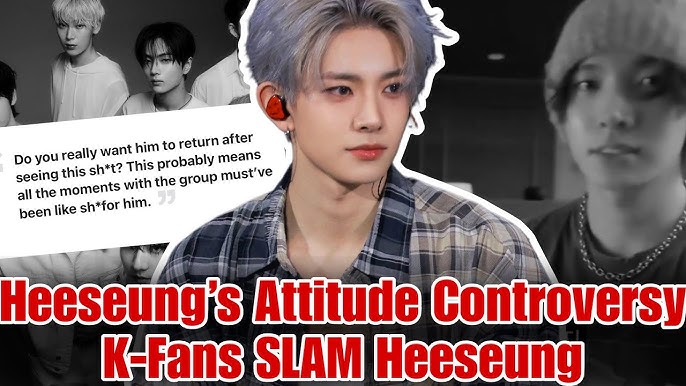
The world of K-Pop moves at the speed of a trending hashtag. A blink, a smile, a pause just a beat too long—any micro-expression can be captured, clipped, and catapulted into the center of a furious online debate. This week, the subjects of this intense, often unforgiving, spotlight are ENHYPEN's Jake and Heeseung. What began as a routine, light-hearted live broadcast on Weverse has morphed into a case study in how fan perception, protective instincts, and the constant hunger for drama can distort even the most innocent of moments. The allegation? That Jake, the group's sunny Australian-born vocalist, threw subtle "shade" at his older bandmate and fellow vocalist, Heeseung.
When a Laugh Becomes a Lightning Rod
The incident, as these things often are, was spectacularly mundane in its origin. During a recent live session, Jake was engaged in a playful conversation with fans. The topic of Heeseung's well-known perfectionism and his meticulous approach to the group's performances came up. In response, Jake laughed and made a comment that has been transcribed and translated in various ways, but essentially centered on the idea of Heeseung being "seriously intense" or "deeply immersed" during practice, contrasting it with his own supposedly more relaxed approach. He accompanied this with a wide-eyed, amused expression. The clip, isolated from the hour-long jovial context, spread like wildfire. For some, Jake's tone and words constituted a veiled criticism, an attempt to subtly undermine Heeseung's dedication by framing it as excessive. For the overwhelming majority, however, it was simply Jake being Jake: observant, honest, and expressing affectionate bewilderment at a close friend's iconic traits.
The Anatomy of a "Controversy" Clip
To understand the escalation, one must look at the clip's journey. It was first shared on community forums like Pann and Nate, with titles heavily editorialized to suggest conflict: "Jake seems annoyed by Heeseung's attitude," or "Is Jake throwing shade at Heeseung's skills?" These posts selectively excluded the minutes before and after where both idols were laughing, the subsequent praise Jake lavished on Heeseung's leadership, and the clear context of brotherly teasing. This curation is a hallmark of modern K-Pop gossip, where narrative is prioritized over nuance. It echoes the tactics seen in The Comment Section's Shadow, where fragmented perceptions are weaponized to fuel online wars. The 20-second snippet became not a piece of communication, but a Rorschach test for the fandom's own anxieties and biases.
ENHYPEN: Forged in the Spotlight, Bound by Survival
To frame this incident properly, one must understand ENHYPEN's unique genesis and the specific dynamic between Jake and Heeseung. The group was formed through the intense survival-reality show I-LAND, a crucible that tested their skills, mental fortitude, and interpersonal relationships under 24/7 surveillance. Heeseung entered as the undisputed top-ranked trainee, a "big brother" figure and technical ace upon whom others leaned. Jake was the determined underdog, having trained for a shorter period, whose growth and bright personality became a central storyline.
Their relationship was never one of rivalry, but of mentorship and mutual support. Heeseung has consistently been Jake's vocal guide and a source of encouragement. Jake, in turn, has publicly credited Heeseung countless times for his help. Their bond, like all seven members of ENHYPEN, was solidified in the extraordinary pressure cooker of pre-debut survival. This history makes the notion of genuine "shade" particularly incongruous. These are individuals who have seen each other at their most vulnerable, celebrated each other's successes, and built a career on a foundation of palpable, documented teamwork. As explored in our analysis of veteran groups like Dignity, longevity in this industry is built on real, resilient bonds that withstand far greater pressures than a misinterpreted live comment.
The Jake-Heeseung Dynamic: A Brotherly Blueprint
Observers of the group have long noted their dynamic resembles that of close siblings. Heeseung is the capable, sometimes quietly intense older brother; Jake is the energetic, openly admiring younger brother who isn't afraid to poke gentle fun. This is a classic and healthy relational pattern. In countless behind-the-scenes clips, V-Lives, and variety appearances, Jake's demeanor towards Heeseung is one of respect blended with comfortable familiarity. To isolate one moment and assign it malicious intent is to ignore the entire library of their public interaction available on our Artists page, which paints a picture of unwavering solidarity.
Fandom Fractures and the Rally of Defense
The reaction to the controversy was swift and multi-layered, revealing the complex ecosystem of a modern fandom, ENGENEs. The initial spark came from a small but vocal subset of netizens—often solo stans or fans predisposed to see conflict—who amplified the negative interpretation. This immediately triggered a massive defensive mobilization from the wider fandom.
"To even think Jake would disrespect Heeseung is to not know ENHYPEN at all. It's called having a sense of humor and knowing your friend for years," wrote one fan with thousands of likes on Twitter.
The defense took several forms:

- Context Warriors: Fans rushed to upload the full, unedited live broadcast, creating side-by-side comparisons showing Jake's comment was immediately followed by praise.
- Historic Evidence: Compilations of "Jake praising Heeseung" moments and "Heeseung's fondness for Jake" clips began trending, flooding timelines with positive counter-programming.
- Linguistic Analysis: Korean-speaking fans provided nuanced breakdowns of Jake's actual word choice and intonation, arguing the translation to "shade" was linguistically inaccurate and culturally tone-deaf, missing the nuance of affectionate roasting common among close Korean friends.
- Calls for Calm: Larger fanbase accounts urged ENGENEs not to give the issue oxygen, to report malicious posts, and to focus on upcoming group activities.
This defensive mechanism is a direct response to the trauma of past online scandals, where small flames have been fanned into career-threatening infernos. Fans now operate as rapid-response PR teams, acutely aware that silence can be construed as admission. This phenomenon mirrors the protective fervor seen in The Pre-Debut Shadow incident, where fans fiercely guard an idol's narrative and privacy against what they perceive as external attacks.
The Silent Majority and the Vocal Minority
It's crucial to note that the "controversy" remained almost entirely confined to specific online niches. On mainstream platforms and in broader K-Pop circles, it barely registered. There was no official statement from BELIFT LAB, nor did it impact the group's activities or chart performance. This disconnect highlights a recurring theme: the intense, often paralyzing scrutiny within a fandom's innermost circles is frequently invisible to the general public. The storm, for all its sound and fury, was in a very small teacup—but for those inside that teacup, the waves felt very real.
Industry Analysis: The Hyper-Scrutiny of the "Good Boy" Image
This incident, minor as it may be, is symptomatic of a larger industry condition. Idols, particularly those from groups marketed with a strong emphasis on brotherhood and "pure" friendship like ENHYPEN, are held to an impossible standard of interpersonal conduct. Every interaction is expected to be a flawless display of unwavering, conflict-free support. Any deviation—a moment of playful sarcasm, a tired expression, a choice to not comment on something—is pathologized.
Jake and Heeseung are not just bandmates; in the eyes of the most intense fans, they are characters in an ongoing drama where harmony is the only acceptable plot. This strips them of the right to have normal, multifaceted relationships that include moments of teasing, disagreement, or simple human irritation. The industry's packaging of idol groups as "families" often backfires, creating an expectation of saintly dynamics that real human relationships cannot sustain. The pressure to constantly perform perfect camaraderie can be as stifling as the pressure to perform perfect vocals and dance, a quiet rebellion against which some artists, as in the case of CSR's 'Can't Hide Anymore', eventually grapple with in their art.
Furthermore, the economic model of K-Pop, which relies heavily on fan devotion and the sale of multiple versions of albums to the same fanbase, makes management companies and idols hypersensitive to any perceived fissure in fan loyalty. While BELIFT LAB did not comment here, the lack of response is itself a strategy—acknowledging such a non-issue could legitimize it. It’s a tightrope walk between addressing genuine problems and ignoring manufactured ones.
The Role of "Solo Stans" and Narrative Creation
A significant driver of these micro-controversies is the rise of the "solo stan," a fan dedicated to a single member of a group, sometimes to the detriment of the group or other members. For a Heeseung solo stan, Jake's comment could be framed as an attack on their bias's character. For a Jake solo stan, the subsequent backlash might be framed as an unfair attack on their bias's innocence. This fractures the fandom into competing camps, each with a vested interest in portraying their bias as the victim or the wronged party. It creates a perpetual motion machine of grievance, where normal interactions are mined for conflict to fuel separate, member-centric narratives. This divisiveness stands in stark contrast to the unified, often overwhelming support seen for truly solo artists, where fan energy isn't split, as was the case in the spectacle surrounding The Airport Escort for Lee Chaerin.
Looking Ahead: Resilience in the Digital Glare
So, what's next for ENHYPEN in the wake of this digitally manufactured storm? The path forward is likely the one they are already on. The group has a packed schedule of global tours, comebacks, and content creation. For Jake and Heeseung, their relationship will continue as it always has, off-camera and on. They may, however, become slightly more measured in their impromptu comments during solo lives, a sad but common consequence of such events—the slow erosion of spontaneity in the name of risk mitigation.
The real consequence is for the fandom and the broader K-Pop consumption ecosystem. Each of these cycles—accusation, defense, fatigue—leaves a residue of cynicism and weariness. It diverts enormous energy and emotion away from supporting the artists' work and towards policing their every blink. It teaches idols that transparency is a liability. For ENGENEs, the task is to continue championing the group's artistry and bond without getting perpetually bogged down in battles started by bad-faith actors. The focus should remain on the music, the performances, and the genuine connection the seven members share—a connection that has weathered a survival show and years in the spotlight, and is unlikely to be shaken by a misinterpreted laugh.
Ultimately, the "Jake shading Heeseung" saga will be archived as a footnote, a testament to the exhausting hypersensitivity of the digital K-Pop sphere. It serves as a reminder that in an era where every moment is recorded and parsed, the greatest challenge for idols may not be hitting the high note, but navigating the endless, often illogical, interpretation of their humanity. The true strength of a group like ENHYPEN will be shown not in addressing every whisper, but in continuing to create, perform, and grow together, letting their work and their long-term unity drown out the temporary noise. For the latest on how they do just that, fans can follow all official updates on our News page.