
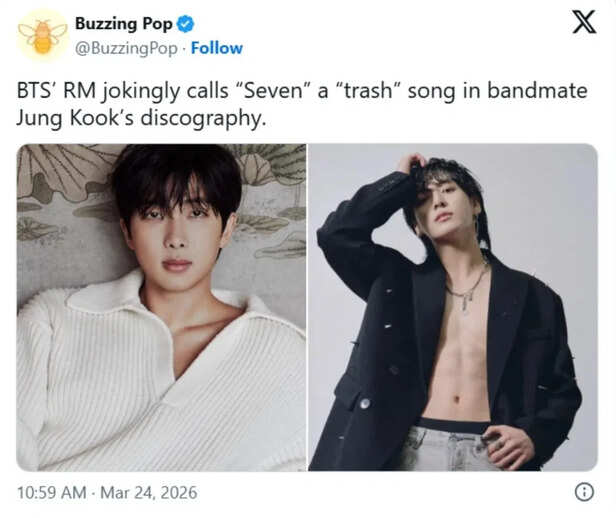
In a recent interview, BTS leader RM's comments about his involvement in Jungkook's solo debut have been misconstrued, leading to unfounded accusations of credit-taking. This analysis traces the quote to its source, contextualizes RM's established mentorship role within BTS, and exposes how fragmented reporting fuels damaging narratives. The incident is less a scandal and more a case study in the heightened sensitivities surrounding BTS's solo endeavors and media literacy in the K-pop ecosystem.
- The Interview That Started It All: What RM Actually Said
- The RM Factor: Re-examining the Leader's Documented Role in BTS
- Jungkook's Autonomous Ascent: Tracing "Golden" From Inception to Release
- The Amplification Machine: How Fandom and Media Fuel Misunderstanding
- Beyond the Headline: What This Teaches Us About HYBE's Post-Enlistment Strategy
- FAQ: Your Questions on the RM & Jungkook Situation, Answered
The Interview That Started It All: What RM Actually Said
The controversy stems from a specific, isolated segment of a much broader conversation. To understand the backlash, we must first isolate the precise language used.
Parsing the Exact Quote and Its Original Context
In his interview with Ilgan Sports, RM was discussing the evolution of BTS's music and his personal journey. The conversation turned to the group's current "Chapter 2," focusing on individual activities. He stated he felt a sense of responsibility and pride in the members' solo work, using Jungkook's global smash "Seven (feat. Latto)" as a prime example.
"I also participated a lot in the beginning of Jungkook's solo. I remember talking a lot with him about the direction, and I recommended 'Seven'."
This statement, when stripped of its conversational tone and the interviewer's preceding questions, became the tinder for the fire. The critical omission in later reports was the nuanced, advisory context RM was clearly speaking from.
The Danger of Decontextualized Translation and Click-Driven Headlines
Outlets like Koreaboo often operate by condensing Korean media reports for an international audience. This process inherently involves simplification. Key mitigating phrases like "I remember talking a lot with him" can be downplayed, while assertive verbs like "recommended" are highlighted. The result is a headline that implies ownership ("Take Credit For") rather than the supportive collaboration described.
The RM Factor: Re-examining the Leader's Documented Role in BTS
Accusing RM of usurping credit ignores a decade of documented history. His role has never been that of a passive member.
A Documented History of Creative Guidance and Mentorship
Since BTS's early days, RM has been the group's primary interface with producers, a lyricist for all members, and a musical compass. He has consistently used his experience to guide the younger members. This is not speculation; it's visible in older content like "Bangtan Bombs" where he advises on recording techniques and songwriting. His leadership extends beyond logistics into artistic development, a model similar to the supportive mentorship seen in stories like The Unseen Anchor: How J-Hope's Grandmother Forged a K-Pop Legend's Heart and Artistry.
RM's Own Words on Leadership: Support, Not Control
In his solo album Indigo and his own interviews, RM has extensively discussed the anxieties and burdens of leadership. He frames his role as a "hyung" (older brother) and a supporter who helps members find their own voice, not imprint his upon them. His recommendation of "Seven" fits perfectly into this long-established pattern: identifying a song that aligns with a member's artistic identity and potential.

Jungkook's Autonomous Ascent: Tracing "Golden" From Inception to Release
To suggest Jungkook's success is not his own is to disregard the deliberate, patient construction of his solo career.
From "Begin" to "Golden": A Decade of Artistic Buildup
Jungkook's solo identity has been curated for years, from his solo song "Begin" on WINGS (2016) to covers on SoundCloud ("Falling," "Paper Hearts"), and official singles like "My Time" and "Stay Alive." Each step revealed a different facet of his artistry, building anticipation. His Golden album is the culmination of this journey, not a sudden project helmed by another member.
The "Seven" Decision: Collaboration in a Major Label System
In the major label system, song selection is a collaborative process involving the artist, A&R teams, producers, and often trusted colleagues. RM, as a senior artist and musical peer within the same company, is a natural part of Jungkook's inner circle for such discussions. A recommendation is just that—a suggestion. The final approval for "Seven," its production, and Jungkook's iconic performance were unequivocally his own. This mirrors the strategic career ownership seen in veterans like How Sandara Park is Rewriting K-Pop's Age Playbook.
Aspect RM's Role (As Documented) Jungkook's Role (As Documented) Song Selection for "Seven" Recommended the track as a potential title. Made the final approval; connected with the song's theme and sound. Creative Direction for "Golden" Participated in early directional conversations. Led the vision; defined the "golden" concept and album cohesion. Public Narrative Has consistently praised Jungkook's work ethic and talent in media. Has openly discussed his own creative process and decisions for his solo work. Industry Credit Listened to as a respected senior artist and leader. Recognized globally as the sole artist and driving force behind "Golden."The Amplification Machine: How Fandom and Media Fuel Misunderstanding
This incident didn't occur in a vacuum. It's a product of the modern K-pop media landscape.
The "Solo Stan" Phenomenon and Protective Narratives
As BTS focuses on individual activities, subsets of the fandom become intensely protective of their bias's narrative. For some solo stans, any mention of another member's involvement can be perceived as diminishing their favorite's autonomy. This protective instinct, while rooted in love, can quickly warp into defensiveness and hostility, creating fertile ground for misunderstanding benign comments.
The Role of Quote-Pulling and Engagement Algorithms
Media outlets, both mainstream and fan-driven, compete for clicks. A headline framing conflict ("Accused of Lying") generates more engagement than one highlighting collaboration ("RM Supported Jungkook's Solo"). Algorithms reward this engagement, creating a cycle where simplified, antagonistic narratives spread faster and wider than nuanced, factual reports. This ecosystem is vulnerable to the type of systemic issues highlighted in reports like The Shadow Network: How A Brother's Scandal Exposes K-Pop's Systemic Vulnerability to Abuse.
Beyond the Headline: What This Teaches Us About HYBE's New Era
This micro-controversy reflects macro-tensions within HYBE and the industry.
Navigating the "Group Legacy vs. Individual Brand" Tightrope
For HYBE, managing BTS's Chapter 2 is a delicate balance. The company must promote each member's distinct identity while leveraging the powerful BTS brand. RM's comments demonstrate an attempt to uphold group solidarity and pride during a period of physical separation. The backlash shows how easily that solidarity can be misread as intrusion when viewed through a purely individualistic lens.
A New Blueprint for Senior Idols: From Performer to Executive Producer
RM's evolving role—from leader to mentor to a figure involved in A&R-like discussions—points to a new career path for senior idols. Like the masters on The Scout Masters Decoded: Why Wendy, Young K & Kim Jae Joong Signal a K-Pop Audition Revolution, they are becoming industry pillars who guide the next generation. This incident is a growing pain in that transition, as public perception catches up to this new reality.
FAQ: Your Questions on the RM & Jungkook Situation, Answered
Q: Did RM actually produce or write "Seven"?
A> No. RM recommended the song to Jungkook during the selection process. The song was written and produced by its credited team, including Andrew Watt, and is officially a Jungkook solo track.
Q: Has Jungkook ever acknowledged RM's help?
A> Yes. In various weverse lives and casual conversations, Jungkook has often mentioned discussing music and ideas with his hyungs, including RM. He has expressed gratitude for their support throughout his career.
Q: Is this controversy affecting BTS's relationship?
A> There is zero evidence to suggest this. Based on their long history of public support and recent interactions, the relationship appears unchanged. The controversy exists almost entirely within online fan and media spaces.
Q: Why didn't HYBE or Big Hit Music issue a statement?
A> Issuing a statement for every misreported interview quote sets an unsustainable precedent. The companies likely view this as a non-issue fueled by misinformation, best addressed by the members themselves in their own time and way.
Q: Where can I find accurate translations of full interviews?
A> Follow dedicated fan translation accounts known for context and accuracy, or wait for official subtitles on platforms like Weverse. Avoid headlines that sensationalize single lines.
The "controversy" between RM and Jungkook is a phantom, a story constructed from a sliver of a quote divorced from its history and heart. It reveals less about any tension between the two artists and more about the fragmented, high-stakes environment in which BTS's solo careers now unfold. It underscores the critical need for nuanced media consumption and a remembrance of the group's foundational bond.
As fans, the most powerful next step is to support the art directly. Revisit the brilliant success of Jungkook's Golden on our Charts page and delve into the introspective lyricism of RM's Indigo. Understand their individual journeys by exploring our Artists page. Finally, stay informed on how the industry evolves around them by following our analysis on our News page. The true story isn't in the clash of headlines, but in the harmony of their continued growth, both together and apart.