
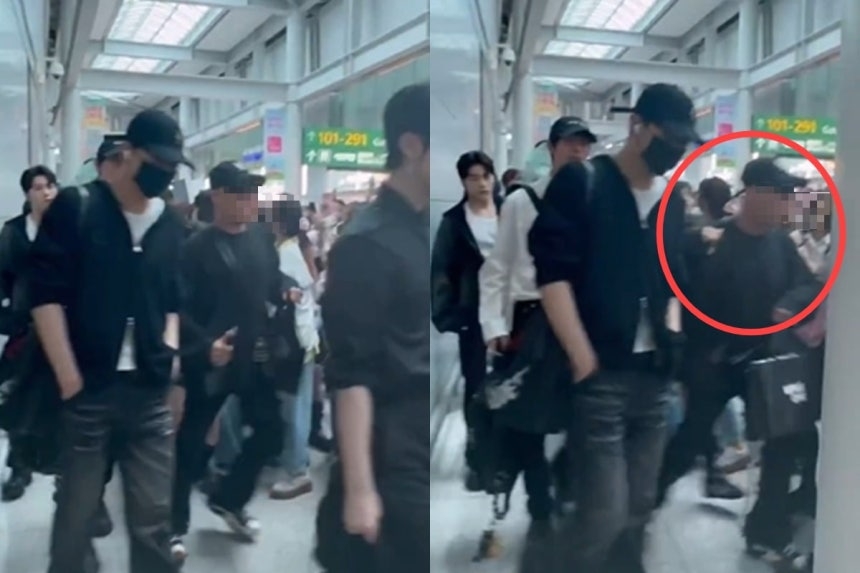

The scene at Incheon International Airport’s Terminal 2 was one of controlled chaos, a familiar ballet for any K-Pop enthusiast. Flashbulbs popped, fans’ chants created a low roar, and a sea of phones recorded every movement. But on this particular Tuesday morning, the choreography was different. At the center wasn’t a member of BTS, but rising soloist Lee Chaerin. Flanking her, however, were faces instantly recognizable to any ARMY: the impassive, professional men of BTS’s own legendary security detail. Forming a near-impenetrable phalanx around the young artist, they navigated the throng with a precision and authority that left onlookers stunned. According to multiple Korean media reports on the ground, her security was “iron clad,” with one outlet famously describing her as being “guarded like a princess.” This singular event has ignited a firestorm of discussion, peeling back the curtain on the severe pressures of idol mobility, the terrifying reality of sasaeng culture, and the unexpected corporate kinship that can emerge in the industry’s most high-pressure moments.
The Protectors and the Protege: Understanding the Key Players
To grasp the full weight of this incident, one must first understand the stature of the entities involved. On one side is the security apparatus of BTS, arguably the most scrutinized and targeted musical act on the planet. Their security team, often referred to in fan circles as “The Wall,” is not employed by HYBE or BigHit Music in a traditional sense. They are a dedicated, elite unit contracted specifically for the group, having evolved over a decade from managing domestic fan signs to orchestrating the logistical nightmare of global stadium tours and navigating geopolitical-level paparazzi attention. Their reputation is built on a foundation of stoic professionalism, pre-emptive threat assessment, and a near-telepathic understanding of both the members they protect and the crowd dynamics they manage. They are the industry’s gold standard.
Lee Chaerin: A Meteoric Rise Under a Microscope
On the other side is Lee Chaerin. A former member of the mid-tier girl group LUMINA, Chaerin reinvented herself as a soloist 18 months ago with her smash hit “Glass Heart.” The song’s vulnerable lyrics and her powerhouse vocal performance struck a chord, catapulting her from group alum to one of the most promising solo acts of her generation. However, with this success came intense, and often invasive, scrutiny. Her agency, Starline Entertainment, is a respected but medium-sized player without the vast resources of the “Big 4.” While they provided competent security, it was reportedly becoming increasingly overwhelmed by the scale and aggression of the crowds greeting her at every public appearance, particularly at airports—a notorious hotspot for overzealous fans and sasaengs. This vulnerability mirrors the pressures discussed in our recent investigation, The Pre-Debut Shadow, which highlighted how an idol’s past can be weaponized by obsessive elements within fandom.
“Airports are the frontline of idol safety. It’s an uncontrolled environment where adrenaline is high, barriers are minimal, and the line between enthusiastic fan and dangerous individual can blur in an instant,” states Park Min-ji, a former security consultant for several entertainment agencies. “For an artist like Chaerin, whose fame has exploded faster than her agency’s infrastructure can sometimes handle, these situations become critical vulnerabilities.”
Deconstructing "The Escort": A Minute-by-Minute Breakdown
So, how did the most formidable security detail in K-Pop come to be deployed for a soloist from a different agency? The accounts from media and fan witnesses paint a vivid picture of an operation that was both spontaneous and impeccably executed.
According to reports, Lee Chaerin had arrived on a morning flight from Bangkok, where she had performed at a festival. Her usual two-person security detail was with her. Simultaneously, BTS’s Jimin and V were scheduled to depart from the same terminal for a scheduled professional engagement in Japan. Their full security team was present, managing the perimeter for their arrival. As Chaerin exited the customs hall, the crowd—a mix of her own fans, general airport passengers, and a significant number of ARMY waiting for the BTS members—surged forward. Her security was immediately swamped, and Chaerin was visibly startled, halting her progress.
At that moment, witnesses report that BTS’s head security chief, identified only by his frequent codename “Agent K” in fan communities, assessed the situation. Communicating swiftly via his earpiece, he directed a team of four agents from the BTS perimeter to immediately reinforce Chaerin’s floundering detail. The transition was seamless. The BTS agents, using their signature linked-arm formation, created a moving buffer around Chaerin. They cleared a path with firm, clear commands, their sheer presence and reputation causing much of the crowd to instinctively fall back. They escorted her all the way to her waiting agency van, only dispersing once she was safely inside.
“It was like watching special forces extract a VIP. They didn’t hesitate. They saw a fellow artist in a potentially dangerous situation and intervened. The professionalism was breathtaking,” described one fan-site master present, who asked to remain anonymous.
The Ripple Effect: Fan Theories, Gratitude, and Digital Discourse
The reaction from the online K-Pop community was instantaneous and multifaceted. On platforms like X (formerly Twitter), Weverse, and various online forums, the incident trended for over 24 hours.
ARMY and MELODY (Chaerin’s fandom) Unite
The predominant sentiment from both fandoms was one of profound gratitude and respect. ARMY praised their boys’ security team for their humanity and professionalism, with many comments echoing sentiments like, “They protect our artists, and they protect artists.” MELODY expressed overwhelming relief and thanks, flooding Chaerin’s social media with messages of support and tagging HYBE and BigHit Music with appreciative notes. This moment of cross-fandom solidarity was a rare positive offshoot of the event.

The Speculation Engine
However, the internet being what it is, the incident also spawned intense speculation. Why did they help? The most plausible theory, supported by industry insiders speaking to K-Beats, points to simple professional courtesy and an understanding of shared risk. A stampede or serious incident involving any idol at the airport reflects poorly on the entire industry and increases scrutiny for all. Other theories ranged from a hidden mentorship between Chaerin and a BTS member (pointing to Jimin’s known support for senior female artists) to discussions of a possible future collaboration or even a transfer to HYBE—though all such claims remain unsubstantiated rumor. For more on an idol overcoming industry skepticism, the journey of Soloist K offers a fascinating parallel narrative of defying expectations.
- Positive Takeaway: A showcase of elite security protocol and inter-agency goodwill.
- Critical Debate: Raises questions about why Starline Entertainment was seemingly unprepared for predictable crowd volume.
- Fandom Impact: Created a temporary but powerful bridge between two distinct fan communities.
Industry Insiders Weigh In: Security, Ethics, and a New Precedent?
Behind the headlines and fan edits, the incident has sent shockwaves through the business side of K-Pop. We spoke with several industry professionals (under conditions of anonymity) to gauge its significance.
One high-level event coordinator framed it as a wake-up call: “This isn’t just a cute story. It’s a glaring spotlight on the resource disparity in this industry. A-tier security, like BTS has, costs more than some small agencies spend on a whole comeback. Chaerin’s situation proves that success can outpace safety infrastructure, and that’s a terrifying liability.” They emphasized that airports remain a critical weak point, where public access laws limit what security can do preventatively.
An executive from a mid-sized agency admitted the incident has sparked internal reviews. “We’re now asking ourselves, ‘Are we a “Glass Heart” moment away from a disaster? Do we need to reallocate budget from, say, more elaborate music video sets to reinforced security details?’ The calculus has changed.” This speaks to a broader evolution in idol welfare, much like the holistic approach to health championed by idols such as HAE-JIN of AURORA.
“This may set a new, informal precedent,” suggested a legal consultant familiar with entertainment contracts. “We might see more clauses about ‘duty of care’ and specific security benchmarks tied to an artist’s chart performance and public exposure. What was once a generic ‘provide adequate security’ line in a contract will now need to be explicitly defined.”
Furthermore, the incident highlights the potential for strategic partnerships. Could large agencies like HYBE offer premium security consulting or even temporary “loaner” details to smaller partners as a form of industry cooperation—or for a fee? The ethical and commercial implications are complex, touching on issues of dependency and corporate power.
Looking Beyond the Terminal: What This Means for the Future
The image of Lee Chaerin surrounded by BTS’s security will linger far longer than the news cycle. Its implications are likely to shape several key areas in the coming months.
Firstly, for Lee Chaerin and Starline Entertainment, this is a pivotal moment. The agency has publicly thanked HYBE and BTS’s team, but internally, the pressure is on to upgrade. Expect to see a visible, enhanced security presence around Chaerin moving forward, potentially sourced from a more premium firm. Her schedule might also see more private arrivals or strategic adjustments to avoid predictable public crushes. For Chaerin herself, while the incident was frightening, the overwhelming public sympathy has solidified her image as a respected artist worthy of top-tier protection, potentially boosting her brand prestige. Her next career moves will be closely watched on our News page.
For the industry at large, this event adds fuel to the ongoing conversation about idol safety and mental health. It demonstrates that crowd threats are not a problem only for the absolute top-tier groups but for any artist experiencing a surge in popularity. This could lead to collective action, such as agencies lobbying airports for better, standardized idol passage protocols or shared intelligence on known sasaengs.
Finally, for fans, it should serve as a sobering reminder. The thrilling proximity of an airport encounter comes with real safety risks for the artists they adore. The hope among many professionals is that this incident encourages more fans to practice respectful distancing in public spaces, understanding that the ultimate sign of love is ensuring an idol’s safe passage. As groups like EVNNE seize their own narratives and legends like Wanna One reunite, the ecosystem that supports them must evolve too.
In the end, the “airport escort” was more than a dramatic minute of news fodder. It was a stark tableau of modern K-Pop: a place where incredible fame intersects with tangible danger, where corporate boundaries can dissolve in the face of a shared crisis, and where the definition of “adequate protection” is being rewritten in real-time. The industry watched a princess be guarded; now it must decide how to better arm the entire kingdom. For continued coverage on how idols navigate these complex landscapes, explore our comprehensive Artists page.