
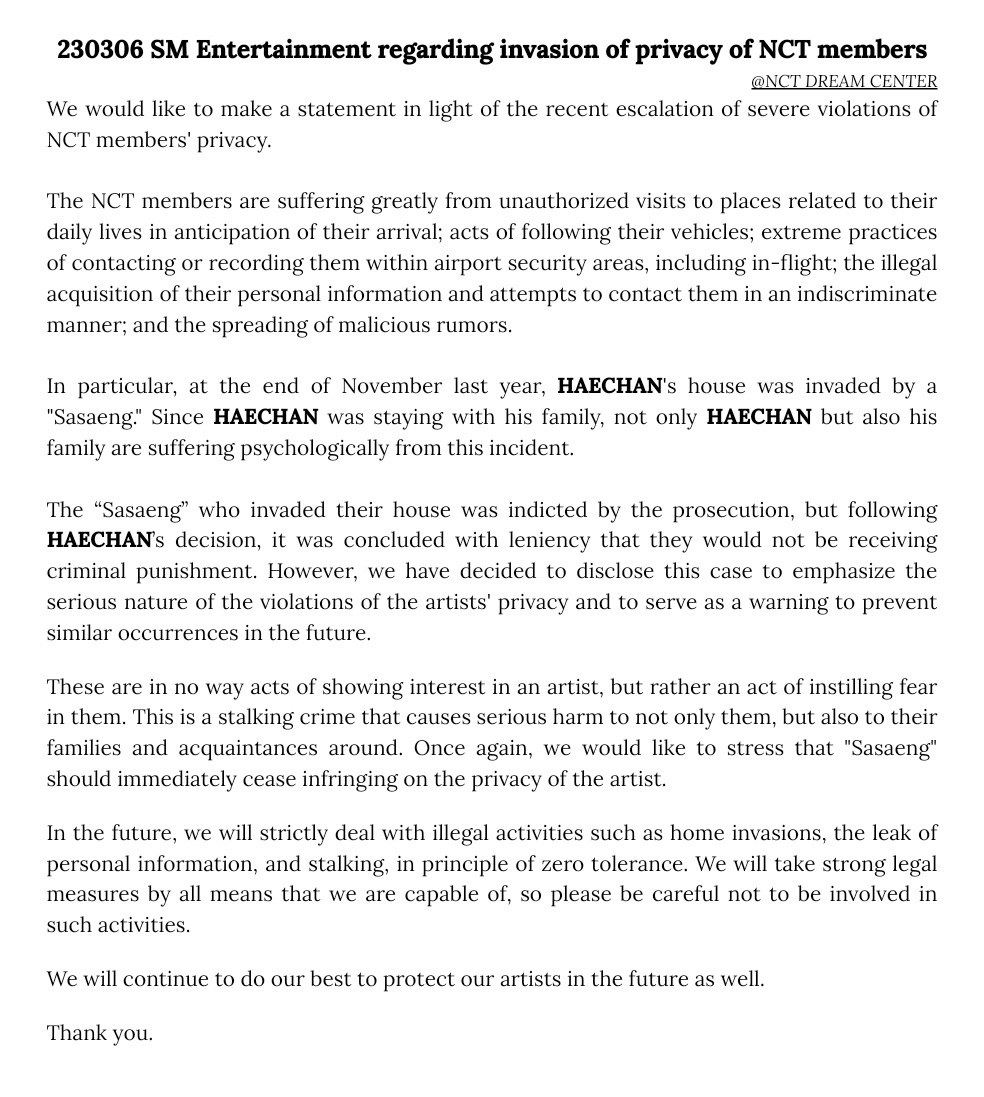
The recent alleged physical altercation involving NCT's Haechan, reportedly incited by sasaeng fans claiming to have "confirmed" dating evidence, marks a severe and dangerous escalation in K-Pop fan-idol relations. This incident transcends typical gossip, highlighting a systemic failure in artist protection and a culture of entitlement that has turned violent. The outcry from the majority of fans is not just about one idol's safety, but a demand for the entire industry to confront its most toxic underbelly before tragedy strikes.
- What Exactly Happened with Haechan?
- The "Proof" Problem: How Sasaengs Manufacture "Confirmation"
- SM's Historic Weakness: A Pattern of Failed Protection
- Can They Be Stopped? The Murky Legal Landscape An Industry at a Tipping Point: From Ten to Haechan
- Your Questions Answered: Idol Safety & Fan Responsibility
What Exactly Happened with Haechan?
While SM Entertainment has yet to issue a full official statement, multiple reports from industry insiders and aggregated fan accounts describe a harrowing scenario. The incident reportedly occurred outside a private schedule, moving beyond the typical harassment into a physically threatening space.
The Timeline of Escalation
According to sources, a small group of individuals, believed to be sasaengs, had been aggressively trailing Haechan for days. Their pursuit was fueled by a self-reinforcing belief in unverified dating rumors. The confrontation allegedly turned physical when they attempted to directly confront him, leading to a chaotic scene where verbal abuse escalated, and objects may have been thrown. Security personnel intervened, but the damage—both physical and psychological—was done.
The "Mobbing" Element: From Digital to Physical
The term "mobbing" is key here. It signifies a coordinated, group-based attack. This isn't a lone, obsessed fan. It's a pack mentality, where individuals egg each other on, believing their collective actions are justified by the "proof" they claim to possess. This shift from digital mobbing on platforms like private messaging apps to physical mobbing in the real world is the critical, alarming development.
The incident forced an abrupt halt to his schedule, a clear indicator of its seriousness. As fans rightly point out on our News page, if the situation was minor, such a disruption would be unlikely.
The "Proof" Problem: How Sasaengs Manufacture "Confirmation"
The engine of this violence is the sasaengs' conviction that they have uncovered irrefutable truth. Their "proof" is a complex web of manipulation, speculation, and invaded privacy, presented as detective work.
The Toolkit of Invasion
So-called evidence is rarely what it seems. It is often built from:
- Stalking-Generated Content: Blurry long-lens photos, videos of idols entering buildings, or audio snippets captured from dangerous distances.
- Digital Pattern Delusion: Obsessive tracking of social media activity—likes, follows, vague story posts—woven into a narrative that ignores coincidence and normal human behavior.
- Private Information Synthesis: Cross-referencing illegally obtained data like flight manifests, family details, or phone numbers to create a false sense of omniscience.
The Confirmation Bias Echo Chamber
This "evidence" is never scrutinized in a vacuum. It is shared and amplified within closed, toxic communities where dissent is banned. Every pixel is analyzed not for truth, but for alignment with the pre-existing rumor. A shadow in a photo becomes a "secret partner"; a delayed Instagram post becomes "proof" of a date. This echo chamber transforms speculation into absolute "fact," which then fuels righteous anger and justifies extreme action.

SM's Historic Weakness: A Pattern of Failed Protection
The furious demand from fans for SM Entertainment to act is rooted in a long history of perceived inaction. The company's reactive, often legalistic responses have failed to deter sasaeng culture, creating an environment where such fans feel emboldened.
A Reactive, Not Proactive, Posture
SM's pattern is consistent: an incident occurs, public outrage grows, and the company eventually releases a statement vowing to take "legal action." While lawsuits are filed—and sometimes even won—the public rarely sees decisive, preemptive measures. Security protocols appear repeatedly breached, as seen with multiple EXO, TVXQ, and now NCT incidents over the years. This reactive cycle signals to sasaengs that the risk of immediate, tangible consequence is low.
The real failure is not in the law, but in the enforcement and the preventative infrastructure. Companies have treated sasaeng behavior as a cost of doing business for too long.
Contrasting Industry Approaches
Other agencies, while also struggling, have at times taken more publicly visible stances. JYP Entertainment has been known to blacklist and publicly ban specific sasaengs from events. HYBE has invested heavily in advanced security details and cybersecurity. While no solution is perfect, SM's approach is frequently criticized as the most opaque and least effective among the major labels, placing an unsustainable burden on artists and sane fans alike. For more on shifting power dynamics within agencies, read our analysis in "The Ten Tipping Point".
Can They Be Stopped? The Murky Legal Landscape
Pursuing legal action against sasaengs is notoriously difficult, creating a frustrating barrier for agencies and a sense of impunity for offenders. The law moves slowly, while harassment happens in real-time.
The Charges: Stalking, Defamation, and Violence
Depending on the act, relevant laws include the Stalking Punishment Act, charges of defamation (for spreading false rumors), assault, and violations of the Information and Communications Network Act. The challenge is evidence collection that meets strict legal standards and the willingness of the idol—who is already traumatized—to undergo repeated interrogations and court appearances.
Why "Winning" Often Feels Like Losing
Even when companies secure a conviction, penalties can be light—often fines or suspended sentences, not jail time. The process is long, emotionally draining, and publicly exposes the victim further. For the sasaeng, the "reward" of attention and notoriety within their community can sometimes outweigh the legal slap on the wrist.
Type of Sasaeng Behavior Potential Legal Charge Common Enforcement Challenge Physical Stalking & Trespassing Violation of Stalking Punishment Act, Trespassing Requires proof of repeated, fear-inducing behavior; difficult to link individuals in crowds. Spreading Malicious Rumors Defamation (Criminal & Civil) Must prove falsehood and malicious intent; anonymous online accounts complicate identification. Illegal Info Trafficking (Phone#, Flight) Violation of Personal Information Protection Act Complex digital trails; requires cooperation from multiple platforms and service providers. Physical Assault/Harassment Assault, Intimidation Idol's testimony is crucial but reliving trauma in court is a heavy burden.An Industry at a Tipping Point: From Ten to Haechan
The Haechan incident does not exist in isolation. It is part of a converging series of events signaling that K-Pop's old models of fan management and artist protection are breaking down. The industry is facing pressure from all sides.
Artist Agency vs. Company Control
As explored in our article "The Ten Tipping Point", artists are increasingly seeking and gaining more control over their careers. However, this empowerment must extend to personal safety. Artists should have direct input into security protocols and a faster, more transparent channel to trigger corporate protection mechanisms, without fearing backlash for being "difficult."
The Double Standard of Idol "Purity"
The violent reaction to mere dating rumors underscores the archaic and damaging expectation of idol "availability." This fantasy, peddled for profit, directly fuels possessive fan behavior. When an idol is perceived as "breaking the contract" of this fantasy, some see retaliation as justified. This toxic dynamic is mirrored in controversies over stage outfits, as seen in our analysis "Beyond The Corset", where control over an idol's body becomes a battleground.
A Call for Collective Action
Solving this requires more than one company. A united front from all major agencies is needed to:
- Share blacklists of known, legally-convicted sasaengs across concert venues and music shows.
- Lobby collectively for tougher, faster-acting amendments to stalking and cyber harassment laws.
- Launch a joint public education campaign redefining "true fan" behavior, supported by senior artists.
Your Questions Answered: Idol Safety & Fan Responsibility
Q: What can normal fans actually do to help?
A: First, stop consuming and sharing any "sasaeng-taken" content, no matter how curious you are. Report malicious posts and communities. Publicly support statements from the artist's agency condemning such behavior. Most importantly, create a positive, respectful counter-culture within your own fan spaces that isolates and disapproves of toxicity.
Q: Will the people who did this actually go to jail?
A> It is possible, but not guaranteed. Jail time is more likely if charges of physical assault are proven. For stalking and defamation, financial penalties are more common. The outcome heavily depends on the evidence SM and the police can gather and present.
Q: Why doesn't SM just hire better security?
A> They likely have substantial security, but sasaengs are relentless, well-resourced, and employ tactics designed to evade standard protocols. This includes using multiple cars, disguises, and exploiting moments of transition. It's an arms race that requires constant adaptation and significant investment in counter-surveillance tactics.
Q: Does this affect NCT's upcoming activities and music?
A> In the short term, absolutely. An idol's mental and physical well-being is paramount. Forced schedules after such an event would be irresponsible. Long-term, the impact depends on SM's handling and the support Haechan receives. The group's future releases, which you can track on our Charts page, will inevitably be shadowed by this event if not addressed properly.
Q: Are other idols at risk like this?
A> Yes. While the severity varies, most top-tier idols, especially in boy groups with intense fandoms, face some level of sasaeng harassment. The Haechan case is a severe example of a widespread problem. It's a risk inherent in the current system.
Conclusion & The Path Forward
The assault on Haechan is a fire alarm for the K-Pop industry. It is the physical manifestation of digital toxicity, enabled by weak enforcement and exploitative systems. SM Entertainment now faces a critical test: will it repeat its cycle of vague statements and slow litigation, or will it lead a transformative charge for artist safety?
True change requires a three-pillar approach: Corporate Accountability (transparent, preemptive, and ruthless protection protocols), Legal Reformation (laws with real teeth and faster enforcement), and Fan Culture Reformation (a collective redefinition of support that rejects possession and invasion). The next steps are clear. Fans must channel their outrage into sustained pressure on agencies and support for stronger laws. Agencies must collaborate, not compete, on safety. The era of treating sasaeng behavior as a taboo but tolerable nuisance must end, before the next headline is even worse.
For more on how artists are navigating this new landscape, explore our features on artists taking creative control, like Rayeon's latest release and Min Jiwoon's OST work. To understand successful, respectful fan engagement, look at the strategic milestones achieved by groups like Stray Kids in Japan. The future of K-Pop must be built on respect, not fear. The time to build it is now.