
The K-pop industry thrives on noise—the synchronized cheers of fanchants, the blistering beats of a title track, the cacophony of camera shutters at a press event. But sometimes, the loudest and most damaging sounds are the ones that happen off-stage, in the shadowy forums and anonymous chat rooms of the digital world. This week, the normally sleek and controlled narrative surrounding rising powerhouse CLOSE YOUR EYES (often stylized as C.Y.E) was violently punctured by a wave of online speculation. The resulting silence from the group, followed not by a quiet dismissal but by a thunderous, legally-backed roar from their agency, UNCORE, has sent shockwaves far beyond a simple scandal containment. It may have redefined the playbook for how a new generation of companies protects its artists.
The Eye of the Storm: A Fandom Holds Its Breath
For three agonizing days, the CLOSE YOUR EYES fandom, known as EYELID, existed in a state of suspended anxiety. It began with cryptic, rapidly multiplying posts on niche community boards, accusing main dancer and vocalist Jang Yeojun of serious misconduct during his pre-debut trainee days. The details were vague, the sources entirely anonymous, but the allegations were severe enough to trend on several social media platforms. What was striking was the absence of the usual cycle: no blurry photos, no alleged receipts, no second-party corroboration. It was, as many veteran industry watchers noted, a "smoke-without-fire" campaign, but the smoke was thick and choking.
CLOSE YOUR EYES had been in the final, intense preparation phase for their first full-length album, a monumental step for the group that debuted just two years ago with the smash hit "Lucid". Schedules were abruptly muted. Yeojun's usually vibrant personal social media feeds went static. The silence from UNCORE was deafening. This radio silence, often a precursor to a devastating announcement, led to rampant speculation. Was this the prelude to a hiatus? A member departure? The atmosphere echoed past, painful industry precedents where unverified rumors gained fatal momentum. As discussed in our analysis of persona and scrutiny in The Kim Taehyung Paradox, the line between an idol's personal identity and public perception is perilously thin, and often exploited.
From Underground Kings to Chart Conquerors: The Meteoric Rise of CLOSE YOUR EYES
To understand the magnitude of this moment, one must understand the unique position CLOSE YOUR EYES holds. They are not a product of the classic "Big 4" agency system. UNCORE, while now a significant player, was a relative startup when it launched the group. C.Y.E’s identity was built on a concept of raw, emotional intensity and artistic authenticity. Their songs often dealt with themes of mental struggle, dreams, and vulnerability, which resonated powerfully with a global Gen-Z audience feeling the pressures of the modern world.
Their debut track, "Lucid," entered our Charts page at number 15 and climbed steadily, driven by word-of-mouth and stunning performance videos. Their subsequent mini-albums, "Parallax" and "Night Chamber," showcased a versatility rare for rookies, blending aggressive hip-hop with haunting melodic lines. Yeojun, in particular, became a focal point. His dancing was praised for its controlled fury, and his vocal tone—a husky, emotive baritone—stood out in a landscape often dominated by higher registers. He was the group's "emotional core," a title fans bestowed and he embodied deeply.
This grassroots, authenticity-first ascent made them vulnerable. Without the monolithic institutional shield of a giant agency, every step felt hard-won, and every threat felt existential. Their story was one of organic triumph, a narrative that, while powerful, can be acutely sensitive to poisoning. For more on artists carving unique paths outside traditional systems, the journey of former trainee Sia offers a poignant parallel From Trainee to True Self.
The Statement That Broke the Silence: UNCORE's Legal Gambit
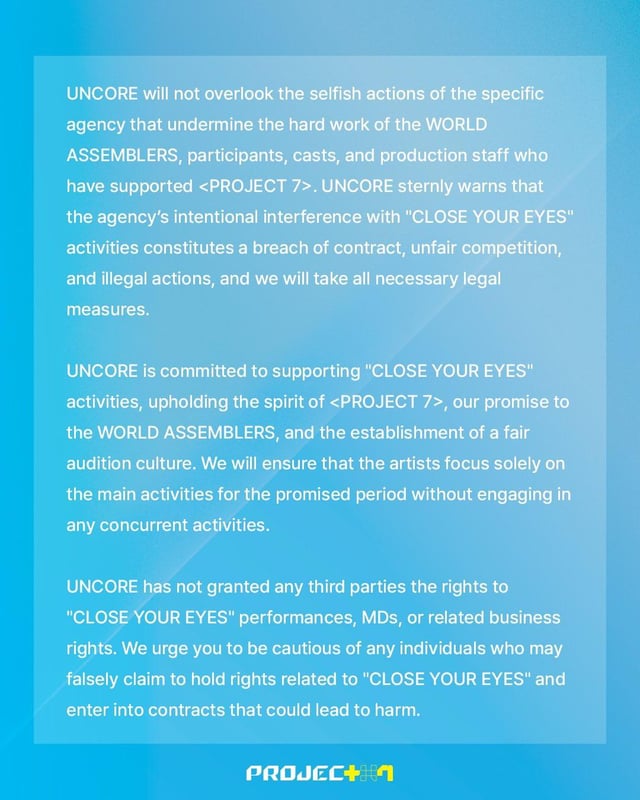
On Thursday morning, the silence ended not with a whisper, but with a declaration of war. UNCORE's official statement, posted on their website and all social media channels, was a masterclass in corporate communication that discarded the usual vague, placatory language for something far more direct.
"We have monitored the spread of malicious, groundless rumors regarding our artist Jang Yeojun. These are not merely differences of opinion or fan speculation; they are criminal acts of defamation and personal harassment fabricated with the intent to cause professional and personal harm. We have already completed the collection of evidence in collaboration with a specialized law firm and will be filing criminal complaints without any settlement or leniency against the original creators and key disseminators of this false information. This is not a warning. This is a notification of legal action already in motion."
The statement meticulously avoided repeating the rumors, a critical tactic to avoid further amplification. It then took an unexpected turn, addressing the human cost: "The past few days have been a period of immense distress for Jang Yeojun, who has dedicated his youth to his art, and for his family. We urge the public to consider the human being behind the stage name before contributing to the spread of unverified claims."

Beyond the Basics: The Legal Machinery in Motion
Industry insiders who spoke to K-Beats on background noted the specificity of UNCORE's language is what sets it apart. "Filing criminal complaints" moves beyond civil defamation suits. It involves law enforcement and can result in actual criminal records for perpetrators, a significantly more daunting prospect. The mention of a "specialized law firm" indicates they have likely engaged one of Seoul's notorious practices known for relentlessly pursuing online malefactors, often tracing them through IP addresses and platform data despite attempts at anonymity.
This scorched-earth legal approach reflects a growing, but still not universal, intolerance within the industry. For years, agencies opted for softer statements, fearing that aggressive lawsuits might keep a story in the news cycle. UNCORE has flipped the script, betting that a show of overwhelming force will not only protect Yeojun but also serve as a deterrent for future attacks on any of their artists listed on our Artists page.
A Fandom Divided? The Ripple Effect Across EYELID and Beyond
The reaction from the CLOSE YOUR EYES fandom has been a complex tapestry of relief, fury, and mobilization. The dominant sentiment on the official fan café and curated social media spaces has been one of unyielding support. Trending hashtags like #EYES_ON_YEOJUN and #PROTECT_C_Y_E have been flooded with archival photos and videos highlighting his professionalism and kindness, a common "proof of character" tactic in K-pop fan defense playbooks.
However, the incident has exposed subtle fractures. Some fringe factions, particularly on international platforms, have expressed frustration at the lack of "transparency," arguing the statement should have more explicitly denied the specific rumors. This highlights a perpetual tension in idol culture: the fan desire for intimate knowledge versus the agency's mandate to control narrative and avoid legitimizing falsehoods.
The broader K-pop online community reaction has been notably watchful. On forums like Pann and TheQoo, the discussion has shifted from the rumors themselves to the implications of UNCORE's response. Comments reflect a mixture of admiration and apprehension: "Finally, an agency with a backbone," versus "This sets a new standard. If your fave's company doesn't respond like this, do they even care?" The response has, perhaps unintentionally, created a new benchmark for agency accountability in the eyes of fans. This moment of collective crisis and support mirrors the powerful fan-driven narratives seen in other comebacks, such as when TWS reclaimed their story with "NO TRAGEDY".
A Watershed Moment? Industry Implications of the UNCORE Doctrine
The UNCORE statement is more than a press release; it's a potential policy shift rendered in public. For years, the default industry position towards malicious online posts was a combination of monitoring, occasional vague legal warnings, and hoping the news cycle would move on. This "spoonful of sugar" approach often failed, leaving artists psychologically scarved and careers permanently dented by baseless allegations.
UNCORE's move represents the "vinegar" strategy: publicly committing to pursue legal consequences to the fullest extent, making the cost of harassment prohibitively high for the attacker. This could signal several major shifts:
- The End of Anonymity as a Shield: As digital forensic techniques improve, the myth of complete online anonymity is fading. Agencies are learning to invest in the legal tech to pierce that veil.
- Agency Power Recalibration: For mid-tier and smaller agencies, demonstrating this capability becomes a powerful recruitment and retention tool. It tells potential trainees and their families: "We will protect our investments."
- Fan Culture Accountability: It places an indirect onus on fandoms to better police their own spaces. The fear that a reckless post could lead not just to fan exclusion but to real legal trouble may temper some of the most toxic behavior.
This is not happening in a vacuum. We are in an era where artists are increasingly taking control of their narratives, whether it's through bold musical statements like ZEROBASEONE's transformative "RE-BIRTH" or through direct legal and personal action. The industry is slowly, painfully, evolving from a model that treated idols as impervious products to one that must acknowledge their humanity and vulnerability.
Looking Forward: The Road Ahead for CLOSE YOUR EYES
So, what comes next? The immediate path for CLOSE YOUR EYES is fraught but clearer. UNCORE has drawn its line. The legal machinery will grind on, largely out of the public eye, potentially resulting in quiet settlements or, in some cases, very public prosecutions meant to serve as examples.
The more critical test will be the group's artistic and commercial trajectory. Can they channel this experience—the collective trauma and the fierce institutional defense—into their art? Their upcoming full album now carries a weight it didn't a week ago. Every lyric will be scrutinized for subtext. Every performance will be watched for a crack in Yeojun's composure or, conversely, for a new layer of defiant strength. The concept of "closing your eyes" to find truth or escape pain has just been violently literalized for them.
Industry watchers will be monitoring their next comeback numbers closely, not just on the charts, but in terms of brand health and public sentiment. A successful comeback will be hailed as a triumph of resilience and a validation of UNCORE's hardline strategy. It could encourage other agencies to follow suit, leading to a tangible reduction in the most egregious forms of online witch-hunting. A stumble, however, might be unfairly attributed to residual "controversy," proving how difficult it is to fully scrub the digital stain.
Ultimately, the saga of the last week is a stark chapter in the ongoing story of K-pop's maturation. It underscores that the industry's greatest battles are no longer just fought on music show stages for trophies, like the historic wins chronicled in our Decade of Dominance report. They are fought in courtrooms and server logs, in the hearts of fans and the minds of the public. CLOSE YOUR EYES did not ask for this fight. But by responding with unprecedented force, their agency may have just changed the rules of engagement for everyone.