
Opening: The Algorithm of Affection
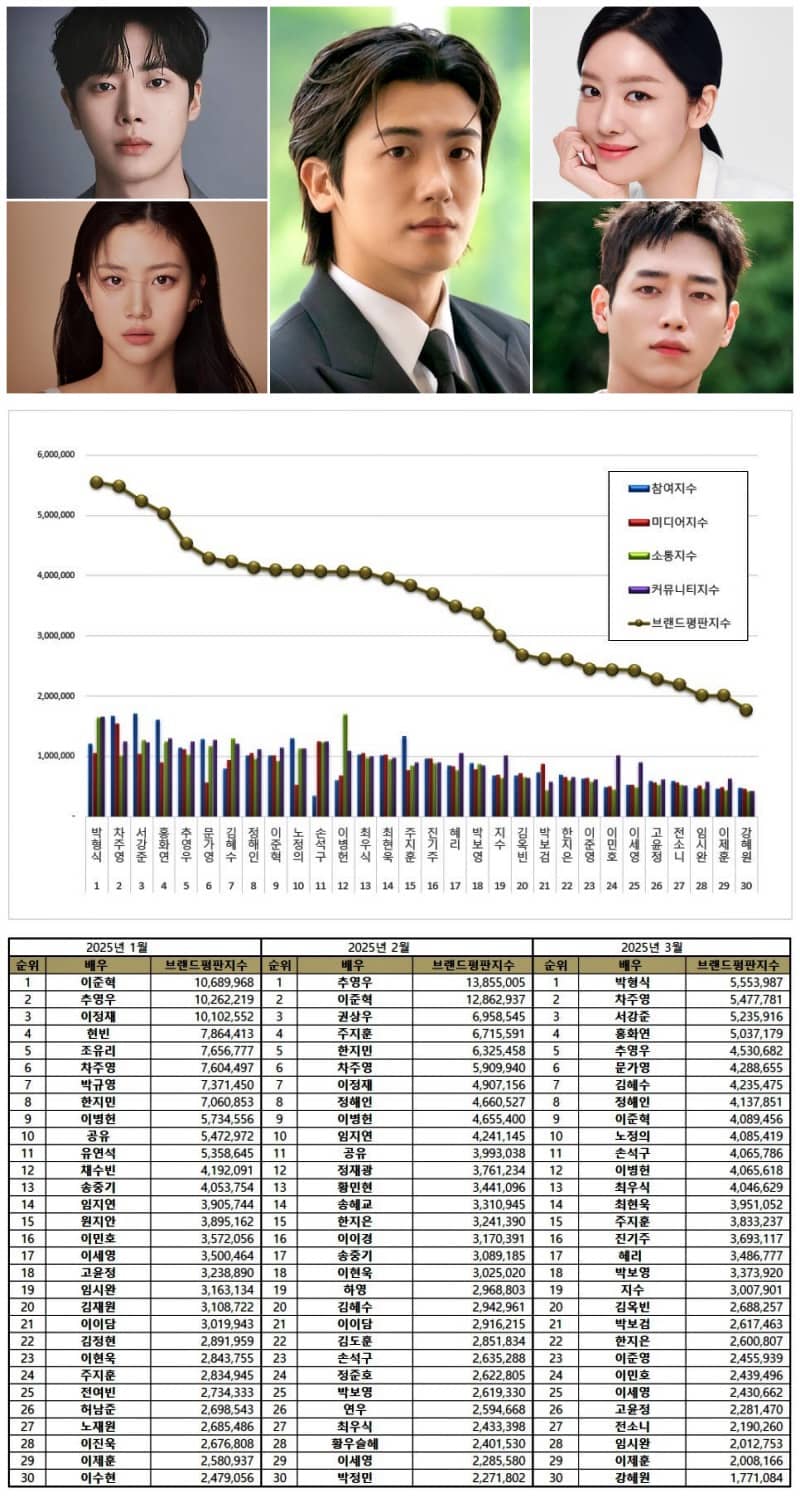
In the meticulously calibrated world of Korean entertainment, where perception is often as valuable as talent, the monthly Brand Reputation Rankings for actors function as a high-stakes report card. Published by the Korean Business Research Institute (KBRI), these rankings are not mere popularity contests. They are a complex algorithmic synthesis of media coverage, consumer interaction, community awareness, and communication volume, quantifying the intangible: cultural relevance. For years, the top spots have been the dominion of established A-listers, megastars whose names are synonymous with box office gold and rating points. However, the data for March 2024 has delivered a narrative twist no screenwriter could have predicted. While familiar giants hold strong, the list tells a deeper story—one of an industry and its audience increasingly valuing authentic connection over untouchable stardom, a trend we’ve seen reverberating through the K-Pop world as well.
Background: Decoding the Brand Power Index
To understand the shockwaves of this month's list, one must first understand the machine that produces it. The KBRI's analysis is a data behemoth. Researchers collect big data from the media coverage, consumer participation, interaction, and community awareness indexes of 50 top actors from February 26 to March 26. This involves sifting through millions of news articles, blog posts, videos, social media mentions, and forum comments. The analysis isn't just about volume; it's about context. Keywords are extracted and analyzed for positive, negative, and neutral ratios, while participation and communication indexes measure active engagement.
Kim Hyun-ho, the director of KBRI, has often stated,
"The brand reputation ranking is a mirror reflecting the public's active interest and emotional engagement. It shows who is not just seen, but who is truly being listened to and embraced."This "emotional engagement" is the X-factor. An actor with a major drama ending might see a surge, but it's often temporary. Sustainable high rankings, or unexpected climbs, speak to a deeper resonance—a connection that transcends a single project and taps into the public's current psyche. It’s a phenomenon not unlike what we track on our Charts page, where a song's longevity often speaks more to its cultural impact than its first-week explosive numbers.
The Historical Heavyweights
Traditionally, the summit of these rankings is occupied by actors with either a major, ongoing hit drama or a colossal, career-defining film. Stars like Kim Soo-hyun, Song Hye-kyo, and Hyun Bin are perennial fixtures. Their brand power is built on years of consistent excellence and a slightly distant, impeccable public image. They are institutions. Their presence in the top five is often considered a given, a baseline stability in the volatile metrics of fame. This makes any disruption to this order not just news, but a cultural signal.
The News: A Top Five Shaken, Not Stirred
The KBRI announced that for March 2024, the brand reputation rankings for actors were calculated with a total participation index of 17,950,205, a media index of 4,452,285, a communication index of 5,621,228, and a community index of 7,499,401. The resulting top five were:
- Yoo Jae-suk (The nation's MC, showing his cross-genre dominance)
- Kim Soo-hyun (Riding the enduring wave of "Queen of Tears")
- Park Gyu-young (The month's shocking breakthrough)
- Song Hye-kyo (A steady pillar of influence)
- Lee Do-hyun (Military service news fueling loyal fan engagement)
While Yoo Jae-suk's #1 placement—driven by his unwavering variety presence and public trust—and Kim Soo-hyun's strong #2 are expected, it is the name in third position that has sparked industry-wide conversation. Park Gyu-young, a talented but previously mid-tier actress, achieved a staggering brand reputation index of 5,204,983, with a 191.21% increase in her score since February. Her keyword analysis was revealing: "Gratitude," "Sincerity," "Everyday," and "Communication" were among the highest associated terms. This stands in stark contrast to the more project-driven keywords for others, like "Queen of Tears" for Kim Soo-hyun or "Disability" (relating to a recent role) for Song Hye-kyo.
The "Park Gyu-young Phenomenon": What the Data Reveals
Park Gyu-young did not have a drama airing in March. She did not have a major film release or a high-profile endorsement deal. Her ascent is attributed by analysts to a perfect storm of organic moments. A heartfelt, lengthy live broadcast on her personal channel, where she candidly discussed the pressure of her previous year's projects, her insecurities, and her simple joys—like cooking a failed stew—went massively viral. Clips of her laughing at her own mistakes, thanking fans with tearful eyes, and refusing to edit out "boring" moments were shared millions of times. This was followed by paparazzi shots of her visiting a small, independent bookstore, not in designer clothes, but in comfortable, everyday wear, further cementing an image of relatable authenticity.

"It feels like we're seeing a friend succeed, not a distant celebrity," one data analyst commented on a Korean business podcast. "The metrics show her engagement is not about curiosity, but about genuine affinity. People feel protective and proud of her."This mirrors a trend we analyzed in-depth in our article, "The Emotional Avalanche: How VIVIDANCE's Hyejin Exposed the Raw Nerve of 5th-Gen Idol Pressure", where the line between idol and fan is being redrawn through shared vulnerability. Park Gyu-young’s case demonstrates this is not confined to the idol world.
Fan & Community Reaction: The Power of the "Relatable"
On platforms like X, Naver Cafe, and TheQoo, the reaction to the rankings has been intensely focused on Park Gyu-young's rise. The sentiment is overwhelmingly positive, with a distinct note of vindication.
- International Fan Communities: "She deserves this so much! It's refreshing to see someone praised for being human. Her live wasn't a curated 'healing' content; it was just real," wrote a top-voted comment on a Reddit translation thread.
- Korean Fan Cafes: "Compared to celebrities who only show perfect images, Gyu-young's honesty is like a breath of fresh air. It makes me want to support her more," a fan posted on her official Daum cafe, which saw a 300% spike in new memberships this month.
- Industry Forums: A more meta-discussion has emerged on blind gossip sites. "This is a direct response to 'over-managed' celebrities. Agencies are taking note. The 'imperfect but sincere' strategy is now quantifiably powerful," one anonymous insider posted.
The conversation often draws parallels to the idol industry's own struggles with image. Fans referenced past incidents where attempts at "perfect" personas backfired, contrasting them with Park's success. Some even drew a line to the discourse sparked by "The Unfiltered Upload", which explored how an idol's accidental reveal humanized them in unpredictable ways. The public appetite, it seems, is shifting from awe to empathy, from pedestals to shared ground.
Industry Analysis: The Blurring Lines and Business Impact
The implications of this month's rankings are profound for talent agencies, broadcasters, and brands. First, it confirms the erosion of the rigid wall between K-Drama actors and K-Pop idols in terms of fan engagement expectation. Actors are now encouraged, or even pressured, to maintain active, personal communication channels—a domain once primarily for idols. The data proves this engagement directly translates to commercial brand value.
Second, it highlights a crisis in traditional marketing. A flawless magazine spread or a scripted variety appearance may generate less positive brand linkage than a single, sincere, unedited live stream. Advertisers are now looking at these brand reputation keywords with intense interest. An actor associated with "sincerity" and "gratitude" becomes a safer, more resonant bet for a wider range of products, particularly in the domestic market, than one associated only with "luxury" or "perfection."
Third, it creates a new paradigm for career longevity. While hit dramas are irreplaceable for an actor's foundation, this data suggests that the "downtime" between projects is no longer a period of brand decline but a critical window for building deeper, more resilient public goodwill. It’s a lesson some in the music industry have learned; for instance, the sustained interest in artists who share their process, as seen in the career trajectories of many soloists we cover on our Artists page.
However, analysts also warn of a potential downside.
"This trend invites scrutiny into authenticity itself," cautions media critic Park Ji-won. "When 'being real' becomes a strategy, how do we measure its genuineness? The public's pendulum can swing from craving relatability to punishing perceived emotional manipulation very quickly."This tension is already visible in K-Pop, where fan service walks a fine line, a topic we’ve seen ignite fierce debate in contexts like the recent RM-Jungkook interview controversy.
What's Next: The New Blueprint for Stardom?
As we look beyond March, the question for the industry is whether the "Park Gyu-young effect" is an anomaly or a blueprint. Will agencies now mandate "authentic" live sessions for their actors, ironically stripping them of the very sincerity the public craves? Or does this mark a permanent shift toward a more holistic, integrated, and humanized form of celebrity?
For the actors on the list, the path forward is dual-pronged. For top-tier stars like Kim Soo-hyun and Song Hye-kyo, the challenge is to integrate moments of accessible humanity into their majestic brand images without diminishing their star power—a high-wire act. For rising stars like Park Gyu-young, the challenge will be to navigate the intense scrutiny that comes with this new level of attention while maintaining the relatable quality that got her here. The pressure to remain "ordinary" under extraordinary circumstances is immense, a paradox famously explored in the criticisms faced by BTS's V for his "ordinary" pursuits.
Ultimately, the March brand rankings are more than a list; they are a cultural document. They reveal a public fatigued by impenetrable glamour and hungry for connection. They prove that in the digital age, brand reputation is no longer just about what you project, but about how you connect. As the lines between drama roles and real-life personas continue to blur, the most successful stars of tomorrow may be those who can master not just the script on set, but the unscripted, genuine narrative of their own humanity. This is a story still being written, and we’ll be here to analyze every data point and every human moment. Stay tuned to our News page for the continuing evolution of star power in the Hallyu wave.