
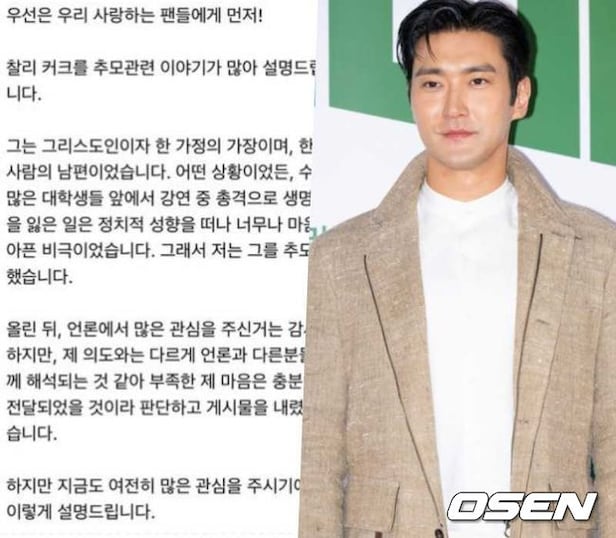

The recent, intense online reaction to a mature scene featuring Super Junior's Choi Siwon in his latest drama is less about the scene itself and more about a profound, system-wide conflict. It highlights the often unspoken and contradictory rules governing idol-actors, the evolving landscape of Korean entertainment, and the precarious balance stars must strike between artistic growth and fanbase expectation. This incident is a case study in the perpetual renegotiation of an idol's public persona.
- What Exactly Sparked the Online Firestorm?
- From Flower Boys to Complex Roles: A Brief History of Idol Acting
- Siwon's Unique Trajectory: How Did We Get Here?
- The Critical Double Standard: When Is "Growth" Acceptable?
- Ripple Effects: What This Means for Future Idol-Led Dramas
- Your Questions, Answered
What Exactly Sparked the Online Firestorm?
The core of the controversy lies in a specific, emotionally and physically intense scene within Siwon's recent drama project. While the plot demanded a moment of raw, adult vulnerability, a segment of the audience was unprepared to see the veteran idol in such a starkly unrestrained light.
The Scene in Context
Unlike typical K-drama romantic sequences, this moment was framed not for fantasy, but for narrative gravity and character breakdown. The director's choice emphasized realism over romanticism, a artistic decision that collided head-on with the curated image many associate with Choi Siwon.
The Spectrum of Netizen Reaction
Responses fragmented quickly. International viewers often framed it as a discussion on artistic freedom, while a vocal Korean netizen segment expressed feelings of betrayal, discomfort, and even "disgust," citing a breach of the "clean" image they had long attached to the star.
Reaction Cohort Primary Argument Underlying Concern Long-Term ELF Fans Support for artistic challenge; pride in his evolution. Defending his right to a serious acting career beyond the idol label. General K-Drama Viewers Mixed; praise for bold acting, shock at departure from his norm. Re-calibrating his perceived "type" as an actor. Vocal Critical Netizens "Unnecessary," "shocking," damaging to his gentleman image. A perceived violation of an implicit contract regarding idol behavior and portrayal. Industry Observers Sees it as an inevitable clash in an evolving industry. The widening gap between idol persona management and authentic acting demands.From Flower Boys to Complex Roles: A Brief History of Idol Acting
To understand the weight of this moment, one must look back. Idol acting has evolved from mere cross-promotion to a legitimate, yet perilous, career path.
The Early "Flower Boy" Archetype
In the 2000s and early 2010s, idol actors were often cast for their visual appeal and fanbase, playing charming, often idealized characters. Roles were extensions of their idol personas—the cheerful best friend, the handsome heir. The risk was minimal, the reward was ratings and album sales.
The Shift Toward Legitimacy
Pioneers like EXO's D.O. and JYJ's Park Yuchun (pre-controversies) broke the mold, earning critical acclaim for transformative, emotionally heavy roles. They set a new precedent: an idol could be a real actor. This opened doors but also raised the stakes for those who followed.
The Modern Tightrope
Today, idol-actors navigate a razor's edge. Audiences and critics demand proof of skill, yet segments of the fandom and public may resist a full departure from a comfortable, familiar image. As explored in our analysis of IU's "Perfect Crown" success, K-pop stars are now drama power players, but with that power comes immense scrutiny over every career choice.

Siwon's Unique Trajectory: How Did We Get Here?
Choi Siwon isn't just any idol dabbling in acting. His path is distinct, making this moment a pivotal point in a decades-long narrative.
The Super Junior Foundation: The "Gentleman" Idol
Within Super Junior, Siwon's persona was built on a triad of visuals, faith, and a polished, gentlemanly demeanor. He was the reliable, handsome, and principled member—an image reinforced by years of variety shows, interviews, and philanthropic work.
Early Acting Ventures: Playing to Type
His initial drama roles, like in Oh! My Lady and Athena: Goddess of War, leveraged his looks and charm. Even in She Was Pretty, his supporting role was that of a kind, model-esque editor. These parts safely aligned with his public identity.
The Conscious Pivot to Substance
In recent years, Siwon has deliberately chosen grittier, morally ambiguous projects. From a vengeful father in My Fellow Citizens! to a corrupted detective, he has actively dismantled the "flower boy" frame. This latest role is the logical, if most extreme, culmination of that years-long campaign for taken-seriously credibility—a journey not unlike the artistic recalibration seen in The Rose's strategic pause.
The Critical Double Standard: When Is "Growth" Acceptable?
This incident lays bare a pervasive hypocrisy in how the industry and public judge artistic maturation.
The "Actor" vs. "Idol-Actor" Perception Gap
When a non-idol actor takes on a challenging, physical role, it's often hailed as brave and committed. When an idol does the same, the narrative can quickly shift to questions of "appropriateness" and image betrayal. The "idol" prefix becomes a qualifier that limits the perceived range of acceptable expression.
Gender Disparities in Scrutiny
Female idol-actors face even harsher and more complex scrutiny for mature roles, often battling misogynistic criticism alongside career critiques. The backlash against Siwon, while intense, exists within a different societal framework than that faced by his female counterparts attempting similar transitions.
The Burnout Connection
This pressure to conform to a narrow, "safe" version of oneself is a direct contributor to the industry's silent burnout epidemic. The immense energy required to maintain a pristine, unchanging public facade while suppressing artistic impulses is unsustainable. It's a dynamic we detailed in "The Coffee Grind Escape," highlighting the desperate need for space to breathe and evolve beyond a fixed idol image.
Ripple Effects: What This Means for Future Idol-Led Dramas
The fallout from this single scene will inform casting, marketing, and creative decisions for years to come.
Casting Directors and Risk Assessment
CDs may now think twice before casting a veteran idol in a role requiring extreme emotional or physical vulnerability. The calculation shifts: does the star's fanbase draw outweigh the potential for distracting controversy? This could inadvertently push roles toward safer, more stereotypical casting.
The "Pre-negotiation" of Image
We may enter an era where an idol's management and drama producers explicitly "pre-negotiate" the boundaries of on-screen portrayal in the contract, delineating what is and isn't acceptable—a formalization of the unwritten rules that just fractured.
A Potential for New Creative Freedom
Conversely, this could also be a breaking point. For idol-actors determined to shed their past, such controversies, while painful, demonstrate that the old model is broken. It may empower a new wave to fully commit to acting without apology, forcing a faster, if messier, evolution of public perception. As one veteran actor noted about avoiding the idol path in "The Road Not Taken," the grueling constraints of idol life are uniquely intense.
Your Questions, Answered
Q: Was the backlash against Siwon as universal as international headlines made it seem?
A: No. The narrative was amplified by algorithmic news and sensationalist reporting. The reaction was deeply polarized, with significant support from his core fandom and many drama critics praising his commitment. The "shock" was real for a segment, but not representative of the entire audience.
Q: Will this permanently damage Siwon's acting career or public image?
A: In the long term, likely not. For the industry, controversy can sometimes cement an actor's seriousness of purpose. Short-term, it may make certain family-friendly brands cautious. However, for the specific niche of complex, mature dramas he is now targeting, this may ultimately reinforce his commitment to that lane.
Q: How does this compare to backlash against other idol actors, like Red Velvet's Irene for her encore stage?
A: The Irene backlash, which we analyzed in "The Encore Heard 'Round the World," was about perceived professional competency and effort within her primary field (singing). Siwon's is about the boundaries of his secondary field (acting). Both speak to unforgiving public standards, but the foundational "contract" being examined is different.
Q: Should idol agencies have more control over their artists' acting choices?
A: This is the central tension. More control protects a lucrative brand but stifles growth and can lead to artistic frustration. Less control allows for evolution but risks alienating parts of the fanbase that fund the idol system. There is no perfect answer, only risk management.
Q: As a fan, how should I process this?
A: Separate the artist from the character. Evaluate the performance based on its narrative purpose and execution. Ask yourself if your discomfort is with the actor's choice or a natural reaction to a challenging story moment. Supporting an artist's growth sometimes means being uncomfortable.
Conclusion & The Path Forward
The eruption over Choi Siwon's scene is a seismic event in the ongoing tectonic shift between K-pop's idol culture and the raw demands of cinematic storytelling. It is not an isolated scandal, but a symptom of a system in transition. The incident proves that the journey from idol to actor is no longer just about taking on a role; it's about forcibly renegotiating a public identity built over decades.
For the industry, the lesson is that audiences are not monolithic. For idol-actors, the path forward requires a steeled resolve, accepting that profound artistic steps may come with temporary, intense backlash. For fans, it invites a reflection on what supporting an artist's "growth" truly means—is it only applauding safe choices, or is it having the fortitude to follow them into uncharted, uncomfortable territory?
The conversation is far from over. To track how other artists navigate these complex waters, follow our ongoing analysis on our News page and explore the profiles of idols balancing multiple careers on our Artists page. The only certainty is that the lines will continue to be tested, blurred, and redrawn.