
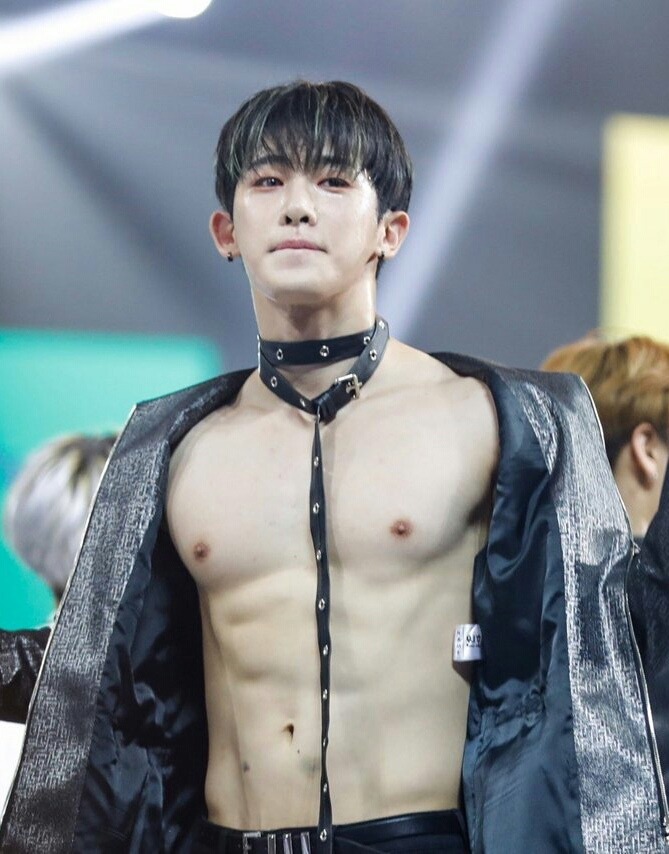
The world of K-Pop fashion is a constant, meticulously curated dialogue. Every ripped seam, every oversized silhouette, every daring accessory is a sentence in a larger story about identity, concept, and rebellion. Sometimes, however, a single punctuation mark—a tiny, seemingly innocuous item—can hijack the entire conversation, revealing far more about the audience than the wearer. This week, that punctuation mark was a hair clip, worn by none other than Rising Phoenix's charismatic main rapper and visual, Taeyang.
In a series of candid, behind-the-scenes photos posted to the group's official fan community, Taeyang was seen sporting a large, black hair clip adorned with a prominent silver O-ring at its center. The styling was effortlessly casual: his dark hair partially swept back, the clip functional yet undeniably a statement piece. To a segment of the international fanbase, the O-ring design was instantly recognizable beyond its hair-holding utility, igniting a swift and surprisingly nuanced online discussion about symbolism, innocence, and the interpretative chasm that can exist between a stylist's rack and a fan's screen.
From Rookie Sensation to Style Vanguard: The Ascent of Rising Phoenix's Taeyang
To understand the weight of any detail concerning Taeyang, one must first appreciate his trajectory. As a core member of Rising Phoenix, a 4th generation boy group known for their complex lore, powerful performances, and genre-blending sound, Taeyang has carved out a distinct niche. Since their debut three years ago, he has been lauded not just for his sharp, rhythmic flow but for his chameleonic visual presence. He embodies the group's concept of "rebirth through fire," often serving as the bridge between their darker, intense title tracks and their brighter, more playful b-side and variety personas.
His fashion sense, both on and off duty, has become a point of study for fans. He is known to mix high-end designer pieces with vintage finds and streetwear staples, often with a subtle, gender-fluid elegance. This has positioned him as a burgeoning style icon within the new generation, a figure whose sartorial choices are dissected for hints about the group's next musical direction or his personal artistic evolution. As seen in our recent analysis of shifting idol influence, "The New Guard Rises", the personal brand of individual 4th gen members like Taeyang is becoming increasingly powerful, often operating independently of their group's activities.
A Canvas for Interpretation: Taeyang's Fashion History
This is not the first time Taeyang's wardrobe has prompted discussion. Past appearances have featured safety pins used as jewelry, harness-inspired detailing on stage outfits, and a general affinity for what fashion critics term "subculture-adjacent" aesthetics. His stylists have consistently pushed boundaries, borrowing elements from punk, goth, and grunge, then filtering them through K-Pop's inherently polished lens. Each choice is deliberate, part of building an idol's multifaceted image. For a deeper look at how visual aesthetics are strategically deployed in comebacks, our analysis of another global superstar's transformation, "Metamorphosis Under the Spotlight," explores similar themes.
Deconstructing the Clip: A Story in Two Parts
The incident unfolded in two distinct acts, a testament to the multi-platform nature of modern K-Pop news.
Act I: The Innocent Post
It began, as so many things do, on the fan platform Weverse. The Rising Phoenix account uploaded a batch of casual, dorm-life photos. In several, Taeyang used the black O-ring clip to manage his hair while engaging in mundane activities—reading a script, playing with a member's dog. The caption was lighthearted, focusing on the group's off-day relaxation. The initial wave of fan comments was overwhelmingly focused on Taeyang's "boyfriend" visuals, his cute expression, and the relatable scene. The clip was largely mentioned as a simple, cute accessory. "Taeyang-ah, even your hair clip is cool!" read one typical, top-liked reply.
Act II: The Cross-Cultural Spark
The conversation shifted dramatically when the photos migrated to broader social media platforms like Twitter and Reddit. Here, the audience expands beyond the dedicated fandom to include casual K-Pop observers, fashion enthusiasts, and cultural commentators. A post pointing out the clip's resemblance to certain BDSM-inspired fashion accessories gained traction. The discourse was not accusatory or scandalized; instead, it was analytical and often amused.

"It's genuinely just a hair clip, but the fact that it's on a male idol in K-Pop and it's *that* specific design is low-key iconic. The stylist knew. They absolutely knew," posted one popular Twitter user with a large following in K-Pop fashion analysis.
The debate bifurcated. One side argued for pure functionality and the "innocence" of the item, asserting that attaching adult connotations to a hair clip was a reach, if not inappropriate. The other side posited that in fashion, context is everything, and the O-ring is a deliberate motif with a known history. They argued that recognizing its potential symbolism wasn't about labeling Taeyang, but about acknowledging the stylist's likely intentional borrowing from a particular aesthetic vocabulary to cultivate an edge.
The crucial, unifying consensus? Almost universally, fans and onlookers agreed that Taeyang looked strikingly good wearing it. The visual, as they say, was immaculate.
Fandom in Flux: Protection, Analysis, and the "Cute" Paradox
The reaction within the Rising Phoenix fandom, known as Embers, was a fascinating case study in modern fan psychology. It highlighted the tension between the protective instinct and the desire for sophisticated analysis.
A significant portion of the fandom mobilized to "defend" Taeyang from what they perceived as unnecessary sexualization. Their argument centered on intent: since Taeyang was clearly in a casual, innocent setting, the clip should be viewed only as a functional item. To do otherwise was seen as importing a Western-centric, potentially lewd interpretation onto a simple Korean hair accessory. Comments on the original Weverse post became fiercely protective, flooding the feed with heart emojis and "he's just cute!" declarations to drown out any external discourse.
Simultaneously, another segment of Embers—often older or more engaged with fashion theory—engaged with the discussion head-on. On platforms like Discord and detailed fan forums, they broke down the history of the O-ring in fashion, from its utilitarian roots to its adoption by designers like Alexander McQueen and Rick Owens as a symbol of rebellion and subversion. For these fans, the clip wasn't a scandal; it was a thrilling piece of fashion communication.
"This is why I love Rising Phoenix's styling. They aren't playing it safe. Using an item with that kind of cultural baggage, even subtly, adds a layer of complexity to Taeyang's 'soft-strong' image. It's a whisper, not a shout, and it makes his overall style narrative more interesting," wrote a user on a popular K-Pop analysis forum.
This internal fandom dialogue mirrors larger conversations in the K-Pop sphere about how idols are perceived and protected. The intense scrutiny of every detail can lead to both unjust criticism and, at times, an overcorrection of defense, as explored in our piece on the extreme pressures idols face, "Beyond the Microscope."
Industry Insight: Styling as Strategic Narrative
From an industry perspective, this micro-event is less about a single accessory and more about the sophisticated, calculated language of K-Pop styling in the 4th generation.
"Idol stylists are master linguists in the dialect of visuals," says a veteran entertainment editor who requested anonymity. "They pull references from music videos, high fashion runways, street style, and subcultures from around the world. An item like this is chosen precisely because it has multiple readings. To the general public, it's a cool, edgy hair clip. To fashion-forward fans, it signals a specific aesthetic awareness. It generates exactly this kind of talk—it's conversation-starting without being overtly controversial."
This strategy aligns with a broader movement in K-Pop towards individuality and "realness." Idols are encouraged to develop distinct personal styles that feel authentic, even if they are meticulously curated. Taeyang, with his known interest in fashion, is a perfect vessel for this. The clip incident demonstrates how stylists for top-tier groups like Rising Phoenix are empowered to take these calculated micro-risks, trusting the idol's charisma and the fandom's intelligence to land the message.
Furthermore, it highlights the globalized nature of K-Pop consumption. An item chosen by a Korean stylist is instantly interpreted through a global fanbase's diverse cultural lenses. What might be a simple, trendy item in Seoul can carry entirely different connotations in London, New York, or São Paulo. The industry is acutely aware of this and often uses it to foster a sense of inclusive, global cool. For more on the dark side of this global online ecosystem, where every visual choice can be weaponized, readers can refer to our investigation "Digital Dystopia."
The Ripple Effect: What Does This Mean for Taeyang and Rising Phoenix?
So, where does this leave Taeyang and the future of Rising Phoenix's image? In the immediate term, the episode is a net positive. It has reinforced Taeyang's status as a fashion trendsetter, generated significant organic buzz, and demonstrated the passionate engagement of the Ember fandom. It's the kind of "soft news" that builds an idol's mystique without touching a real scandal.
Looking ahead, we can anticipate several developments. First, Taeyang's personal styling will be watched even more closely. Fans and fashion commentators will look for continuations or evolutions of this "hinted edge." Second, this event may embolden stylists for other 4th gen groups to incorporate similarly coded items, further blurring the lines between traditional idol aesthetics and global alternative fashion trends.
Most importantly, it sets a stage for Taeyang's—and by extension, Rising Phoenix's—artistic maturation. As the group moves past their rookie years, their concepts are likely to deepen. Having an idol who can visually carry more complex, nuanced, and slightly dangerous connotations is a powerful asset. It opens the door for musical concepts that explore darker, more mature themes of love, conflict, passion, and rebellion, all while maintaining the core fandom's unwavering support.
In the end, the black O-ring hair clip was more than an accessory. It was a litmus test. It revealed a fandom capable of both fierce protection and intellectual analysis. It showcased the razor-sharp intentionality of modern K-Pop styling teams. And it solidified Taeyang as an idol unafraid to be a canvas for conversations that extend far beyond the music—conversations about art, perception, and the ever-evolving definition of what it means to be a K-Pop icon in a hyper-connected world. For the latest on how idols like Taeyang are shaping the industry, keep an eye on our Artists page for in-depth profiles and updates. The next chapter for Rising Phoenix is being written, one carefully chosen accessory at a time.