The digital realm where K-Pop idols share curated glimpses of their lives is typically a landscape of flawless selfies, behind-the-scenes rehearsal shots, and carefully staged café visits. It is a space governed by unspoken rules of fan service and brand safety. So, when Park Jaehyun, a respected main vocalist of the veteran third-generation boy group NOVA, posted a series of casual, cheerful photos to the group’s official fan café last Tuesday, he likely expected a wave of heart emojis and comments about his visual charm. Instead, he detonated a cultural bomb, plunging himself and his group into the center of an international controversy that stretches far beyond music charts and into the fraught arena of global politics, consumer activism, and the ever-evolving definition of an idol's public responsibility.
The photos in question were disarmingly simple: Jaehyun, wearing a comfortable hoodie and a bright smile, biting into a cheeseburger. Another showed a table scattered with wrappers for Big Macs, french fries, and a prominent cup bearing the iconic golden arches of McDonald’s. The caption read: “Late-night cravings hit different. Sometimes you just need the classics #McDonald’s #CheeseburgerLove #NOVAsBack.” Within minutes, the post was no longer just about a meal. It became a flashpoint in the ongoing, widespread global boycott movement targeting companies perceived as supporting Israel, with McDonald’s being one of the most prominent names on activists’ lists.
What followed was a torrent of tens of thousands of comments, a whirlwind of condemnation, defense, and geopolitical discourse flooding the feeds of a pop music fan community. The incident forced a stark question into the spotlight: In an era where idols are global influencers, can their personal consumption choices ever truly be just personal? And what happens when the expectations of a deeply passionate, politically engaged international fandom collide with the perceived normalcy of a Korean celebrity’s daily life?
Jaehyun & NOVA: The Third-Gen Pillars Navigating a New Era
To understand the magnitude of the reaction, one must first understand the stature of Park Jaehyun and NOVA. Debuted in 2014 under Horizon Entertainment, NOVA carved their name during the explosive, globally competitive zenith of third-generation boy groups. They were never the flashiest or most controversial, but built a reputation as “musicians’ idols,” praised for their intricate vocal harmonies, consistent live performances, and sophisticated musicality. While they may not have reached the stratospheric commercial heights of some peers, they cultivated a loyal, dedicated fanbase, NOVALIGHT, known for its maturity and long-standing support.
Jaehyun, as the main vocalist, has always been seen as the group’s warm, steady core. His image is one of gentle reliability—the member who gives thoughtful advice on V Live, writes heartfelt song lyrics, and expresses deep gratitude to fans who have stayed with them for a decade. He is, in the eyes of the fandom, the unproblematic pillar. This pristine image made his foray into controversy all the more jarring. As a senior artist with over ten years in the industry, Jaehyun and NOVA have successfully navigated numerous industry shifts, from the rise of 4th gen superpowers to the pandemic’s virtual concert era. They represent a bridge between K-Pop’s past and present, a group whose actions are scrutinized not just as current celebrities, but as respected sunbaenim (seniors).
This context is crucial. A similar action from a freshly debuted idol might be dismissed as a naive misstep. From Jaehyun of NOVA, it was interpreted by many as a deliberate, informed choice—or a profound lapse in awareness. Their career phase also matters; with several members, including Jaehyun, approaching the end of their mandatory military service, the group is in a period of anticipated reunion and renewed group promotions, a time when public sentiment is critically important. For more on how senior idols navigate modern fandom landscapes, see our analysis in Crossing Sunbaenim Lines.
The Weight of a Decade in the Spotlight
NOVA’s journey has been one of steady growth rather than viral explosions. They’ve built their career on a foundation of musical respect and fan loyalty, avoiding major scandals. This clean record amplified the shock value of the McDonald’s incident. For NOVALIGHTS, the group’s integrity was part of its appeal. The incident forced fans to confront an uncomfortable reality: even their most trusted idols operate within a complex, globalized information ecosystem where every action, no matter how mundane, can be politicized.
The Post, The Response, and The Digital Firestorm
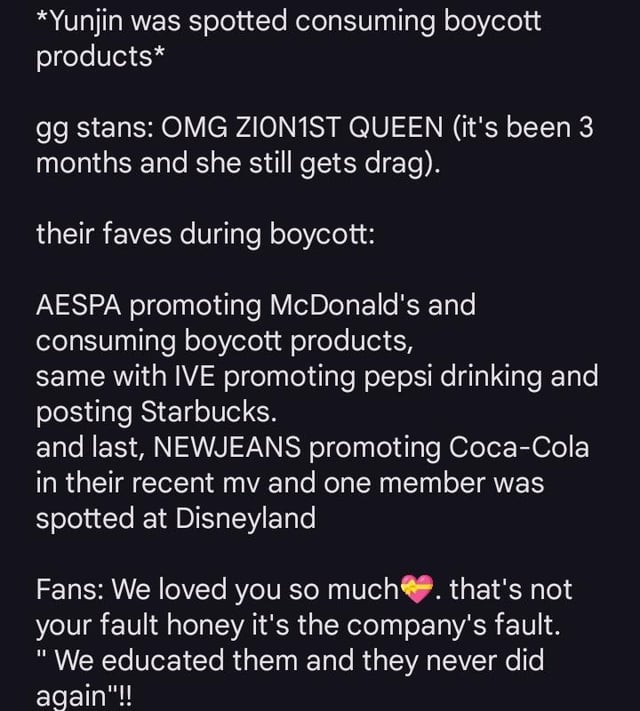
The initial post, as described, was innocuous on its surface. However, the speed and scale of the backlash were unprecedented for the group. The comments section quickly bifurcated. International fans, particularly those from regions where the boycott movement (often organized under the BDS—Boycott, Divestment, Sanctions—framework) is strong, flooded the post with Palestinian flags, infographics about McDonald’s franchise operations in Israel, and messages of profound disappointment.
“How can you sit there smiling with a burger when children are starving? You have a global platform. Do some research. This is heartbreaking,” wrote one top-liked comment.
Korean and some Southeast Asian fans reacted with confusion and defensive anger, viewing the criticism as an unfair attack on an idol’s personal freedom and an imposition of foreign political conflicts onto a simple meal. “He’s just eating! Since when did eating a burger become a crime? Leave him alone,” became a common retort.
The situation escalated dramatically when Jaehyun, seemingly in real-time, engaged directly. Instead of deleting the post or letting the company issue a standard “idol was unaware” statement, he added a new comment to the thread. It read: “I just wanted to share a happy moment of enjoying food. I don’t think sharing a meal should be a reason for hate. Let’s all be kind.”
This response, intended to defuse, acted as gasoline on the fire. Critics saw it as a dismissive, tone-deaf refusal to engage with the substantive ethical concerns raised, framing valid political critique as mere “hate.” Supporters saw it as a brave stance against online bullying. The direct engagement was a stark break from the typical idol protocol of silent removal or a formal agency apology, reminiscent of the raw, unfiltered debates that sometimes erupt on live streams, as seen in The Velvet Curtain Twitches.
Breaking Protocol: The Idol Speaks
Jaehyun’s decision to respond personally is perhaps the most significant facet of the entire incident. It shattered the fourth wall that usually insulates idols from direct, unmediated conflict with fractions of their fandom. It presented Jaehyun not as a perfectly managed brand asset, but as an individual frustrated by the condemnation of his personal action. This human moment, however, clashed violently with the demand for idols to be perpetually conscientious global citizens. The episode highlighted a growing tension: the industry encourages idols to be more “real” and connected, but that very authenticity opens them up to immense risk when their personal “realness” conflicts with the political values of segments of their audience.
A Fandom Divided: NOVALIGHT’s Civil War and the Global Disconnect
The reaction within NOVA’s fandom has been a microcosm of the wider global divide. Online fan spaces, from Twitter/X to dedicated forums, have become battlegrounds. A significant portion of the international fandom, especially in North America and Europe, has expressed a sense of betrayal. For these fans, support of the boycott is a core moral stance, and their idol’s apparent disregard for it—and subsequent defense of his choice—feels like a personal affront. Some have posted images of torn NOVA albums or canceled pre-orders for the group’s upcoming comeback anthology.
“I’ve collected every version of their albums for eight years,” shared a fan on an international forum. “But this isn’t about K-Pop anymore. It’s about basic human conscience. I can’t separate the art from the artist’s willful ignorance on this.”
Conversely, Korean fans and many across Asia have rallied fiercely to Jaehyun’s defense, launching hashtags like #RespectJaehyunsMeal and #LeaveNOVAAIone. They argue that Western fans are engaging in cultural imperialism, demanding Korean celebrities adhere to a specific, foreign political framework. They point out that the geopolitical context and the prominence of the boycott movement are not as universally mainstream in Korean media, and that expecting an idol to be aware of every global consumer activism campaign is unreasonable. This faction accuses the critical fans of performative wokeness and of damaging the group they claim to support.
The schism reveals a fundamental disconnect in how different segments of the global K-Pop community perceive the idol’s role. Is an idol primarily an entertainer providing music and performance, or are they, by virtue of their influence, de facto political actors with a responsibility to align their public actions (including personal social media) with progressive ethical consumption? There is no consensus, and the McDonald’s incident has ripped the band-aid off this long-simmering debate.
Industry Analysis: Brand Safety, Global Sensitivities, and the "Apolitical" Myth
From an industry perspective, this incident is a case study in modern brand management crisis. Horizon Entertainment’s silence for over 48 hours was deafening, suggesting internal turmoil. The standard playbook—a swift, vague apology—was likely complicated by Jaehyun’s own public response. To contradict their artist would undermine him; to support him explicitly could incur further global backlash.
The incident starkly underscores that the concept of K-Pop idols being “apolitical” is an unsustainable myth in 2024. Every brand endorsement, every product used on a variety show, every casual social media post is a political and economic statement, whether intended or not. Agencies now face a near-impossible task: they must train their artists to be globally aware citizens without venturing into explicit political commentary that could violate Korean broadcast laws or alienate domestic fans. It’s a diplomatic tightrope walk conducted in the public eye.
Furthermore, this affects more than just NOVA. Every agency’s PR team is now likely conducting emergency briefings with their artists, especially senior ones with established social media habits, about the symbolic weight of global brands. The risk calculus for celebrity endorsements has just become more complex. McDonald’s Korea, which often partners with idols for local campaigns, may find some agencies newly hesitant. This demonstrates how global political currents directly impact the local Korean entertainment economy. For insights into how global and local perceptions can diverge, examine the unique case of Charting Uncharted Waters: How BTS Conquered the UK Charts.
The situation also highlights the immense power of the organized, digitally-native international K-Pop fan. These fans are not passive consumers; they are activists who leverage their collective voice to hold artists and companies to ethical standards they define. This power has been used for positive causes like fundraising and demanding better treatment for idols, but this incident shows it can also be a tool for enforcing specific political compliance, creating a volatile environment for artists. You can track how fan actions influence broader industry movements on our dedicated News page.
What's Next for NOVA, Jaehyun, and the Idol Social Contract?
The path forward is fraught with difficulty. The immediate concern is NOVA’s planned 10th-anniversary comeback and world tour. Will the boycott calls translate into tangible commercial impact on album charts and ticket sales outside of Asia? More importantly, can the fandom heal from this rift? Mending the torn fabric of NOVALIGHT will require more than a hit song; it will require a nuanced, empathetic approach that acknowledges the pain on both sides without alienating either.
The most likely outcome is a carefully worded statement from Horizon Entertainment that expresses regret for “causing unintentional distress” and emphasizes the artist’s desire to bring people together through music, without retracting Jaehyun’s personal sentiment. Jaehyun himself may go quiet on personal social media for a period, or use future posts to highlight neutral, universally positive content. The group’s public appearances will be meticulously managed to avoid any triggering subjects.
Long-term, this event is a landmark. It serves as a brutal awakening for veteran idols of the third generation who rose to fame in a slightly less globally-interconnected social media landscape. The rules have changed. It also signals to the entire industry that fan education—or artist education—on global sensitivities is no longer optional, but a necessary component of career maintenance. The illusion that an idol’s private life is separate from their public influence has been彻底 shattered.
Ultimately, the “Big Mac Offense” is not about a burger. It is about the collision of a Korean entertainment industry built on controlled image-making with a global audience that demands ethical authenticity. It is about the painful process of reconciling the human being, Park Jaehyun, with the idol, Jaehyun of NOVA. As the industry moves forward, this incident will be studied as a critical moment where the social contract between idol and fan was rewritten under intense, public pressure, proving that in the global K-Pop ecosystem, even the most casual bite can carry the weight of the world. For a look at how artists rebuild and connect after moments of public scrutiny, the journey of artists like Rosé offers a compelling parallel, as seen in The "APT." Anomaly.