
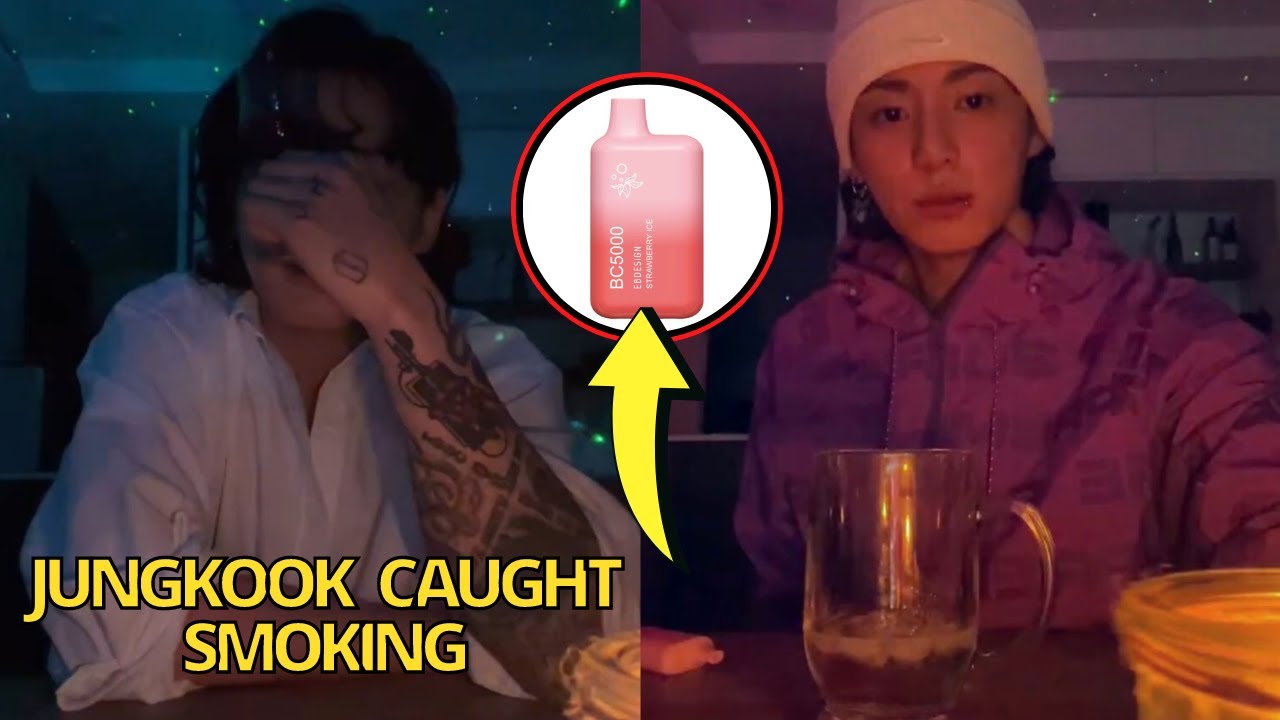

The world of K-Pop is built on a foundation of meticulous image curation, a delicate dance where the line between the personal and the persona is often invisible to the public eye. It’s a system that has propelled the industry to global dominance, turning idols into ideals. Yet, all it takes is one unguarded moment, one flicker of reality bleeding through the digital veil, to send shockwaves through that carefully constructed universe. This week, that moment came courtesy of Hwan, the charismatic main rapper and center of the meteoric 5th generation boy group STARZ, during what was supposed to be a relaxed, post-promotion "Thank You" live stream for fans.
In a clip that has since gone supernova across social media platforms, the 20-year-old idol, seemingly thinking he was off-camera or that the angle was safe, briefly exhaled a thick, unmistakable plume of vapor. The cloud hung in the air for a fraction of a second before Hwan’s eyes darted to the screen, his expression shifting from relaxed to stricken as he realized the capture. He quickly ended the stream minutes later, but the digital die was cast. The incident, immediately dubbed "Vape-gate" by international fans, has ignited a firestorm of debate far beyond a simple question of rule-breaking. It has cleaved fandom, prompted urgent closed-door meetings at Nova Entertainment, and forced a stark examination of the enduring, and often contradictory, "purity" standards imposed on idols, particularly as a new, more globally-integrated generation takes the stage.
The Ascent of STARZ and the Boy Next Door Named Hwan
To understand the magnitude of the reaction, one must first appreciate the trajectory of STARZ and the specific image Hwan embodies. Debuted just under two years ago under the ambitious agency Nova Entertainment, STARZ was crafted as the archetypal 5th Gen group: hyper-digital native, with a musical style blending metallic trap with euphoric synth-pop, and a lore-heavy universe launched alongside their first single. They found rapid, explosive success not just in Korea but across Southeast Asia and Latin America, a testament to Nova’s targeted global strategy.
At the center of this constellation was Lee Hwan. Known for his feline eyes, sharp choreography, and a surprisingly gentle speaking voice that contrasted with his rap tone, Hwan was marketed heavily on the "duality" trope—the fierce performer who was, at heart, a shy and dedicated young man from Daegu. His persona was the "golden hyung" of the group, responsible and caring. Fan content overwhelmingly focused on his apparent innocence: his love for cooking for members, his tendency to blush during fan calls, and his meticulously clean-living image. There were no prior scandals, not even a whisper of controversy. He was, in the parlance of fan forums, a "safe" bias—a figure whose image was untarnished and seemingly untarnishable. This context is crucial; the incident wasn't just about an idol vaping, it was about this specific idol, the personification of a certain ideal, appearing to shatter that illusion in real-time.
Building the Brand: Innocence as a Commodity
Nova Entertainment’s strategy for Hwan was not accidental. In a landscape where groups like BLACKPINK project a image of high-fashion confidence and self-possessed maturity, many boy groups, especially newer ones, still leverage boyish charm and approachability as key assets. As explored in our analysis of idol public perception on our Artists page, an idol's "pure" image is a tangible market commodity, affecting endorsement deals, fan loyalty, and public sentiment. Hwan was the cornerstone of several family-friendly brand deals, from a popular milk brand to an educational app for students. His value was intrinsically linked to a perception of wholesome, youthful reliability.
The Incident: A Frame-by-Frame Breakdown of a Fandom Quake
The live stream in question, "HWAN'S COZY SATURDAY," began like any other. For forty minutes, Hwan, dressed in a simple hoodie, reviewed STARZ's recent music show win for their title track "Event Horizon," answered pre-submitted fan questions, and played a gentle acoustic version of their B-side "Starlight." The mood was intimate and grateful. The shift happened during a lull as he reached for a drink off-camera.
"I just want to say again, thank you for this win. It means more than you know. You’ve given us everything," he said, smiling softly before turning slightly to his left.
It was this turn that proved fateful. The camera, seemingly stationary, captured his profile as he exhaled. The vapor was dense and white, clearly not from a drink or a fog machine. The action itself lasted less than two seconds. What followed was a masterclass in non-verbal panic. Hwan’s eyes widened almost imperceptibly as they snapped to the camera lens. A forced, stiff smile appeared and vanished. He cleared his throat, stammered a "I'll be right back, my connection is…" and the stream abruptly cut to black.
Within minutes, the clip was isolated, zoomed in, and slo-mo'd across Twitter, TikTok, and Instagram. The forensic analysis by fans began instantly. Was it a vape? Was it an e-cigarette? Could it have been… something else? The consensus, aided by comparative video analysis with known vaping products, quickly solidified around a high-wattage vape pen. The debate then exploded from what it was to what it meant.

A Fandom Divided: Outrage, Defense, and Existential Fatigue
The reaction from the fandom, STARLIGHT, was immediate and profoundly polarized, reflecting the broader generational schism in K-Pop consumption.
The "Protective" Wing: Betrayal of Image and Trust
A significant portion of the fandom, particularly older Korean fans and a segment of international "moral guardians," expressed deep disappointment and a sense of betrayal. Comments flooded Nova Entertainment's social media demanding an apology and clarification.
- Contract & Health Concerns: "Most idol contracts explicitly forbid smoking. He broke his contract and set a bad example for younger fans," one fan wrote on Weverse.
- Shattered Persona: "I supported him because he seemed so pure and dedicated. This feels like being lied to for two years. How much of 'Hwan' is even real?" lamented another on an online forum.
- Group Liability: "This isn't just about him. This hurts STARZ's whole image. Their family-friendly CF deals are now at risk because of his carelessness," argued a comment that garnered thousands of likes.
This perspective views the idol not just as an entertainer, but as a moral investment, a standard-bearer whose personal conduct is inextricably linked to their professional worth.
The "Defensive" Wing: Privacy, Hypocrisy, and Changing Norms
Conversely, a massive wave of support, primarily from younger international fans, surged under hashtags like #WeLoveYouHwan and #LetIdolsBreathe.
"He's a 20-year-old adult under insane pressure. If he vapes to cope, that's his business. We're not buying a saint, we're supporting a musician," tweeted a fan with over 100k followers.
This camp argues for a modernization of fan-idol boundaries:
- Adult Autonomy: Emphasizing that Hwan is a legal adult, and his choice to vape, while potentially unhealthy, is a personal health decision, not a moral failing.
- Industry Hypocrisy: Pointing out the intense stress, sleep deprivation, and pressure idols face, suggesting vices like vaping are an open secret, and punishing one idol for a visible moment is unfair.
- Separating Art from Artist: Advocating for a focus on his talent and performance, not his private habits. "I'm here for the music and the stages. What he does on his own time is his own time," was a common refrain.
This division highlights the core tension: Is an idol a product with a guaranteed set of attributes, or an artist whose personal life is entitled to a degree of privacy? The incident has turned STARLIGHT into a microcosm of this ongoing, global debate.
Industry Analysis: Precedent, Punishment, and the 5th Gen Crossroads
The K-Pop industry's response to such incidents has historically been swift and severe, but patterns are shifting. This scandal lands at a pivotal moment where 4th gen precedents collide with 5th gen realities.
The Weight of Precedent: From Hiatus to Termination
History offers a grim roadmap. Lesser-known idols have had careers ended for smoking or drinking violations. Even major stars have faced significant backlash. The incident inevitably draws parallels to other falls from grace, such as the case detailed in our previous report, "The Unending Aftershock: Jung Minsu's Third Apology...". While the severity differs, the underlying theme of fractured trust and the long, arduous path to any form of public redemption is a cautionary tale every agency studies.
Standard protocol involves a public apology, often accompanied by a temporary hiatus from group activities—a move that punishes both the individual and the group, leveraging peer pressure as a corrective tool. For Hwan and STARZ, currently riding a wave of success and eyeing potential our Charts page dominance with a planned comeback, a hiatus would be a devastating commercial blow.
The 5th Gen Variable: Global Standards and "Realness"
This is where the calculus changes. The 5th generation is defined by its direct, unfiltered access to global audiences. These fans, raised on the more relaxed (though still scrutinized) personal conduct of Western pop stars, often have different thresholds for scandal. For them, vaping is a relatively minor transgression compared to issues like bullying or fraud. Agencies like Nova are now forced to perform a complex balancing act: appeasing the traditional domestic market and its strict mores while not alienating the international fanbase that provides massive digital engagement and touring revenue.
Furthermore, there's a growing, albeit risky, argument within some marketing circles that controlled "imperfection" can humanize an idol, making them more relatable. This incident, if managed correctly, could be a perverse opportunity to transition Hwan's image from "untouchable pure boy" to "flawed but genuine young adult"—a rebrand with its own potential market. It’s a dangerous game, but one the increasingly sophisticated 5th gen strategy may be willing to play.
What's Next: Apologies, Hiatus, or a New Paradigm?
All eyes are now on Nova Entertainment. The agency's silence in the 48 hours following the incident is telling; they are likely weighing every possible outcome. Several scenarios are on the table:
1. The Traditional Path: A solemn, handwritten apology posted by Hwan on Weverse, taking full responsibility, expressing remorse for disappointing fans and his group, and promising to reflect. This would almost certainly be followed by an announcement of a temporary voluntary hiatus from activities. He would miss upcoming variety show recordings and potentially a fan meeting, serving as both punishment and a cooling-off period.
2. The Deflective Path: A more ambiguous agency statement citing "personal health matters" and "a moment of poor judgment in a private setting," expressing regret for the concern caused but stopping short of a detailed confession. This attempts to placate without fully confirming, leaving room for plausible deniability among supportive fans.
3. The Bold Re-frame: The least likely but most revolutionary option. Hwan returns to a live stream, addresses the incident directly without shame, acknowledges his adulthood and the pressures of the industry, and commits to making healthier choices while asking fans for understanding as he navigates his personal life. This would be a seismic shift, essentially rewriting the rulebook for a mid-level scandal. Its success would depend entirely on the fandom's willingness to accept this new contract.
Regardless of the path chosen, the fallout will be instructive. Will this moment be a footnote in STARZ's rise, or a catalyst for a broader conversation about idol autonomy? As groups like STARZ continue to push artistic boundaries and our News page covers their journey, the expectations placed upon their personal lives remain the industry's most stubborn anachronism. Hwan's errant cloud of vapor has, ironically, cleared the air on one fact: the 5th generation is here, and it may not be willing to play by all the old rules. The velvet curtain has been pulled back, just for a moment, and the audience's reaction will determine if it closes tightly once more, or remains forever slightly ajar.