
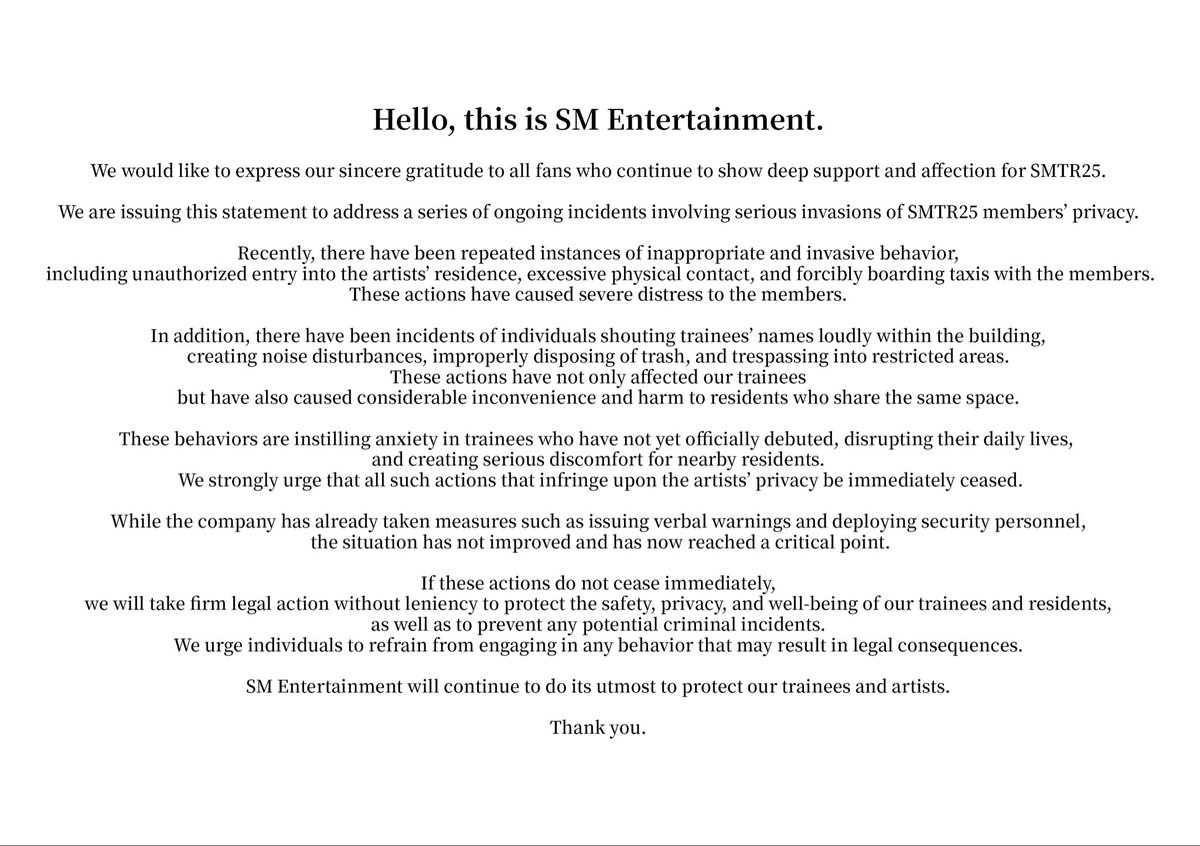

The air in Seoul’s Gangnam district is thick with more than just spring pollen this March. At the sleek, modern headquarters of SM Entertainment, a different kind of tension has crystallized into a formal, and fiercely worded, declaration of war. Not against a rival agency, but against the shadowy figures and toxic corners of fandom that threaten the very foundation of a new artist’s career before it even begins. On March 25, the industry giant released a stark statement, moving beyond the usual polite warnings to issue a direct legal threat aimed at those invading the privacy and violating the rights of its upcoming pre-debut project, SMTR25. This isn't just another agency advisory; it’s a seismic shift in protocol, a protective fortress being erected around trainees who have yet to sing their first official note.
The statement, cold and precise in its legal phrasing, paints a picture of a situation that has escalated far beyond manageable levels. It speaks of “persistent and illegal acts” including stalking, unauthorized filming, and the circulation of private information, creating an environment where the members' "basic human rights and safety are being severely compromised." For a company that has nurtured legends from H.O.T. to NCT, the decision to go public with such a severe warning for a pre-debut group is unprecedented. It signals that the traditional, often porous boundary between trainee life and public scrutiny has been violently breached, and SM is now willing to wield the full force of its legal department to rebuild it. This story is more than a press release; it's a litmus test for the entire industry's ability to protect its future stars in an era of hyper-digital obsession.
The Veil Before The Debut: Understanding SMTR25 and SM's New Era
To grasp the gravity of SM's action, one must first understand what—and who—SMTR25 represents. The project is the first major initiative under SM Entertainment’s ambitious “SM 3.0” multi-label and production center strategy, a blueprint designed to move beyond the legacy systems that defined its past. Unlike the meticulously sequenced reveals of aespa or the collective universe-building of NCT, SMTR25 has been shrouded in an almost mythic level of secrecy, punctuated by cryptic, aesthetic teasers. The name itself, a fusion of “SM” and “True,” hints at a concept centered on authenticity and raw potential, a return to core idol values in a technologically saturated landscape.
Who are the members? Officially, the public knows almost nothing. There are no confirmed names, no official profiles. Yet, this informational vacuum has become the problem. In the absence of sanctioned content, a rabid subsection of the K-Pop ecosystem has taken it upon itself to fill the gaps. Online communities and social media channels have become hubs for “pre-debut detective work,” where blurred photos from training academies, alleged school records, and grainy subway sightings are traded like currency. This has created a bizarre paradox: the members of SMTR25 are simultaneously anonymous and exposed, their private lives dissected before their artistic identities have been formed. This environment directly contradicts the “True” concept SM seems to be cultivating, forcing the agency to defend an idea of its artists before it can even present it.
A Legacy of Protection and Problem
SM Entertainment is no stranger to invasive fan behavior. Its history is, in part, a history of managing the intense, sometimes dangerous, adoration directed at its idols. From early sasaeng fans tormenting TVXQ! and Super Junior to the constant airport mobs and illegal tracking of EXO members, the agency has a long, fraught relationship with boundary-crossing. Their previous responses have typically been reactive—issuing statements after a major incident, pursuing legal action in extreme cases like stalking or assault. However, the case of SMTR25 is fundamentally different because it is preemptive and systemic.
“The company has determined that the current level of infringement has reached a point where it can no longer be ignored or addressed through standard monitoring,” the statement reads, marking a clear departure from past tactics.
This shift suggests SM has identified a new, more virulent strain of intrusion, supercharged by digital tools and decentralized online communities. It’s no longer just about individuals following a van; it’s about coordinated online efforts to doxx trainees, hack private social media, and build detailed dossiers from the scattered debris of their pre-idol lives. By acting now, SM is attempting to set a boundary in cement, not sand, for this new generation.
The Statement Decoded: More Than a Warning, A Legal Blueprint
SM Entertainment’s March 25 announcement is a masterclass in corporate legalese with a sharp edge. It moves swiftly from expression of “deep concern” to a detailed enumeration of prohibited acts, effectively serving as a public legal notice. The violations cited are specific and cover both physical and digital realms:
- Illegal Tracking & Stalking: Following members to private locations including homes, training facilities, and unofficial schedules.
- Unauthorized Recording & Distribution: Secretly filming or photographing members and sharing the content online.
- Circulation of Personal Information: The leaking or trading of private details such as real names, family information, educational history, and contact details.
- Spread of False Information & Malicious Posts: The creation and distribution of rumors, edited media, or defamatory content.
The statement explicitly notes that evidence of all such activities is being “continuously collected and archived,” indicating a sustained forensic operation is already underway. This is a crucial detail—it transforms the warning from a bluff into a demonstrable process. SM is not just threatening future action; it is documenting current crimes.

The Legal Teeth: Civil and Criminal Repercussions
The most striking portion of the document is its unequivocal declaration of intent to pursue both civil and criminal charges. This two-pronged approach is significant. Civil lawsuits can seek monetary damages for emotional distress and invasion of privacy, hitting perpetrators in the wallet. Criminal charges, which would involve reporting individuals to the police for investigation, could lead to fines or even imprisonment under South Korea’s strict stalking and defamation laws, which have been strengthened in recent years.
“We wish to make it clear that there will be no settlements or leniency regarding these matters,” the statement asserts, closing the door on the possibility of quiet payoffs or out-of-court resolutions that may have occurred in the past. This zero-tolerance policy is designed to serve as the ultimate deterrent. It also, perhaps intentionally, shifts the public narrative. By framing the issue squarely as criminal activity and human rights violations, SM recontextualizes the perpetrators from “overly enthusiastic fans” to “violators” and “criminals,” a rhetorical move aimed at delegitimizing their actions in the court of public opinion. For more on how agencies navigate protecting idols in the public eye, see our analysis on the intense scrutiny on stars' personal lives.
Fandom Fractures: The SMTOWN Divide Over Protection vs. Privacy
The reaction from the broader K-Pop community has been a complex tapestry of support, concern, and unsettling defiance. On mainstream platforms like Twitter and Instagram, the hashtag #ProtectSMTR25 quickly trended globally, with thousands of fans applauding SM’s firm stance. “This is long overdue for the entire industry,” wrote one popular fan account. “Trainees are not public property. Thank you, SM, for finally putting their safety before curiosity.” Many expressed hope this would set a new standard, encouraging other agencies to be more proactive. Comments on our own K-Beats News page reflected a deep relief, with readers noting the psychological toll such pressure can take on young artists before their debut.
However, venturing into the more niche, often anonymous online forums and messaging apps where the detective culture thrives reveals a starkly different sentiment. In these spaces, the statement was met with derision and skepticism. Some users accused SM of “bluffing” or “creating hype,” interpreting the legal threat as a morbidly clever pre-debut marketing stunt. Others defiantly posted what they claimed were new “clues” or “spoilers,” treating the warning as a challenge rather than a deterrent. This faction views the uncovering of private information as a game or a form of insider status, a perverse way to demonstrate dedication.
“If they didn’t want us to be curious, they shouldn’t have teased them at all,” argued one user on a popular forum, highlighting a toxic entitlement that equates a company’s promotional teasing with an invitation to invade privacy.
This fracture underscores the central challenge: the core audience that SM needs to cultivate for SMTR25’s success is largely supportive, but a vocal, destructive minority operating in the shadows is driving the crisis. The situation mirrors the toxic undercurrents seen in other fandom spaces, such as the allegations discussed in our report on chart manipulation and fandom warfare, where a segment of fans believes any action is justified in the name of their obsession.
Industry Crossroads: Will SM's Gambit Reshape Idol Protection?
The implications of SM’s legal ultimatum ripple far beyond the walls of its own training dormitories. Industry analysts are watching closely, recognizing this as a potential watershed moment. For decades, a dangerous, unofficial pact has existed: idols exchange a degree of privacy for fame and fan devotion. That line has been constantly redrawn, almost always moving further into the idol’s personal space. SM, by drawing such a hard line pre-debut, is attempting to reset that boundary at the very start of a group’s lifecycle.
“This is SM using its considerable market power to try and establish a new norm,” says culture critic Park Ji-won. “They are betting that by taking an extreme, public stand for a group with no commercial footprint yet, they can create a safer container for their development. If successful, it pressures every other agency to match their level of protection or risk being seen as negligent.” The move also cleverly aligns with evolving cultural and legal attitudes in South Korea regarding stalking, cyberbullying, and digital privacy.
However, the strategy is not without risk. The intense, detective-work-driven hype, while problematic, does generate early buzz and a sense of investment from a certain segment of fans. By aggressively clamping down, SM might cool some of that frenetic, pre-debut energy. Furthermore, the agency must now follow through. If violations continue and no high-profile legal actions materialize, the statement will be seen as an empty threat, potentially emboldening offenders and undermining SM’s authority for all its artists. The precedent set here will be closely studied by every major agency, from HYBE to YG Entertainment, as they manage their own new generation of talent in an increasingly invasive digital world. This moment reflects a broader industry evolution, similar to groups like WEi strategically shifting to individual promotions to manage longevity and member well-being.
The Road to "TRUE": What Comes After the Warning?
So, where does SMTR25 go from here? The immediate path is fraught but clear. SM’s legal and security teams are now publicly on high alert, likely working in tandem with cybersecurity firms and private investigators. The first test will be if the agency makes good on its threat by identifying and prosecuting a violator, setting a concrete example. The debut timeline for SMTR25, presumably later this year for their 2025 namesake, will now unfold under this unprecedented shield of explicit legal protection.
The long-term success of this gambit, however, will be measured in the mental and professional health of the SMTR25 members themselves. Can they train and eventually perform without the paranoia of hidden cameras and leaked conversations? Will this protected space allow the “TRUE” concept to flourish authentically, or will the debut itself feel like a reaction to this pressure? The narrative surrounding their first introduction to the world is now irrevocably tied to this battle for their private selves.
Ultimately, SM Entertainment’s stand is a reflection of a changing industry. It acknowledges that the tools of fan obsession have evolved, and so must the tools of protection. This is not just about safeguarding SMTR25; it is about reclaiming a degree of agency in the artist-fan relationship that has been eroding for years. The message is for the violators, for the industry, and for the fans who genuinely care: the era of passive tolerance is over. The journey to debut should be one of preparation and dream-building, not of evasion and fear. As the K-Pop world watches, SM has staked its reputation on ensuring that for SMTR25, the story that breaks first is not a scandal, but their music. For insights into how groups build their artistic identity in a high-pressure environment, explore our piece on Xdinary Heroes' innovative approaches to music and concept.
The spotlight on our Artists page will soon, rightfully, shine on SMTR25’s talents and performances. SM Entertainment’s hope is that when it does, the shadows lurking at its edges will have been chased away by the very real prospect of legal consequence, allowing a new “True” story to finally begin.