
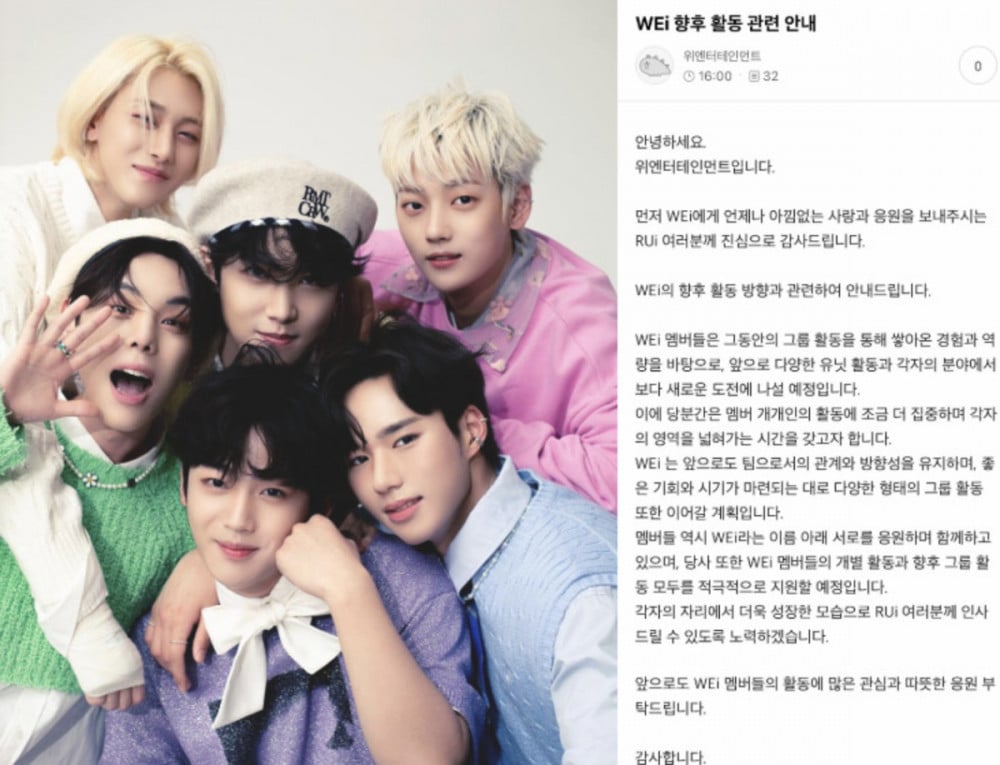
The familiar rhythm of the K-Pop industry—comeback, promotion, fan meeting, repeat—has been deliberately interrupted for one particular group. In a move that has both surprised and intrigued observers, OUI Entertainment announced on March 25 that the boy group WEi will be focusing on individual member activities for the foreseeable future, putting a pause on full-group comebacks. This is not a hiatus announcement laden with military enlistment schedules, nor is it a reaction to public scandal. Instead, it presents a calculated, potentially pioneering strategy for a group positioned in the crucial mid-tier of the fourth-generation boy band scene.
For the fandom, RUi, the news is a double-edged sword: excitement for solo endeavors mingles with anxiety over the group’s long-term cohesion. For industry watchers, it raises compelling questions about sustainable idol career paths in an era defined by constant content saturation and the relentless pressure to “break through.” Is this a savvy adaptation to a changing market, or a risky gambit that could dilute the group’s hard-earned identity? This deep dive goes beyond the official statement to explore the context, implications, and potential futures for WEi and the groups navigating similar waters.
From Produce to "WEi": The Forged Identity of a Survival Show Symphony
To understand the significance of this shift, one must first appreciate the unique fabric of WEi. The group’s story is inextricably woven from the threads of K-Pop’s survival show era. Each member arrived at their 2020 debut under the WEi banner with pre-existing narratives and fanbases. Leaders Jang Dae-hyeon and Kim Dong-han had already launched solo careers, with Dong-han in particular making waves as a solo artist after his win on “The Unit.” Kim Yo-han, the group’s center, carried the immense popularity of being a finalist and the original X1 center from the seismic “Produce X 101.”
This presented both an immense advantage and a classic challenge. The group debuted with a built-in level of attention few rookie groups enjoy. Their first mini-album, “IDENTITY : First Sight,” was a statement of intent, introducing a versatile, self-producing image. Over subsequent releases like “IDENTITY : Challenge” and “Love Pt.1 : First Love,” they cultivated a signature sound that blended bright, melodic pop with harder-hitting performance tracks, all while increasingly contributing to songwriting and production.
WEi’s journey has been one of consolidation—melding distinct survival show star power into a unified group identity. They’ve built a respectable discography, cultivated a loyal international fandom, and established themselves as compelling performers. Yet, like many groups of their generation, they operate in the shadow of titanic chart dominators and face the relentless pressure to secure a “winning formula” that guarantees a leap to the next tier. This context is essential for decoding OUI Entertainment’s latest strategic play.
The OUI Blueprint: Nurturing Individuality Within a Group
OUI Entertainment’s approach has often emphasized member individuality. Unlike agencies that maintain strict “group-first” uniformity for years, OUI has gradually allowed WEi members to stretch their solo wings. Kim Yo-han’s successful forays into acting (“A Love So Beautiful,” “School 2021”) and MCing, Kang Seok-hwa’s musical theatre roles, and Kim Dong-han’s continued solo music work have run parallel to group activities. This agency history makes the current announcement feel less like an abrupt halt and more like an acceleration of an existing philosophy.
“The members of WEi will be focusing on individual activities, such as acting, variety, and solo music releases, to show their diverse charms and accumulate deeper individual experiences,” the agency stated. “This period is for the growth of each member, which will ultimately strengthen WEi as a whole in the future.”
This rationale frames the move not as a step back, but as a strategic investment. The theory is clear: by elevating each member’s public profile and skillset independently, the group’s collective brand power and creative reservoir will be enriched when they reunite. It’s a patient, long-game approach in an industry notorious for its short-termism.
Decoding the Announcement: A Tactical Retreat or a Diversified Advance?
The official announcement, while straightforward, leaves room for interpretation. The phrase “for the time being” offers flexibility but little concrete timeline, a common yet anxiety-inducing industry tactic. The specified activities—acting, variety, solo music—are notably broad, suggesting tailored paths for each member rather than a one-size-fits-all hiatus.

For Kim Yo-han, this likely means a deeper immersion into his acting career, potentially securing a leading role in a major drama. For main vocalist Kim Dong-han and leader Jang Dae-hyeon, both proven songwriters, it could mean dedicated solo albums that explore musical directions outside WEi’s group sound. For the group’s performance anchors like Yong-ha and Jun-seo, opportunities in musical theatre, dance shows, or variety could be on the horizon. This individual-focused period mirrors, on a smaller scale, the strategic diversification seen with top-tier groups like BTS and Got7, whose members’ solo successes have massively amplified the group’s overall legacy and resilience.
However, the risk is palpable. The K-Pop memory is fickle, and group momentum can be fragile. As explored in our analysis of The "Bittersweet" Gamble: Inside Baby DONT Cry's Risky Rebrand, navigating an identity shift in the crowded fourth-generation field is fraught with peril. Can WEi’s group identity remain salient in the public consciousness while its members are scattered across different entertainment sectors? The answer may lie in how effectively OUI manages the narrative and maintains connective tissue with fans.
The RUi Pulse: Anxiety, Hope, and the Promise of "Solo-Cation"
Fan reaction, as tracked across social media platforms, fan cafes, and community forums like our News page discussions, is a study in nuanced conflict. The dominant emotion is a cautious optimism, tinged with a protective fear.
“I’ll miss them as a group terribly, but I’ve been wanting a proper solo album from Dong-han for ages,” shared one longtime RUi on Twitter. “If this means he gets to fully showcase his artistry, I can be patient.” This sentiment is echoed by many who see untapped potential in specific members. The announcement has sparked what fans are jokingly calling a “solo-cation” era, with elaborate fan projects already being planned to support each member’s individual endeavors.
Yet, the anxiety is equally present. “I hope this doesn’t become a permanent state,” commented another fan on an online forum. “We’ve seen groups announce a ‘short break for individual activities’ that never truly recover their synergy or schedule.” This fear is rooted in precedent. The K-Pop landscape is littered with groups whose “temporary” focuses on solo work inadvertently led to de facto disbandment as member careers diverged.
Furthermore, for a fandom built around the group’s dynamic, the shift requires a logistical and emotional adjustment. Instead of pooling resources for one comeback, RUIs may need to split support across multiple solo debut albums, acting role promotions, and variety show appearances. This tests the cohesion and economic capacity of the fandom itself. The situation recalls the fanbase fractures and strategic challenges discussed in The Reverse Stream, albeit on a different scale, where supporting multiple fronts becomes a complex fandom operation.
A Test of Fandom Loyalty and Structure
This period will serve as a rigorous stress test for the RUi fandom’s structure. Will fanbases unite to support all members equally, or will they splinter into individual member-centric units? OUI Entertainment’s challenge will be to ensure transparent communication and balanced opportunities to prevent intra-fandom rivalry. The agency’s ability to stage regular, meaningful group interactions—even simple live streams or special photo releases—during this period will be critical in keeping the collective flame alive.
Industry Lens: The Fourth-Gen Crossroads and the Search for Sustainability
WEi’s strategic pivot is a microcosm of a larger evolution within the fourth-generation boy band industry. The traditional model of relentless back-to-back group comebacks is proving unsustainable for many groups outside the absolute top tier, both financially and creatively. The market is oversaturated, and the pathways to mainstream recognition have multiplied and fragmented.
In this environment, investing in individual member brands is not just an artistic choice; it’s a potential economic imperative. A successful actor or variety star in the group can bring in new revenue streams and, more importantly, attract new audiences to the group’s music—a reverse gateway effect. This “all-fronts” approach to building celebrity is becoming a hallmark of the modern idol career, as groups seek resilience in a volatile industry. It aligns with a broader trend of idols redefining their playbooks, much like the sonic deconstruction attempted by bands such as Xdinary Heroes in their 'X room' project.
Furthermore, for a group like WEi with members possessing strong pre-debut identities, this strategy leverages their unique history rather than suppressing it. It acknowledges that in today’s K-Pop ecosystem, a group’s strength can be a composite of powerful individual reputations. This period of individual focus can help each member shed the “former survival show contestant” tag and build a more mature, standalone artistic profile.
The risk for the industry at large, however, is a gradual erosion of the “group” magic that defines K-Pop. If too many mid-tier groups adopt this model simultaneously, it could signal a shift away from the intensely synchronized, unit-focused philosophy that has been K-Pop’s global calling card. The balance between individual expression and group synergy is becoming the central creative and commercial tension for this generation.
Navigating the "Mid-Tier" Challenge
WEi sits at a critical juncture familiar to many groups on our comprehensive Artists page: they have surpassed rookie status, built a stable fandom, and demonstrated quality, but have yet to score that breakout, culture-defining hit. The “mid-tier” is a challenging space where resources must be deployed with maximum cleverness. OUI’s gamble is that diversifying assets (the members) will yield a higher collective return than continuing to concentrate them in periodic group promotions. It’s a bold experiment in portfolio management, applied to idol careers.
The Road Ahead: Reunion Speculation and a Redefined WEi
All eyes now turn to the horizon. The most pressing question is not *if* but *how* WEi will reconvene. The success of this strategy will be judged by the quality and impact of their next group comeback. Will it be a mere return to form, or will it be a transformative event enriched by the members’ solo journeys?
We can speculate that the next WEi album may feature subunit tracks born from new creative partnerships discovered during this period, or solo tracks seamlessly integrated into a group format. Lyrically and conceptually, it could be their most mature work yet, reflecting personal growth. The members’ experiences—whether facing a drama set’s pressure, composing alone in a studio, or bantering on a variety show—will inevitably feed back into the group’s dynamics and performance depth.
The ultimate hope, for fans and the agency alike, is that this period creates a “rising tide lifts all boats” effect. A breakout acting role for one member, a viral solo song for another—these individual sparks could dramatically raise the group’s overall public recognition, making their reunion a major event rather than a routine comeback. This aligns with the industry’s increasing recognition of idols as multi-hyphenate artists, a theme even visible in fashion symbolism, as discussed in our feature Beyond the Line: How Stripes Became K-Pop’s Most Potent Symbol, where individual expression within a uniform becomes a powerful metaphor.
In conclusion, WEi’s move is a fascinating case study in modern K-Pop group management. It is a rejection of stagnation in favor of a potentially riskier, but more dynamic, growth model. It places immense faith in the individual talents of its members and the loyal patience of its fandom. While the specter of missed momentum looms, the promise of a more resilient, versatile, and artistically rich group shines as a compelling counter-argument. The journey of WEi is no longer just about their next music video; it’s about six parallel storylines, unfolding independently, with the promise of converging into a future chapter that is greater than the sum of its parts. The industry, and RUi, will be watching closely.