
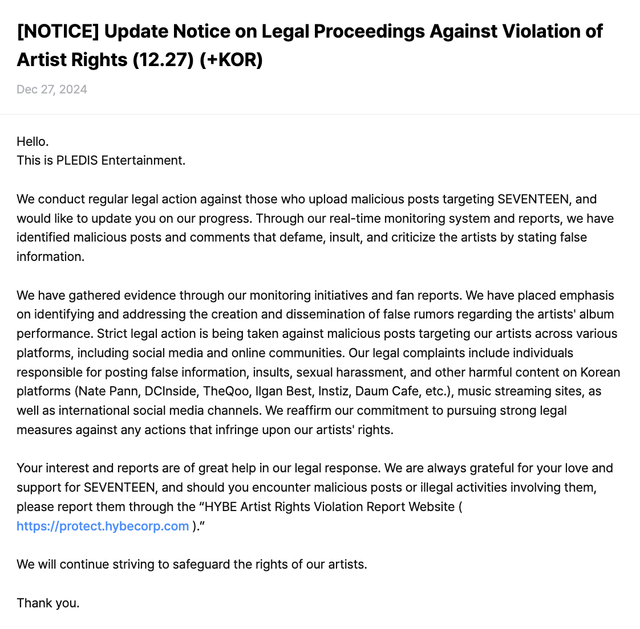

The notice, posted quietly on a Saturday afternoon, was a masterclass in corporate understatement. Yet, for the millions who compose the global fandom of SEVENTEEN, PLEDIS Entertainment's March 30th legal update was a thunderclap. It wasn't just an announcement of ongoing lawsuits; it was a declaration of a new, fortified era. As the K-Pop industry barrels toward a pivotal horizon in 2026—a year marked by contract renewals, impending military enlistments for older members, and peak global ascendancy for the group—PLEDIS is not merely playing defense. It is constructing a legal and strategic fortress, and the blueprints are now public.
This move transcends the typical "we are taking strong action" boilerplate that fans have grown accustomed to. It is a detailed, preemptive, and shockingly transparent roadmap of protection. It reveals an agency on a war footing, battling on multiple fronts: from malicious commenters and stalkers to intellectual property thieves and speculative rumor mills. For industry watchers, this is a case study in how a top-tier agency plans to shield its most valuable asset during the most vulnerable transition period any modern K-Pop group faces. The message is clear: PLEDIS intends for SEVENTEEN to not just survive the coming years, but to thrive, insulated from the chaos that has consumed other giants at similar crossroads.
The Foundation: From Trainee Debt to Defining an Era
To understand the gravity of PLEDIS's current legal offensive, one must first appreciate the unique journey of SEVENTEEN and their symbiotic, sometimes tumultuous, relationship with their agency. Debuting in 2015 under a PLEDIS still reeling from financial instability and the departures of key artists, SEVENTEEN famously shouldered the weight of their own pre-debut costs. This "self-producing" ethos wasn't just musical; it was existential. Their climb was steep, built on relentless performance, a revolutionary unit system, and a fanbase, CARATs, forged in shared struggle.
Their first contract renewal in 2021 was a landmark moment of unity, with all thirteen members re-signing. This wasn't just a business decision; it was a powerful statement of trust and shared vision. It solidified SEVENTEEN not just as performers, but as stakeholders and partners in the PLEDIS empire, which had by then become a powerhouse label under the HYBE umbrella. This context is crucial. The legal actions of 2026 aren't being taken on behalf of employees in a traditional sense. They are being executed in defense of core partners and the foundation of HYBE's album-sales juggernaut. The agency is protecting its past investment and its future, knowing that the group's stability is paramount as they navigate the complex logistics of member enlistment and sustained global promotion.
This proactive stance stands in stark contrast to the reactive, often messy legal battles seen elsewhere in the industry. It reflects lessons learned from a decade of observing how scandals, rumors, and invasions of privacy can derail even the most promising careers.
The Precedent of Turbulence: Learning from Industry Scars
The K-Pop landscape is littered with examples of what happens when agencies are slow to act. Defamation campaigns have damaged mental health, stalkers have crossed terrifying lines, and intellectual property leaks have undermined major comebacks. PLEDIS's detailed notice suggests a studied awareness of this history. They are not waiting for a crisis to erupt; they are systematically fortifying the walls. This shift from reactive to preemptive legal strategy may become the new standard for top-tier groups, much like the now-commonplace use of bodyguards and privacy screens. It acknowledges that in the digital age, the threats are constant, sophisticated, and scalable.
Decoding the Legal Battlefield: A Multi-Front Campaign
PLEDIS's notice meticulously outlines several distinct theaters of operation. This isn't a single lawsuit; it's a coordinated campaign.
Frontline 1: The War on Malicious Posts and Defamation
The agency reported filing multiple criminal complaints against individuals for "writing malicious posts based on groundless information" and "defaming artists' character." The key term here is "criminal complaint." This moves beyond civil suits for damages. PLEDIS is pushing for state prosecution, which can result in criminal records and more severe penalties for perpetrators. They specifically cite violations of the Act on Promotion of Information and Communications Network Utilization and Information Protection (the infamous "Malicious Comments Act") and criminal defamation under the Penal Code.

"We have recently filed additional criminal complaints with the investigative agency against the perpetrators of malicious posts that were collected through our monitoring," the notice states, emphasizing a continuous, evidence-gathering process rather than a one-off action.
This signals a dedicated, in-house or contracted monitoring team that scours forums, social media, and comment sections—a digital sentry system working 24/7 to identify threats before they spiral.
Frontline 2: Stalking and Invasion of Privacy: Zero Tolerance
In perhaps the most chilling section, PLEDIS addresses "stalking and other acts that invade the privacy of artists." They confirm that police reports have been filed and investigations are ongoing. The stalking phenomenon in K-Pop has evolved from airport chases to sophisticated tracking of schedules, hotel bookings, and even family members. By publicly stating actions are being taken, the agency serves a dual purpose: it warns potential stalkers of consequences, and it reassures the fandom that artist safety is a non-negotiable priority. This is a direct response to the increasing normalization of invasive behavior disguised as fandom, a topic we've explored in investigations into backstage chaos and boundary violations.
Frontline 3: Protecting Intellectual Property and Curbing Speculation
This is where the notice looks furthest ahead. PLEDIS warns against the "unauthorized use of intellectual property" and the "infringement of portrait rights and copyrights." In the lead-up to 2026, unauthorized merchandise, speculative "renewal rumor" videos using copyrighted footage, and leaks will be prime targets. Furthermore, they explicitly condemn the "creation and dissemination of groundless information," including "false schedules and speculative articles." This is a preemptive strike against the media frenzy and fan speculation that will inevitably surround enlistment orders and contract discussions, aiming to control the narrative and reduce ambient noise and stress for the artists.
A Fandom's Mixed Relief: CARATs Weigh In
The reaction from CARATs has been a complex blend of gratitude, anxiety, and fierce pride. On social media platforms like Twitter and Weverse, the dominant sentiment is one of support for the agency's strong stance. "Finally, they're putting their foot down," one fan tweeted, garnering thousands of likes. "We've reported so many malicious accounts for years. Seeing this official action feels like validation."
Many have expressed relief, particularly regarding the anti-stalking measures. "Knowing they're actively protecting them from intruders lets me sleep a little easier," commented a fan on an online forum. This protective instinct from the fandom mirrors the agency's own, creating a unified front against external threats.
However, intertwined with the support is a palpable undercurrent of anxiety. The notice, for all its reassurances, is a stark reminder of the pressures and dark sides of fame that SEVENTEEN endures. It has also sparked deeper conversations about the 2026 horizon. Fans are connecting the dots, discussing how this legal "fortress" is meant to create a stable environment for the members as they make deeply personal decisions about their futures. The mood reflects a fandom that is both fiercely protective and realistically apprehensive, a dynamic not unlike the emotional spectrum witnessed during NCT Dream's own period of contractual and existential uncertainty.
Notably, the discourse has remained largely focused on artist well-being, a credit to the mature relationship between SEVENTEEN and CARATs. Unlike scandals driven by dating rumors, such as the frenzy that followed a certain clip involving an ENHYPEN member, this conversation is rooted in a collective desire for safety and longevity.
Industry Shockwaves: Redefining the Agency Playbook
Within the industry, PLEDIS's notice is being dissected as a potential new benchmark. "This is next-level crisis management, but it's happening before the crisis even hits," remarked an anonymous industry PR consultant. "They're publicly demonstrating their capability to protect, which is a message to the artists, the fans, and competitors."
The strategy carries significant financial and reputational implications. First, it represents a substantial ongoing investment in legal teams, monitoring software, and security personnel. This is only feasible for a label with the resources of HYBE, underscoring the growing divide between mega-labels and smaller agencies. Second, it proactively manages investor confidence. By showing a meticulous plan to safeguard their key revenue driver, PLEDIS and HYBE assure shareholders of risk mitigation ahead of a volatile period.
Most importantly, it sets a new tone for artist-agency relationships. In an era where artists are more empowered than ever, agencies must prove their value beyond just booking schedules. PLEDIS is positioning itself not as a controller, but as a guardian and enabler. This builds immense internal goodwill with the artists, fostering the kind of trust that leads to renewed contracts. It is the opposite of a short-term, exploitative approach; it is a long-term partnership strategy written in legal briefs. This forward-thinking approach to artist welfare and career trajectory is becoming a critical differentiator, as the industry slowly moves past archaic systems that have led to burnout and conflict.
The 2026 Pivot: A Industry-Wide Test Case
All major third-generation boy groups are approaching a similar cliff edge of enlistment and career evolution. How PLEDIS navigates this for SEVENTEEN will be a case study for the entire industry. Their legal strategy is just one pillar of a larger plan that likely includes meticulously staggered enlistments, subunit activities, solo projects, and group comebacks during downtime. The public legal action serves to clear the field of distractions, allowing this complex logistical machinery to operate smoothly. If successful, it could provide a blueprint for how to maintain momentum, relevance, and fan engagement through a group's mandatory service period—a challenge that has diminished the reach of many prior acts.
The Road to 2026 and Beyond: A Fortress Built for the Future
So, what comes next? The notice concludes with a standard but firm warning that PLEDIS will "continue to take strict measures without any leniency or settlement." This is not a one-off purge; it is a permanent state of vigilance. Fans can expect a steady, if behind-the-scenes, drumbeat of legal updates as cases progress through the system.
For SEVENTEEN themselves, this ecosystem of protection is designed to grant them something invaluable: clarity and space. Space to focus on their upcoming musical projects, like their impending world tour and inevitable comebacks. Space to contemplate personal and group decisions without the cacophony of toxic noise. Space to simply breathe as they enter their late twenties and thirties, navigating adulthood in the blinding public eye. This legal framework is, paradoxically, meant to give them back a degree of privacy and normalcy.
The ultimate goal is clear: to ensure that when 2026 arrives, the story is not one of chaos, speculation, or fragmentation, but one of managed transition and continued excellence. PLEDIS is betting that by securing the perimeter today, they guarantee that SEVENTEEN's legacy—and their active, dominant career—continues for decades to come. It is the most concrete investment imaginable in the group's future, a declaration that the story of these thirteen artists is far from over. As the industry watches, this legal war room may well be writing the first chapter of K-Pop's next mature era, where protection is as pivotal as promotion. For the latest on SEVENTEEN's journey and all K-Pop news, follow our continuous coverage on our News page and explore profiles of your favorite artists on our Artists page.