
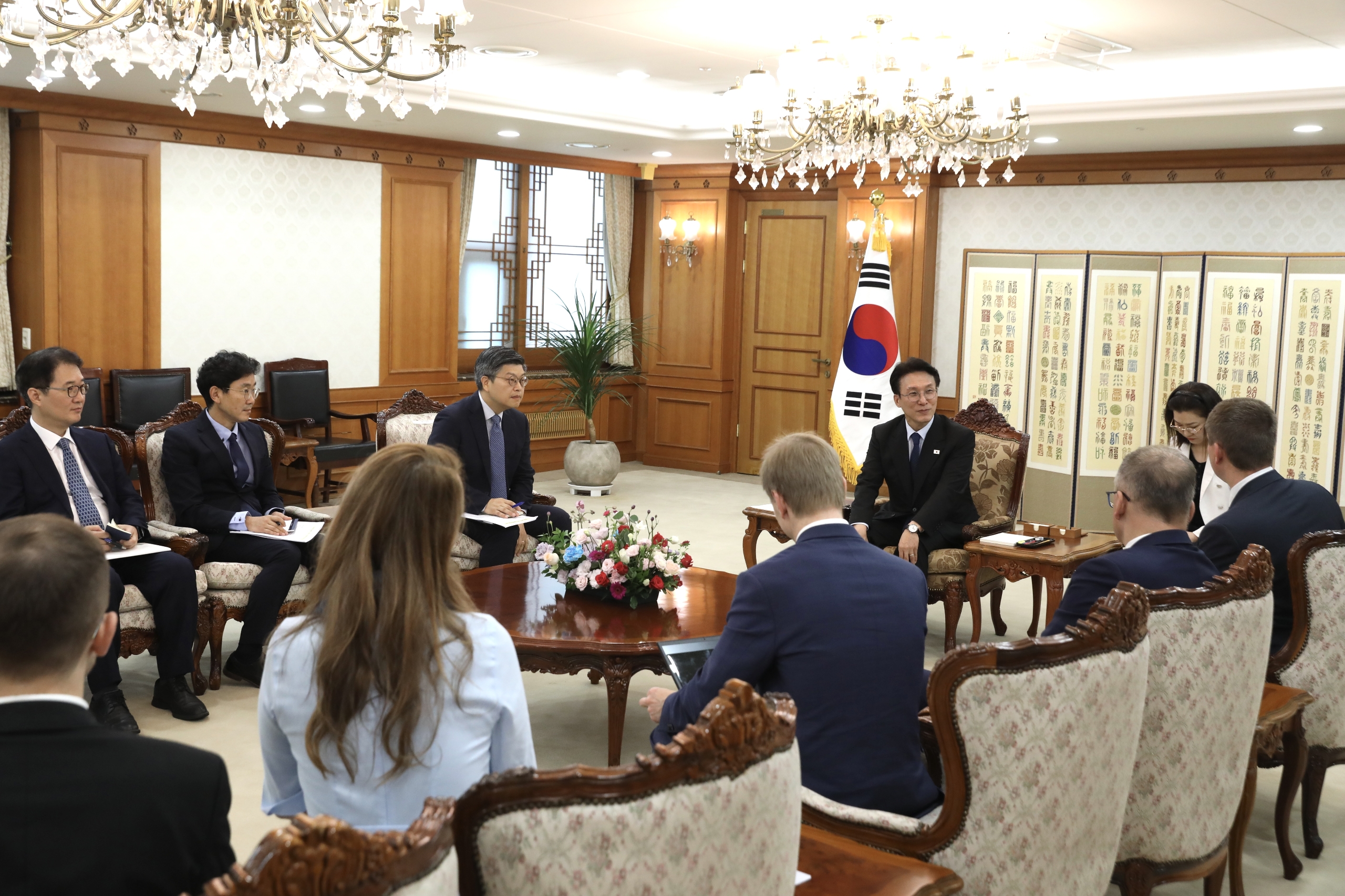

The world of K-Pop is no stranger to viral moments. A fancam, a wardrobe malfunction, a surprise interaction between idols—these are the currencies of daily online discourse. But rarely does a single, seemingly innocuous photograph ripple outward from fan forums and into the halls of political power, forcing an industry and its audience to confront a question it often dances around: What is the true societal weight of a K-Pop idol? This week, that question became unavoidable when a crisp, official photograph from a Ministry of Culture, Sports and Tourism event surfaced, placing Mamamoo's Moonbyul not amongst her fellow artists, but standing calmly beside South Korea's Prime Minister, Han Duck-soo.
The Image That Broke the Timeline
It was not a paparazzi shot from a back alley or a blurry fan capture. This was an official government release—a high-resolution image of a dignified cultural forum on creative industry exports. In a row of suited officials, academics, and veteran film producers, Moonbyul’s presence was both perfectly logical and utterly jarring. Dressed in a sharp, tailored pantsuit, her signature platinum blonde hair styled elegantly, she appeared less the charismatic idol who commands stadiums and more a poised cultural ambassador. The internet, predictably, split at the seams. The photograph did not show her singing or dancing; it showed her listening, engaged in a conversation about national soft power. For a fanbase accustomed to seeing their idols in highly controlled, performance-oriented contexts, this was a paradigm shift. It was a visual confirmation that the artists they champion have graduated to a different tier of recognition—one that carries a different kind of responsibility and scrutiny.
The event, as later detailed by both the Prime Minister's office and RBW (Mamamoo's agency), was the "Future Vision Forum for Hallyu Sustainability." Moonbyul had been invited not merely as a popular celebrity, but specifically for her insights as a successful female solo artist and a key member of a veteran group with proven longevity, a rarity in the fast-paced idol industry. Her perspective on artist autonomy, fan engagement over a decade-long career, and the creative process was deemed valuable to policymakers. Yet, this context was lost in the initial tidal wave of reactions, which focused purely on the symbolic power of the image itself.
Moonbyul and Mamamoo: A Foundation Built on Defiance and Authenticity
To understand why this moment resonates so deeply, one must understand Moonbyul's and Mamamoo's unique trajectory. Debuted in 2014 under the then-small company RBW, Mamamoo carved their path not through conformity, but through exceptional vocal prowess, bold stage presence, and a reputation for genuine, unscripted interaction. They were never the "manufactured" archetype; they were musicians first. Moonbyul, as the main rapper and dancer, further defied stereotypes. In a landscape where female idols often face restrictive labels, she built a formidable solo career with a distinct androgynous, charismatic style, commanding respect for her songwriting and production credits.
This history of authenticity is crucial. When fans defend Moonbyul's place at that forum, they point to her artistic credibility. She wasn't there as a fleeting "It" girl; she was there as a seasoned professional with eight years of industry survival and evolution. This is a group that has openly discussed creative burnout, the pressures of fame, and the struggle for artistic control—themes that align surprisingly well with a forum on sustainable cultural growth. Their career offers a case study in navigating the pitfalls of Hallyu fame, a point not lost on the forum's organizers. For a deeper look at how veteran artists navigate public scrutiny, our analysis of BTS's own candid revelations in "The Weight of the Diadem" provides compelling parallels.
From Stage to Summit: A Calculated Invitation
Industry insiders suggest this invitation was neither random nor purely ceremonial. "The government has long wanted to tap into the practical, ground-level knowledge of artists who've survived past the typical seven-year curse," says a cultural commentator who requested anonymity due to ongoing government contracts. "They're tired of only hearing from agency CEOs. They want the performer's perspective on intellectual property, international touring logistics, and mental health. Moonbyul, especially with her solo work, represents a model of artist-led content creation that the ministry wants to encourage."
This shift signifies a maturing of the government's approach to Hallyu. No longer just a flashy export, it's being treated as a complex ecosystem with workforce issues, ethical concerns, and long-term strategic needs. Having an idol in the room, especially one known for her thoughtful demeanor off-stage, bridges a massive gap between policy and practice. You can explore more about the artists shaping this ecosystem on our comprehensive Artists page.
Decoding the Digital Firestorm: Pride, Politics, and Purism
The fan and public reaction was a masterclass in modern digital sociology, fracturing along several distinct lines.

The "Proud Moomoo" Brigade
For Mamamoo's fandom, Moomoos, the reaction was initially one of unadulterated pride. Hashtags like #문화권위자문별 (Culture Authority Moonbyul) and #문별총리옆 (Moonbyul Next To Prime Minister) trended domestically. Fan art depicting Moonbyul in statesman-like poses flooded Twitter.
"This is what happens when you invest in artists with brain and talent, not just faces. She wasn't a prop; she was a participant. My bias is helping shape national cultural policy, and I've never been prouder,"wrote a prominent fanbase account. This segment viewed the event as the ultimate validation of their artist's hard work and intelligence, a transcendence beyond the idol label.
The Critical Consensus and Political Anxiety
However, a significant counter-narrative emerged from netizens outside the fandom and even from some within it. Concerns were raised about the implicit endorsement of a political administration. "Idols should remain politically neutral," became a common refrain. In Korea's intensely partisan climate, any perception of alignment can be dangerous. Critics questioned whether this blurred the line between celebrity and state endorsement, potentially alienating fans of opposing political views. This taps into a broader, ongoing debate about the boundaries of an idol's public role, a tension we explored when an audience member's actions at an IVE concert exposed the fragile social contract within fandom spaces.
The Analytical Lens: Semiotics of the Photo
A third group, comprising media analysts and older fans, dissected the symbolism. "The photo is a powerful piece of visual rhetoric," notes Professor Kim Seo-yeon, a specialist in media studies. "It consciously places K-Pop—often still dismissed as 'teenager music' by older generations—within the sanctified space of governance. The message is clear: this industry and its stars are national assets on par with traditional arts. For Moonbyul, it re-frames her public image from 'idol' to 'cultural representative.' This carries immense prestige but also immense risk. She is now accountable to a wider public, not just her fans."
Industry Ripples: Precedent, Power, and the New Playing Field
The implications of this event for the K-Pop industry are multifaceted and profound.
1. Setting a New Precedent: While groups like BTS have met with presidents and addressed the UN, those were often framed as mega-star exceptions or specific diplomatic envoys. Moonbyul's presence was quieter, more integrated. It suggests a pathway for other respected, veteran idols to be consulted in a professional capacity, not just paraded as trophy celebrities. This could open doors for artists to influence copyright law, mental health support systems, and fair wage practices from the inside.
2. The Double-Edged Sword of Legitimacy: The industry has craved this kind of institutional recognition for decades. However, with it comes heightened scrutiny and expectations. If idols are to be treated as cultural ambassadors, their actions, both public and private, will be judged against that standard. A scandal involving an artist in such a position could damage not just their career, but the perceived integrity of the entire cultural export project. The pressure is immense, as seen when even veteran celebrities face unforgiving criticism, similar to the sustained scrutiny explored in our case study on Song Ji Hyo's "Running Man" journey.
3. Redefining the Idol Career Arc: This event paints a picture of a viable "post-idol" future that isn't just acting or variety shows. It suggests a career arc that can evolve into advocacy, policymaking, or cultural diplomacy. This could change how young trainees and their families view the profession—not as a short-lived flash of fame, but as a potential springboard to lasting, impactful careers in the creative economy.
The Government's Hallyu 3.0 Strategy
Analysts reading the latest policy briefs on our News page see this as a hallmark of "Hallyu 3.0," a government strategy moving beyond simply promoting content to actively structuring and protecting the industry that creates it. "They are building infrastructure," says industry reporter Park Ji-min. "Including idols like Moonbyul is a way to gather actionable data, but it's also a signal to the domestic establishment that these artists are serious stakeholders. It's an attempt to normalize K-Pop's success within Korea's own cultural hierarchy."
What Comes After the Photo Op? The Road Ahead for Moonbyul and K-Pop
The forum is over. The photo is immortalized. The question now is: what changes?
For Moonbyul, her immediate path likely returns to the familiar: preparing for Mamamoo's promised group activities and her own solo work. However, the lens through which she is viewed has permanently altered. She may face more invitations for serious commentary, not just variety show appearances. Her words will carry new weight. The challenge will be navigating this without losing the authentic connection with fans that forged her path. It is a tightrope walk between authority and accessibility.
For the industry, this event is a benchmark. Other agencies will now likely lobby for their mature, articulate artists to receive similar opportunities. We may see a new genre of "idol-consultant" emerge. Furthermore, it places a subtle pressure on artists to be more informed about the broader business and cultural landscape they operate within. Ignorance is no longer an option when you might be asked for your opinion by a cabinet minister.
Ultimately, the photograph of Moonbyul and the Prime Minister is more than a curious news blip. It is a snapshot of a cultural moment in transition. It captures the precise instant where K-Pop's overwhelming commercial and global power is being formally—and awkwardly—invited to sit at the domestic table of power and planning. The reactions, from pride to panic, simply prove how unprecedented this moment is. The idol, long confined to the stage, the screen, and the fan's dream, has stepped into the spotlight of civic responsibility. The nation is watching to see what she, and the industry she represents, will do next. As one viral tweet succinctly put it: "They used to tell us to turn down the music. Now they're asking us how to build a better stereo system for the whole world to hear." The volume, it seems, is only going up.