
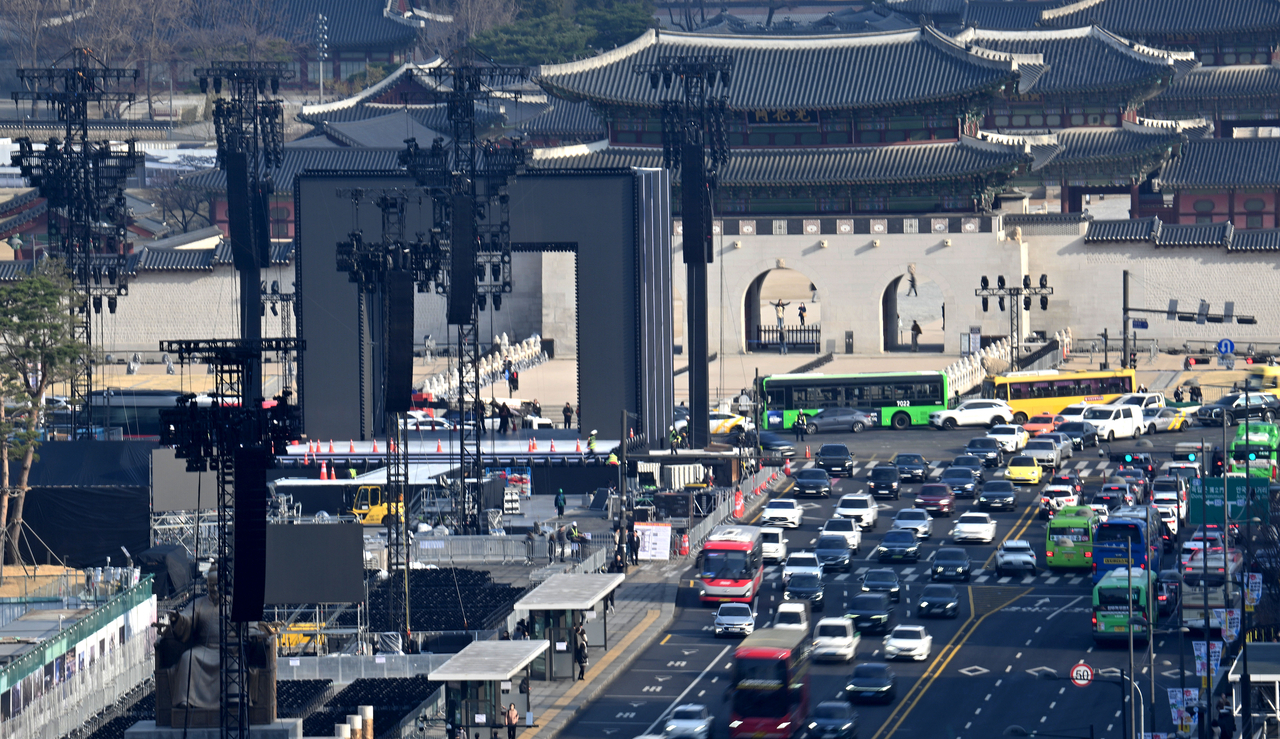

The scene in Gwanghwamun Square last Tuesday was one of pure, unadulterated euphoria. Tens of thousands of ARMY, BTS's global fanbase, painted the historic plaza in a sea of Borahaegae purple, their collective voice rising to meet the Seoul sky as BTS performed their first public comeback stage in years. Yet, just blocks away, a starkly different reality unfolded: subway stations locked down, buses rerouted into incomprehensible labyrinths, local businesses shuttered not by choice but by necessity, and residents trapped in their own neighborhoods. What was designed as a celebratory landmark event for K-Pop's standard-bearers swiftly escalated into a civic event of such overwhelming scale that it has ignited a fierce and complex debate, one where netizens and media outlets have invoked a startling and somber comparison: the martial law shutdowns of South Korea's authoritarian past.
This is not a story merely about traffic jams or concert crowds. It is a profound examination of what happens when the gravitational pull of a cultural phenomenon like BTS collides with the day-to-day machinery of a megacity. The list of disruptions, meticulously catalogued online, reads like a civic emergency report: the virtual paralysis of one of Seoul's most critical administrative and commercial hubs. The ensuing conversation has moved far beyond typical fan excitement, probing deep questions about public planning, the limits of fandom density, and the historical weight we assign to communal spaces. At its heart, the Gwanghwamun comeback has become a mirror, reflecting both the dazzling height of Hallyu's power and the daunting logistical shadows it casts.
A Plaza of Patriots and Performers: Gwanghwamun's Dual Identity
To understand the magnitude of last week's event, one must first understand Gwanghwamun itself. This is not simply a large square; it is the symbolic front yard of Korean nationhood. Framed by the Gyeongbokgung Palace gates, statues of Admiral Yi Sun-sin and King Sejong the Great, and leading directly to the Blue House, it is a space reserved for history, protest, remembrance, and national ceremony. It is where citizens gather to mourn tragedies, demand political change, and celebrate sporting victories. Its use for a K-Pop comeback stage—while not unprecedented—immediately layers any event with a significance beyond entertainment.
BTS's relationship with this plaza is itself storied. From early busking events to the triumphant "BTS MUSTER" gatherings and their iconic "Arirang" performance that bridged traditional and modern Korea, as explored in our analysis The ARIRANG Anomaly, the group has repeatedly used this space to cement their connection with both fans and the national narrative. Each appearance has been larger, more complex, and more impactful than the last, building towards an inevitable crescendo. Their latest comeback, following the members' gradual return from mandatory military service, was always destined to be a historic moment of reunion and reaffirmation. The choice of Gwanghwamun was a powerful statement: BTS is back, not just on charts, but in the heart of the nation's public consciousness.
The Weight of the Wait: A Fandom at Fever Pitch
The context of military enlistment cannot be overstated. For ARMY, a fandom that sustained its global presence through members' solo projects, this was the long-awaited moment of full-group return. The pent-up demand was astronomical, transforming what would already be a major event into a global pilgrimage. Fans from across Korea and around the world descended upon Seoul, many without tickets to the tightly controlled square event, hoping simply to be in the vibrational radius of the moment. This created a secondary, diffuse layer of crowds that official planners seemed ill-equipped to handle, compounding the centralized chaos in Gwanghwamun itself. The fervor echoed the intense, system-straining alerts that marked the members' enlistments, a phenomenon we documented in Code Red for Fandom.
The Day Seoul Stood Still: Cataloging the Collateral
The news, as broken by various outlets and exploded upon by netizens, was defined by a rapidly expanding list of concrete, serious disruptions that affected far more than just concertgoers. This wasn't about inconvenience; it was about systemic overload.
Transportation Gridlock
The most immediate and widespread impact was on Seoul's famed, efficient transit system. Gwanghwamun Station (Line 5) and surrounding stations implemented "skip-stop" protocols, where trains simply did not allow boarding or alighting at certain stations for hours. Major bus routes were canceled or diverted, creating a domino effect of delays across the city's entire network. Taxi and ride-share apps showed massive surge pricing and complete unavailability for a 3-kilometer radius. For residents needing to commute to work, attend appointments, or simply go about their Tuesday, options vanished.
"I had to walk 40 minutes just to get to a subway station that was operating normally. My clinic, which is 700 meters from the square, was effectively cut off. It felt like the city had been sectioned off, and we were on the wrong side," shared Kim Jae-won, a local dentist, in an interview with K-Beats.
The Business Shutdown
While some cafes and shops hoped for a windfall, the reality for many, especially non-retail businesses, was a forced closure. Delivery services flatly refused orders within the zone due to impassable roads. Office buildings with strict security protocols prevented entry to non-tenant individuals, trapping workers inside and keeping others out. Government offices in the complex, including parts of the Seoul Metropolitan Library and other public service outlets, were forced to close or operate at minimal capacity.

- Financial District Impact: The nearby Yeouido and Jongno financial areas experienced severe spillover congestion.
- Supply Chain Snarls: Restaurants reported failed ingredient deliveries, forcing last-minute menu changes or closures.
- Lost Revenue vs. Safety: Many businesses chose to shutter purely for safety and liability reasons, sacrificing a day's income.
Security and Public Resource Strain
An estimated 6,000 police officers and private security personnel were deployed, a number comparable to major political rallies or national holiday events. This massive diversion of public resources meant other areas of the city experienced thinner police presence. Emergency service access became a paramount concern, with designated lanes often blocked by the sheer density of pedestrian crowds. The visual of a city center transformed into a high-security concert venue, with barricades, checkpoints, and a overwhelming uniformed presence, fueled the online comparisons to more controlled, less celebratory times in the nation's history.
From Celebration to Controversy: The Digital Firestorm
Online reaction split into distinct, passionate camps. On one side, ARMY celebrated the undeniable proof of BTS's drawing power, sharing breathtaking aerial shots of the purple ocean and emotional testimonies of the performance's beauty. "This is history. This is cultural power. The world is watching Seoul today," one viral tweet read.
However, another powerful narrative emerged from netizens, residents, and commentators. The term "Gwanghwamun Martial Law (광화문 군정)" began trending, with users drawing side-by-side comparisons. They posted archival photos of the square closed during the 1980 military regime, juxtaposed with images from Tuesday showing empty streets blocked by police buses and checkpoints.
"The methods are different—one was for control, the other for celebration—but the effect on the average citizen trying to live their life felt eerily similar: a complete suspension of normalcy by an overwhelming external force," commented a popular politics blogger on Naver.
This comparison, while controversial and sensitive, struck a chord. It framed the disruption not as a mere nuisance, but as an event of such force that it temporarily overrode fundamental civic functions. Discussion boards filled with lists of disruptions, each new addition—"my grandmother's physiotherapy appointment was canceled," "the courier with my important documents couldn't get through"—adding weight to the argument that the event's scale had been dangerously miscalculated.
Industry Analysis: A Reckoning with "BTS-Scale" Events
The Gwanghwamun situation is not an isolated incident, but rather the most extreme symptom of a growing tension in the K-Pop ecosystem. It highlights a critical infrastructural gap. Cities are adept at planning for political rallies, sporting events, and traditional festivals. However, the unique, hyper-concentrated, and digitally mobilized nature of a top-tier K-Pop fandom event presents a new kind of challenge.
First, the "Digital to Physical" Avalanche. Unlike a scheduled parade, the intensity of a K-Pop event is amplified exponentially by real-time social media. Live streams, location-tagged posts, and last-minute information create a dynamic, unpredictable crowd flow that static traffic plans cannot accommodate.
Second, the "Pilgrimage" Factor. For groups like BTS, a significant portion of attendees are international or domestic travelers for whom this is a primary destination trip. They are in the city solely for this event, concentrating their entire presence in a specific area for a prolonged period, unlike a sports fan who might disperse to various bars or restaurants.
Finally, the Precedent of Density. This event will now be the benchmark. It raises urgent questions for future activities not just from BTS, but from the entire upper echelon of K-Pop. Can any city center reasonably host a "comeback stage" for a group with, say, 10 million global followers? As we've seen with the explosive growth of fourth-generation groups like P1Harmony, whose own landmark wins signal their rising pull, the industry is creating more entities with massive, dedicated followings. The lessons from Gwanghwamun are not BTS-specific; they are industry-critical. For more on the rising power of newer groups, see our coverage of Harmony Achieved.
This also intersects with the ongoing conversation about K-Pop's relationship with public discourse and civic space, a topic we've touched on regarding political satire in The Variety Show Verdict. The use of a nationally symbolic square inherently politicizes, or at least nationalizes, what is a commercial music event. The resulting strain then becomes a matter of public, not just private, concern.
What's Next: Navigating the New Normal of Monumental Fandom
The aftermath of the Gwanghwamun comeback will likely shape major event planning in Korean pop culture for years to come. Several key developments are on the horizon.
1. Municipal Policy Revisions: The Seoul Metropolitan Government and the Mapo District Office (home to many music broadcast studios) are already facing calls for a comprehensive review. Expect future permits for public space events to involve stricter crowd modeling, mandatory impact assessments for surrounding businesses and residents, and clearer, earlier communication of shutdown plans. The ad-hoc approach has reached its limit.
2. The Venue Arms Race: This event powerfully argues for the continued development of massive, dedicated entertainment complexes. While places like the Olympic Gymnastics Arena or the yet-to-be-completed HYBE's multi-purpose arena in Yongsan are designed for large crowds, they lack the symbolic potency of a Gwanghwamun. The industry must grapple with whether scale or symbolism is the priority, or find new ways to achieve both without civic paralysis.
3. A More Nuanced Public Narrative: The discourse will move beyond simple "fan vs. resident" binaries. It will encourage a more mature conversation about the responsibilities that come with cultural power. How do artists, agencies, and fan communities themselves proactively mitigate the external impact of their celebrations? Can "fandom citizenship" become a concept that extends to respecting the host city's ecosystem?
The Gwanghwamun comeback of June 2024 will be remembered not just for the spectacular performance that marked BTS's full-group return, but as a watershed moment. It was the day the K-Pop world, and the nation it calls home, looked at the incredible, beautiful monster of its own creation and realized it had outgrown some of its old containers. The path forward requires innovation, dialogue, and a shared recognition that when a fandom can move a city to a standstill, the future of events must be built on a foundation of smarter planning, deeper empathy, and a collective commitment to harmony that extends beyond the music. For continued coverage on the evolving strategies of idols and the industry, follow our dedicated News page and explore profiles of your favorite artists on our Artists page.