
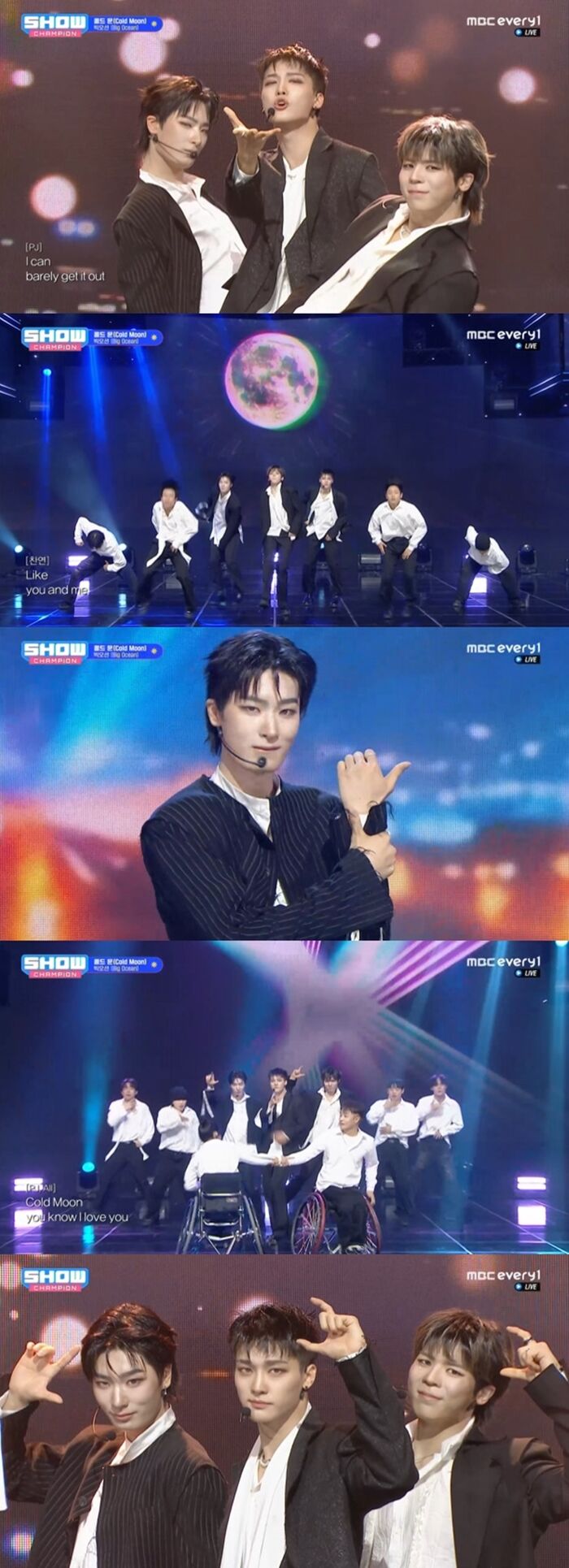

The bright, flashing lights of a live music show stage are a universal symbol of K-Pop’s high-octane, meticulously choreographed world. For generations, the image has been one of synchronized, physically demanding perfection. But on a recent Wednesday evening broadcast of MBC M’s Show Champion, that image was beautifully, irrevocably expanded. In a landmark moment for the industry, rising 5th-generation boy group ODYSSEY performed their latest title track, “Gravity,” alongside two professional wheelchair dancers, integrating their artistry seamlessly into the core choreography. This wasn’t a separate interlude or a symbolic backdrop; it was a powerful, mainstream declaration that the stage belongs to everyone.
The performance, which has since ignited a firestorm of praise and introspection across social media and industry forums, marks one of the first times a major K-Pop group on a weekly live broadcast has featured wheelchair dancers as an integral part of their core stage presentation. It’s a move that transcends a simple “special stage” and touches on deeper questions about representation, accessibility, and the very definition of performance in an industry often critiqued for its rigid standards. This is the story of how ODYSSEY, a group still carving its name into the competitive 5th-gen landscape, may have just carved a new path for everyone.
ODYSSEY: Charting an Unconventional Course from the Start
To understand the significance of this move, one must first understand ODYSSEY. Debuting in late 2023 under the relatively niche but artistically bold agency, Horizon Entertainment, the seven-member group was never marketed as just another face in the crowd. From their pre-debut material, the narrative focused on “journey,” “discovery,” and “inclusive worlds.” Their concept photos and lore-heavy music videos often featured symbolic imagery of bridges, diverse landscapes, and interconnected pathways.
“Their whole brand is built on the idea of exploring uncharted territory, both in sound and in message,” says K-Pop critic Lee Ji-hyun, who has followed the group since their debut. “While their peers were leaning heavily into hyper-masculine ‘teen crush’ or fantastical lore, ODYSSEY’s lyrics consistently touched on themes of connection beyond barriers—emotional, physical, and societal. This performance feels less like a publicity stunt and more like a logical, if incredibly brave, extension of their core identity.”
Their management, Horizon Entertainment, is known for a small but distinctive roster, often prioritizing artistic direction over rapid commercial growth. This has given ODYSSEY a unique, if riskier, runway. They’ve yet to score a #1 on the real-time charts or break a major sales record, but they’ve cultivated a fiercely loyal, intellectually engaged fandom, “Wayfarers,” who dissect their thematic albums and advocate for their progressive stance. This performance, therefore, is not an anomaly but a crescendo in a symphony they’ve been composing since day one. For more on rising 5th-gen groups making waves, visit our Artists page.
The Precursor: A Quiet History of Advocacy
Insiders note that the seeds for this performance were planted months ago. Member JAE, the group’s main vocalist and a known advocate, has frequently used the group’s behind-the-scenes content to discuss his volunteer work with arts programs for youth with disabilities. In a VLive last December, he mentioned being “profoundly inspired” by a contemporary dance performance that integrated adaptive movement.
“We talk so much about ‘world-building’ in our albums,” JAE said during that stream. “But what is a world if it isn’t built for everyone to enjoy and participate in? That’s the real fantasy we should be chasing.”
This sentiment, echoed subtly by other members, signaled a group thinking beyond typical idol mandates. It aligns with a slow-burning trend in the wider Korean performance arts scene, where inclusive dance companies like Unlimited and Dance With Me have been gaining recognition. ODYSSEY’s stroke of genius was bridging that evolving performing arts landscape with the monolithic, trend-setting platform of K-Pop music television.
A Stage Transformed: Deconstructing the "Gravity" Performance
The performance on Show Champion for “Gravity,” a synth-heavy track about attraction and support, began like any other. The members stood in their opening poses. But as the first verse progressed, the camera panned to reveal two dancers, Park Min-soo and Choi Hye-rim, entering the stage space in sleek, custom-designed wheelchairs that matched the group’s futuristic white-and-silver outfits. What followed was a masterclass in inclusive choreography.

Choreographed by the group’s main dancer TAEIL in collaboration with Park and Choi themselves, the movements were a dialogue. At times, the wheelchair dancers took the center, their chairs spinning and weaving with graceful, powerful motions, while ODYSSEY members danced around them, their movements mirroring the circular momentum. In the song’s chorus, a key moment saw member SEONGJUN leaning back, supported by the locked wheels of Park Min-soo’s chair, creating a stunning tableau of trust and interdependence.
The choreography did not treat the wheelchairs as limitations, but as instruments. The dancers used their chairs’ frames for percussive hits, incorporated the wheels’ rotation into the flow, and executed complex partnered lifts where the power dynamic flowed both ways—sometimes the standing member was the support, sometimes the seated dancer provided the foundational stability. The performance’s climax featured all nine performers (seven idols, two dancers) in a unified, geometric formation, with the wheelchairs forming the pivotal anchor points of the design.
“We worked for weeks on this,” TAEIL shared in a brief post-show interview captured by K-Beats. “It wasn’t about adding them to our existing dance. It was about creating a new dance, from the ground up, where the wheelchair was part of the language. Min-soo and Hye-rim taught us so much about weight, momentum, and a different kind of strength. It changed how we think about movement.”
Behind the Scenes: Production, Accessibility, and Setting a Precedent
Sources close to the production reveal that Horizon Entertainment and ODYSSEY were adamant about more than just the performance. They negotiated with Show Champion’s production team to ensure full backstage accessibility for the dancers, a detail often overlooked. This included ramp access to the staging area, an accessible dressing room, and consultations on camera angles that would showcase the dance without resorting to pitying or “inspirational” tropes.
Furthermore, the group’s agency is reportedly covering the dancers’ fees at a rate equivalent to top-tier backup dancers, setting a professional and respectful standard for future collaborations. This holistic approach underscores that the gesture was rooted in respect for craft, not charity. It’s a nuanced but critical distinction that elevates the act from mere representation to genuine integration and professional partnership. For the latest on chart performances and how stages impact rankings, check our Charts page.
The Wave of Response: From Fandom to the Industry
The reaction was immediate and overwhelmingly positive. The hashtag #오디세이_함께_춤춰요 (#ODYSSEY_LetsDanceTogether) trended at #1 on Korean Twitter for over 18 hours. Fan-edited videos comparing the integrated choreography to the original version went viral, with millions praising the artistic merit and emotional impact.
Comments from the disability community, both in Korea and internationally, have been particularly poignant. “For the first time, I saw joy and power, not struggle,” wrote one Korean netizen who uses a wheelchair. “They weren’t ‘overcoming’ something on stage; they were just dancing, and it was magnificent.” International “Wayfarers” launched donation drives to sub and translate the performance and related interviews into multiple languages, amplifying its message globally.
Within the industry, the reaction has been more varied but significant. Several senior choreographers, including those who have worked with top-tier groups, posted messages of admiration on their social media. An anonymous staffer from another major entertainment company told K-Beats, “It’s all anyone is talking about in planning meetings. There’s a sense of, ‘Why didn’t we think of that?’ and ‘What does this mean for our own stages?’ It’s a healthy shock to the system.”
This moment of inclusion stands in stark contrast to other recent industry controversies that highlight rigid expectations, such as The Velvet Curtain Twitches: A 5th Gen Star's Live Stream Sparks the "Purity" Debate Anew. Where that incident revolved around enforcing a narrow ideal, ODYSSEY’s act works to shatter ideals altogether.
A New Frontier for Fan Engagement
The “Wayfarer” fandom has leveraged this moment into a broader movement. They are now petitioning music shows to include sign language interpreters for live broadcasts and are compiling resources on making fan meetings and concert venues more accessible. ODYSSEY’s action has empowered their fans to become advocates, transforming typical fan projects into a form of social activism aligned with their idols’ expressed values. This deepens the fan-idol bond in a way that transcends album sales, building a community with a shared purpose.
Industry Impact: A Watershed Moment or a Flash in the Pan?
The critical question now is whether this will be a one-off moment of applause or a genuine inflection point. K-Pop has a history of absorbing subcultures and social movements into its aesthetics, sometimes superficially. However, the depth of execution and premeditation behind ODYSSEY’s stage suggests something more substantive.
“This has the potential to be a true watershed,” argues cultural commentator Park Min-kyung. “It touches on two major pressures facing the industry: the need for genuine innovation in a saturated market, and the growing global demand for social consciousness from celebrities. ODYSSEY has just demonstrated that inclusivity, when done authentically, isn’t a compromise on artistry—it’s an enhancement. They’ve raised the bar.”
The performance also intersects with broader conversations about mentorship and influence across generations. Just as TXT's Kang Taehyun Credits Red Velvet's Wendy as a Pivotal Mentor showed impactful cross-generational respect, ODYSSEY’s collaboration with professional adaptive dancers represents a mentorship in reverse—idols learning from and elevating experts from a different field, fostering a richer creative ecosystem.
Commercially, the risks are real. Some conservative segments of the audience may reject it. But the overwhelming data so far points to a massive boost in brand reputation, international media coverage (from outlets that rarely cover K-Pop beyond the biggest names), and a surge in album pre-orders for their upcoming repackage. Horizon Entertainment’s stock saw a noticeable, if modest, rise. They are proving, much like landmark successes in other genres, that artistic bravery can be a viable market strategy.
The Global Stage Awaits
On the world stage, this move positions ODYSSEY uniquely. Western markets, in particular, place a high premium on diversity and inclusion narratives. As K-Pop continues its global conquest, groups that can authentically speak to these values while delivering top-tier music and performance may find a powerful point of connection. They are not just exporting K-Pop; they are exporting a more expansive vision of what K-Pop can be, similar to how BTS Conquered the UK Official Charts by blending Korean heritage with global pop appeal.
What's Next: The Ripple Effect
So, where do we go from here? For ODYSSEY, the immediate path is clear: they must continue. Sources indicate that the wheelchair dancers are contracted for several more music show appearances and are in discussions for the group’s first concert tour, where stage design will be re-imagined with accessibility as a core principle, not an afterthought.
The larger industry is watching. We can likely expect to see other groups, particularly from mid-sized or artistically driven agencies, attempt similar inclusive stages within the next year. The challenge will be in the execution—avoiding tokenism and ensuring genuine collaboration. Music show producers may now need to consider universal design principles in their set construction as a standard, not a special request.
This moment also opens the door for other forms of representation. Could we see hearing-impaired dancers incorporated through vibration-focused choreography? Or more openly neurodiverse idols? ODYSSEY has cracked open a door, and the potential for storytelling is vast. It mirrors the way groundbreaking collaborations, like Rosé's Collab With Bruno Mars, redefine success metrics, pushing the industry to think bigger.
Ultimately, the legacy of this Show Champion stage may not be measured in trophies (though it did win that day’s “Best Performance” poll by a landslide), but in a shifted paradigm. In an industry built on fantasy, ODYSSEY has proposed a radical new fantasy: one where the stage is truly for all, where talent is not defined by physical conformity, and where the most powerful connection is not just between idol and fan, but between all humans through the universal language of movement. As the applause fades, the work begins to ensure this isn’t the end of a conversation, but the first, bold line of a new chapter in K-Pop history. Stay tuned to our News page for continuing coverage on this evolving story.