
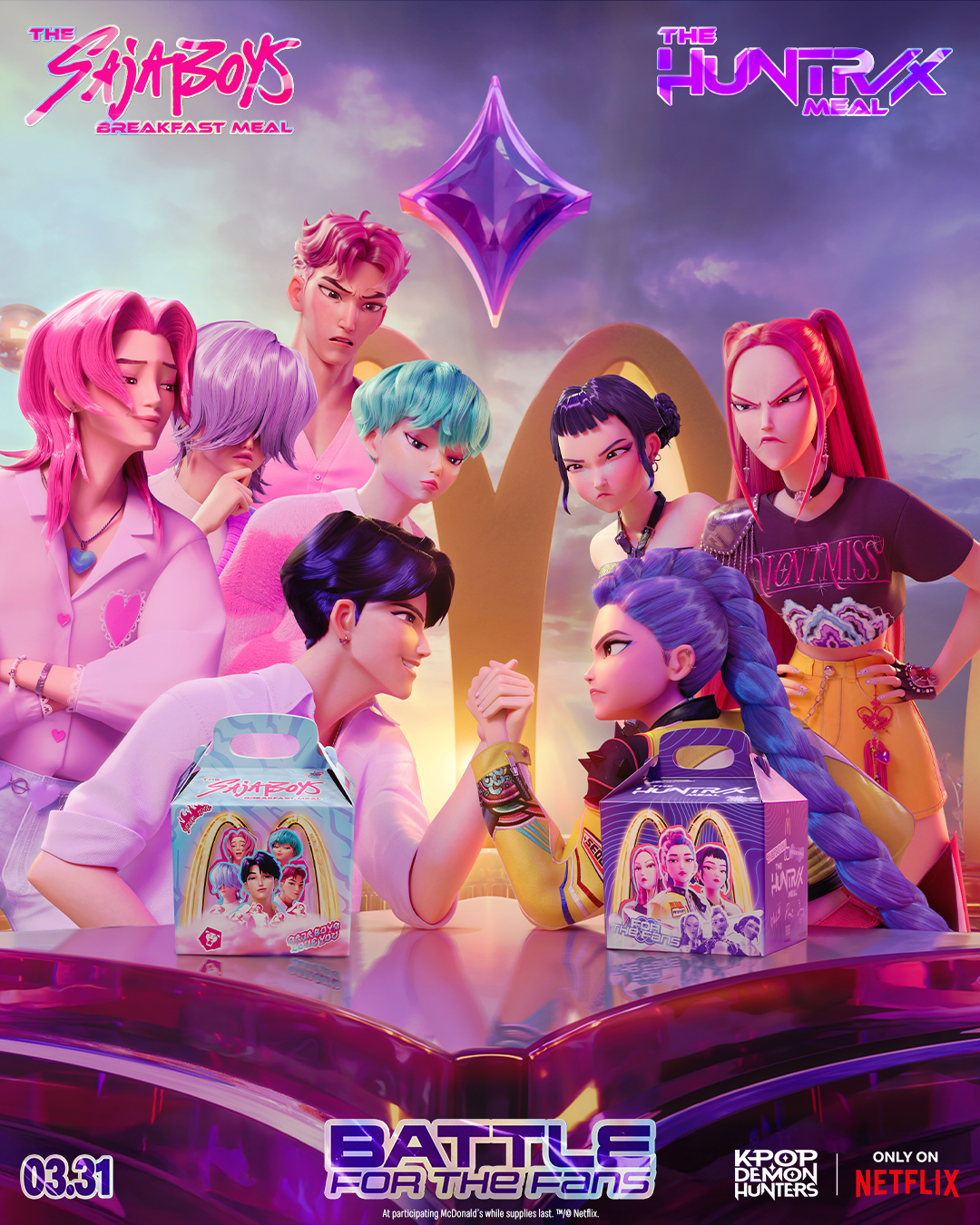
The landscape of K-Pop brand endorsements has long been a familiar tableau: a photogenic idol holding a cosmetic product, a group dancing in matching sportswear, a star smiling over a cup of coffee. It's transactional, effective, and often creatively safe. But this week, that landscape was irrevocably altered by an unlikely alliance between a fast-food titan, a streaming colossus, and two of K-Pop's most narratively-driven boy groups. McDonald's Korea, in partnership with Netflix, has launched a multi-platform marketing phenomenon for the animated film KPop Demon Hunters, starring idols from HUNTR/X and Saja Boys not just as faces, but as integral characters within a branded story universe.
This is not merely a new meal deal; it is a full-scale, transmedia narrative deployment where the lines between idol persona, animated character, and brand ambassador blur into a potent marketing singularity. The campaign, which dropped on March 24, features a cinematic-quality advertisement, special packaging, exclusive merchandise, and a promise of deeper lore. For fans of HUNTR/X and Saja Boys, it’s a content bonanza. For the industry, it’s a masterclass in the next evolution of idol commercialization, raising compelling questions about artistry, narrative ownership, and the sheer gravitational pull of K-Pop as a global cultural engine.
The Idols in the Arena: Unpacking the HUNTR/X and Saja Boys Phenomena
To understand the significance of this collaboration, one must first grasp the unique positioning of the two groups involved. They are not just any idols; they are groups built from the ground up with high-concept stories that resonate deeply with their fandoms.
HUNTR/X: The Cyberpunk Mythologists
Debuting in 2022 under Ouroboros Entertainment, HUNTR/X (stylized as HUNTR/Ʌ) quickly carved a niche with their "neo-mythology cyberpunk" concept. Their lore involves members as reincarnated deities and legendary figures navigating a dystopian, tech-dominated Seoul to "hunt" societal corruption. Their music videos are dense with symbolism, their albums come with cryptic novellas, and their fandom, the Oracle, delights in decoding every clue. Leader and main rapper Jian is particularly known for his intricate, world-building rap verses that tie their discography into a continuous saga. This makes them a perfect fit for a project about demon hunters, as their entire identity is already rooted in a battle against metaphorical (and now, literal) demons.
Saja Boys: The Emo-Fantasy Storytellers
On the other side of the conceptual spectrum are Saja Boys (사자소년), whose name translates to "Lion Boys." Managed by Fantasia Records, they debuted in 2023 with a lush, fantasy-based "emo-kingdom" concept. Their storyline paints the seven members as princes from a fallen celestial kingdom, exiled to the modern world and using their music to reclaim their lost magic and heal their broken bonds. Their title tracks are emotional, orchestral, and often accompanied by webtoon collaborations. Their fandom, ROAR, is fiercely protective and deeply invested in the emotional arcs of each member. Member Leo, the group's main vocalist, recently opened up about the pressures of maintaining such an intense narrative, a sentiment that echoes the experiences discussed in our recent analysis of idol mental health, "The Emotional Avalanche: How VIVIDANCE's Hyejin Exposed the Raw Nerve of 5th-Gen Idol Pressure".
Deconstructing the Campaign: More Than Just a Happy Meal
The collaboration is a multi-pronged assault on the senses and the wallet. At its core are two themed meals: the "HUNTR/X Spectral Burger Set" and the "Saja Boys Celestial Spicy Chicken Set." Each comes in specially designed packaging featuring original artwork of the groups as their KPop Demon Hunters counterparts, not just their idol selves.
The centerpiece, however, is the two-minute advertisement. Directed with the flair of a movie trailer, it opens in a gritty, neon-soaked alleyway where HUNTR/X members, clad in tactical gear, are besieged by shadowy creatures. The scene then seamlessly shifts to a more ethereal, sun-drenched rooftop where Saja Boys use glowing, musical notes as weapons against a different breed of demon. The clash of aesthetics—cyberpunk versus celestial fantasy—is stark and intentional. The groups' paths converge at a McDonald's restaurant, which transforms into a glowing bastion. The ad’s climax shows the idols, now in their casual attire, enjoying the themed meals, with the tagline: "Recharge Your Power. The Hunt Continues."
"This wasn't about slapping our faces on a bag. It was about extending our worlds," said HUNTR/X's leader Jian in a behind-the-scenes clip released by McDonald's. "Our concept has always been about fighting unseen evils. In this ad, the McDonald's restaurant becomes our safe house, our recharge station. It's lore-accurate for us, which is what our Oracle fans will appreciate."
Furthermore, the campaign includes:

- Exclusive Photocard Randomization: Each meal includes one of 14 exclusive photocards (7 per group) featuring the members in both their "hunter" and "idol" personas, guaranteeing collector frenzy.
- AR Experience: Scanning the packaging with a dedicated app unlocks short AR filters that superimpose a member's "demon hunter" weapon or aura onto the user.
- Soundtrack Integration: Snippets of a new, collaboration-specific instrumental track are used in the ad, with rumors of a full digital single release persisting.
Fandom Frenzy and The Lore Deepens
Reaction from the Oracle and ROAR fandoms has been predictably volcanic, but notably, it has transcended simple excitement for a idol endorsement. Social media platforms are alight with forensic analysis.
"This is the ultimate validation of our fan theories," tweeted a prominent HUNTR/X fanbase account. "The demon designs in the ad match the corrupted corporation logos from their 'Apex Predator' music video. McDonald's just canonized itself into the HUNTR/X universe!" Meanwhile, Saja Boys fans are obsessing over the symbolism in their set's "celestial" sauce and how its colors match the member Leo's designated kingdom hue.
The collaboration has also sparked a friendly, but intense, inter-fandom competition. Fans are rallying to "out-buy" the other fandom, posting receipts of bulk meal purchases to secure full photocard sets, a phenomenon visible on our Charts page where related keywords have skyrocketed. This mirrors the potent, sometimes overwhelming, consumer power of dedicated fandoms that can turn any branded venture into a record-breaking event, similar to the solo success explored in "Jennie Forges Her Own Platinum Path".
However, a minor contingent within the fandoms has expressed a nuanced concern. "It's incredibly cool, but it does make me wonder where the story ends and the advertisement begins," commented one fan on an online forum. "If Jian's next rap verse mentions a 'golden-arched sanctuary,' will I think of his character's journey, or will I crave fries?" This touches on a delicate balance between artistic narrative and commercial integration that this campaign pushes to its limit.
Industry Implications: The New Blueprint for Brand Synergy
This McDonald's-Netflix-KPop trifecta is not an anomaly; it is a bellwether. Industry analysts at K-Beats see this as the logical endpoint of several converging trends.
First, the rise of the "Lore-Dense" Idol Group. The success of groups like HUNTR/X and Saja Boys proves that a significant segment of the modern K-Pop audience craves immersive storytelling. Brands are no longer just buying an idol's likeness; they are buying access to a fully realized fictional universe with a built-in, emotionally invested audience. This provides a depth of engagement far beyond traditional modeling.
Second, the erosion of barriers between entertainment platforms. Netflix, a content creator, is partnering with McDonald's, a food retailer, using K-Pop idols as the connective tissue to promote an animated film. This is horizontal integration at a global scale. The idols are the live-action touchpoints that make the animated film feel more "real" and accessible, while the film provides a prestigious, global platform for the idols.
Third, the premium on "Experiential" Commerce. The AR filters, the collectible lore-based photocards, the narrative-driven ad—fans aren't just buying a burger. They are purchasing a piece of expandable content, a token that grants them deeper access to the group's world. This transforms a mundane transaction into a fan experience, a strategy that guarantees higher sales volume and immense social media amplification.
"This campaign effectively turns McDonald's restaurants into temporary fan sites and the meals into official merchandise," says Park Mina, a pop culture analyst we consulted. "It's a staggering efficiency of marketing. They're simultaneously promoting a film, selling food, boosting the idol groups' profiles, and creating collectible content. It’s a closed loop of consumer engagement." This level of strategic planning stands in contrast to the more organic, and sometimes controversial, ways idols interact with their personal lives and brand image, as seen in discussions around "The Unbearable Weight of the Spotlight".
What's Next: The Hunt Continues Beyond the Drive-Thru
The immediate future involves sold-out meals, trading frenzies for photocards, and a likely boost in viewership for KPop Demon Hunters when it premieres on Netflix. But the long-term implications are more fascinating.
Will other groups with strong lore, like aespa with their æ universe or ATEEZ with their pirate chronicles, be the targets of similar deep-narrative integrations? Will we see a BTS member voice a character in a Pixar film with a related fast-food campaign? The precedent is now set. The success of this campaign, measured by sales, social metrics, and streaming numbers, will dictate how aggressively brands and studios pursue this model.
For HUNTR/X and Saja Boys, this is a monumental career milestone. It places them at the forefront of a new commercial-artistic hybrid model. The key challenge for their agencies will be to ensure this external narrative integration feels like a rewarding expansion for fans rather than a disruptive commercial intrusion. Can the lore survive its own commercialization without dilution? The groups' next musical comebacks will be scrutinized for any thematic carryover from this campaign.
Ultimately, the "KPop Demon Hunters" collaboration is a testament to K-Pop's unprecedented cultural capital. It demonstrates that the stories idols tell are now valuable, licensable IP powerful enough to anchor a multinational marketing campaign for the world's largest fast-food chain and streaming service. The demons being hunted may be animated, but the real-world ambition of this synergy is clear: to completely dominate the attention economy. As the fandoms recharge with their themed meals, the industry watches, knowing the game has just changed. For more on the evolving dynamics of idol groups and their partnerships, explore our Artists page for in-depth profiles and ongoing analysis.