
The recent firestorm over a "Produce 101 Japan" trainee's deliberately provocative and widely panned "Ending Fairy" pose is far more than a fleeting scandal. It represents a calculated, high-risk maneuver in the brutal economy of attention that defines modern survival shows. This incident underscores a harsh truth: in an oversaturated market, triggering absolute disgust can be a more viable path to visibility than eliciting mild approval, forcing us to examine the desperate strategies trainees employ to escape obscurity.
Table of Contents
- What Exactly Happened on "Produce 101 Japan"?
- Why is the "Ending Fairy" Moment So Sacred in K-Pop & Survival Shows?
- How Did the Internet React and What Does "Absolute Disgust" Actually Achieve?
- Was This a Genuine Misstep or a Brilliantly Calculated Career Move?
- Is There a Precedent? Comparing to Other "Shock Value" Survival Show Tactics
- What's Next for the Trainee and the Show's Narrative?
- Frequently Asked Questions (FAQ)
What Exactly Happened on "Produce 101 Japan"?
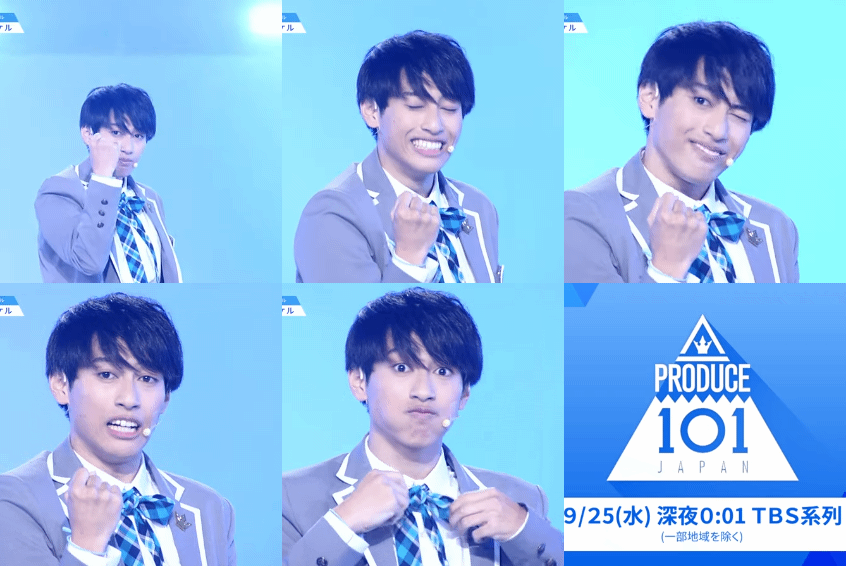
During a recent group performance broadcast, the camera panned to each trainee for their coveted "Ending Fairy" moment—the few seconds where they hold a final pose and expression directly into the lens. While most trainees offered smiles, winks, or fierce concept-appropriate stares, one male trainee, whom we'll refer to as Trainee K for ongoing evaluation fairness, chose a starkly different path.
The Pose That Broke the Pattern
Trainee K's pose was a dissonant cocktail of exaggerated, almost grotesque facial expressions and a body posture that read as deliberately awkward rather than stylized. It wasn't a failed attempt at coolness; it felt like a conscious rejection of the typical "Ending Fairy" grammar. In a sea of polished, fan-service-ready finishes, his moment stood out for its jarring, meme-ready strangeness.
Immediate On-Site and Broadcast Reaction
Reports from the live recording detail a palpable wave of confusion and murmurs from the live audience. Fellow trainees were seen breaking their own poses with bewildered glances. The show's edit compounded this, likely replaying the moment with reaction shots, a classic survival show technique to amplify controversy. The producers framed it not as a mistake, but as a "moment," instantly branding it within the show's narrative.
Why is the "Ending Fairy" Moment So Sacred in K-Pop & Survival Shows?
The "Ending Fairy" is not a trivial tradition. It is a critical, hyper-condensed form of non-verbal communication between idol and fan, a key currency in the industry's economy of affection.
A Micro-Showcase of Charisma and Concept
In three to five seconds, a trainee must:
- Demonstrate an understanding of the performance's concept.
- Showcase their unique charisma or "star quality."
- Deliver a moment of direct, seemingly personal connection to viewers at home.
The Survival Show Lifeline
For trainees buried in large group performances, this may be their only solo camera focus for the entire episode. In the cutthroat environment of "Produce 101 Japan," where first impressions are everything, wasting this moment is seen as career suicide. It's why trainees spend hours practicing not just their performance, but that final, frozen glance. For more on how idols craft their on-screen personas, visit our feature on Jungkook's camera rebellion and visual autonomy.

How Did the Internet React and What Does "Absolute Disgust" Actually Achieve?
The reaction online was swift and polarized, but the volume was undeniable. The phrase "absolute disgust" trended, but beneath the hyperbole lay a complex engagement metric.
The Spectrum of Viral Engagement
Negative Engagement is Still Engagement. The digital outrage cycle—shock, screenshot, meme-ification, debate—guaranteed Trainee K's name and face circulated far beyond the show's typical viewership. He became a topic of discussion on forums that normally ignore mid-rank trainees. This follows a pattern we've seen where intense fan reaction, even concern, drives narrative, as analyzed in our piece on the unseen pressures on BTS members post-enlistment.
Memes as a Pathway to Recognition
His expression was instantly turned into reaction memes and GIFs. While often used mockingly, this digitally embeds him into the online lexicon. Before talent evaluation, comes name recognition. In the attention economy, being the "weird Ending Fairy guy" is a more distinct brand than being "trainee #47 who smiled nicely."
Was This a Genuine Misstep or a Brilliantly Calculated Career Move?
This is the core question. Analysis of Trainee K's prior screen time and the precise nature of the pose suggests a strategy, not an accident.
Evidence for a Deliberate "Shock and Awe" Tactic
- The Precision of the Awkwardness: The pose was too specifically odd to be a simple failure. It read as a studied anti-charm.
- Pre-existing Obscurity: If Trainee K had been a top-ranked visual or vocalist, this would be a baffling self-sabotage. For a trainee at risk of elimination without a storyline, it's a Hail Mary.
- Producer Complicity: Survival show editors are masters of narrative. Their decision to highlight and replay the moment suggests they recognized its value as a plot device, potentially in collusion with a trainee seeking a "villain" or "eccentric" edit.
The High-Stakes Risk/Reward Calculus
The gamble is extreme. The potential reward is a unique, unforgettable identity and a surge in mid-week voting from curious viewers. The risk is being permanently branded as "cringe," alienating general voters, and becoming a punchline that overshadows any future talent display. It's a play for notoriety over traditional approval.
Is There a Precedent? Comparing to Other "Shock Value" Survival Show Tactics
While extreme, Trainee K's move exists on a spectrum of deliberate attention-grabbing tactics in survival show history. The following table contrasts different strategies:
Tactic Example (Show) Goal Outcome & Risk "Shock Value" Ending Fairy Trainee K ("Produce 101 Japan") Viral notoriety, meme status, unique branding. High risk of permanent "cringe" label; may struggle to pivot to serious idol image later. Deliberate "Evil" Edit Solicitation Various trainees ("Produce 48," "Girls Planet 999") Secure screen time via conflict, become central to story arc. Can backfire with severe fan backlash and career-long stigma, but guarantees narrative centrality. Over-the-Top Audition Idols performing unusually cute or intense songs ("Produce 101 S2") Stand out from similar auditions, show versatility/memorability. Moderate risk. Can be endearing if sincere, but can also be perceived as gimmicky. Vulnerability & "Underdog" Narrative Openly discussing insecurities (common across all series) Earn sympathy votes, build deep fan connection through perceived authenticity. Lower risk. Aligns with trends toward idol vulnerability, as seen in moments like Stray Kids' height confession.The Line Between Notorious and Notable
History shows that surviving a negative-first impression requires a swift, strategic follow-up. The trainee must quickly showcase compelling talent or redeeming humanity to convert curiosity into genuine support. Otherwise, they become a mere footnote of controversy.
What's Next for the Trainee and the Show's Narrative?
The coming episodes are critical. The show's producers now hold a powerful narrative card, and Trainee K's fate hinges on the follow-up.
Potential Producer Narratives
The editors can craft several arcs:
- The Redemption Arc: Show Trainee K as humbled, hardworking, and surprisingly talented in subsequent evaluations, framing the pose as a moment of misguided desperation.
- The Eccentric Genius Arc: Double down on his oddness, pairing it with exceptional, unconventional skill to build a "mad artist" persona.
- The Cautionary Tale: Use him as an example of what not to do, leading to an emotional elimination that lectures on the importance of sincerity.
The Long-Term Career Implications
Even if he debuts, this moment will be a permanent part of his digital footprint. It will require meticulous image management to transition from a viral "disgust" figure to a respected idol. This speaks to the broader, often harsh, reality of building a public persona in this era, a challenge even established stars face during career pivots, similar to the scrutiny in analyses of HyunA's agency exit.
Frequently Asked Questions (FAQ)
Q: Will this controversy actually help Trainee K debut?
A: It significantly increases his chances of surviving the next elimination due to sheer name recognition. However, debuting in the final lineup requires converting notoriety into dedicated fandom, which depends entirely on his subsequent performances and the narrative crafted around him.
Q: Is this kind of strategy becoming more common in survival shows?
A: Yes. As the market becomes more saturated, trainees and their agencies are employing increasingly sophisticated, data-driven "attention hooks." Shocking the audience is a known variable in an otherwise unpredictable formula. For deeper industry power dynamics, read about how external commentary influences fan perception.
Q: Could this have been a genuine, unrehearsed moment?
A: While possible, it is highly unlikely given the rehearsed nature of stage endings and the acute awareness trainees have of the camera's importance. A genuine mistake would more likely be a look of panic or forgetting to pose, not a composed, sustained bizarre expression.
Q: How are fans of other trainees reacting?
A: Reactions are mixed. Some view it as a cheap tactic that steals focus from talented peers, while others see it as harmless entertainment that brings more viewers to the show, potentially helping their own favorites. It has certainly sparked intense debate within the fan community.
Q: Where can I see the pose and judge for myself?
A: The clip is widely circulated on social media platforms like Twitter, TikTok, and YouTube. We advise watching the full performance context on the official "Produce 101 Japan" channels to understand the stark contrast it presented.
Conclusion: The Desperate Calculus of Dream-Chasing
The "Ending Fairy" scandal is a stark microcosm of the modern idol-making machine. It reveals a environment where visibility is the paramount currency, and the lines between authenticity, strategy, and performance are irrevocably blurred. Trainee K's gamble highlights a desperate truth: in the gladiatorial arena of survival TV, being talked about in any tone can be preferable to silence.
This incident forces us to question our own role as consumers. Our clicks, our outrage memes, and our debates are the fuel for this very calculus. As the season progresses, monitor not just Trainee K's ranking, but the nature of his screen time. Observe if the show offers redemption, doubles down on eccentricity, or delivers a moral lesson. This single pose has written a storyline; its next chapter will be dictated by votes, edits, and the unforgiving court of public opinion. To track how other idols rise through public perception, explore our comprehensive Artists page.