
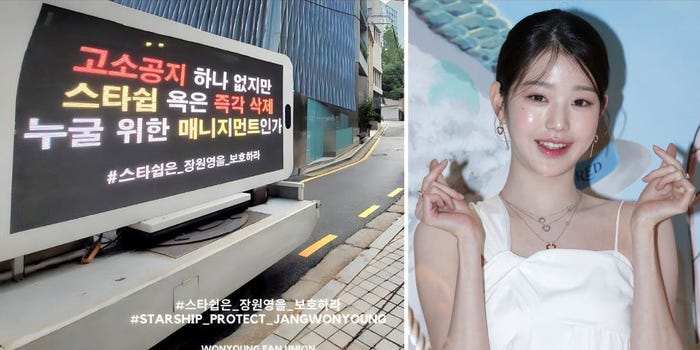
The image was jarring, even in an industry accustomed to spectacle and scrutiny. Parked stoically on the curb in front of the gleaming headquarters of STARLIGHT Entertainment, a large, white truck adorned not with congratulatory messages or fan support, but with stark, black text broadcasting a list of grievances. Its target: Lee Ara, the beloved main vocalist and visual of the powerhouse girl group ECLIPSE. This was not a celebratory fan project; this was a protest truck, a tool of public dissent typically reserved for political figures or corporations, now leveled at one of K-Pop's brightest stars. The news, first captured by a passerby and disseminated across social media with viral speed, sent shockwaves through the fandom and the industry at large. What could prompt such an extreme, public rebuke of an artist widely admired for her talent and professionalism?
The Spotlight's Darling: Lee Ara and the Meteoric Rise of ECLIPSE
To understand the shock, one must first understand the pedestal upon which Lee Ara stands. Debuted five years ago under the prestigious STARLIGHT Entertainment, ECLIPSE quickly shattered records with their dual-concept mastery, alternating between elegant, orchestral pop and fierce, hip-hop-influenced tracks. Ara, positioned front and center from the start, became the group's undeniable stan attractor. Her voice, a clear, powerful soprano with a distinctive emotional crack, carried title tracks like "Luna" and "Event Horizon" to music show dominance. Her visuals, often compared to a classic Korean painting come to life, made her a fixture on our Charts page and in endorsement deals ranging from high-end cosmetics to global beverage brands.
From Trainee to Top Tier
Ara's backstory is well-documented K-Pop lore: a six-year trainee known for her relentless work ethic. Pre-debut clips show a focused, slightly reserved girl transforming into a charismatic stage presence. Unlike idols who cultivate intense, intimate parasocial bonds through constant bubble messages and fan calls, Ara's relationship with her fandom, ECLIPSERs, has been one of respectful distance and profound gratitude expressed through performance. She was the "idol's idol," a musician first. Her few solo ventures, like her stunning OST for the drama "My Starry Night," were critically praised, and her recent appearance as a featuring artist on the track "Starlight" by a respected soloist was seen as a step toward artistic maturation. As we analyzed in our review of Solar's "Before We Knew Pt.7", the journey of a vocalist seeking their unique artistic color is a nuanced and often challenging one.
The Day the Truck Arrived: Dissecting the Grievances
The protest truck appeared on a quiet Tuesday morning. Its messages, written in both Korean and serviceable English, presented a series of demands that laid bare a specific and growing rift between a segment of fans and the idol they claim to support.
"Lee Ara! Remember your promise to ECKLIPSERs! 1. Stop ignoring the fans who made you! 2. No more 'musical experimentation' that tarnishes ECLIPSE's color! 3. Focus on group activities, not selfish solo pursuits! 4. We demand proper communication and respect!"
Each point was a bombshell cloaked in criticism. The accusation of "ignoring fans" seemed to stem from Ara's noticeably less frequent updates on the group's private messaging platform compared to her members, and her decision to take a brief social media hiatus last month to "recharge." The condemnation of "musical experimentation" directly referenced her recent studio vlog where she played snippets of demos influenced by indie folk and R&B, genres distinct from ECLIPSE's signature sound. The demand to halt solo pursuits targeted her ongoing, unofficial collaborations with producers outside STARLIGHT's usual circle. The final point, a call for "respect," was the most nebulous and damning, painting the idol as aloof and ungrateful.
The Agency's Response and the Wall of Silence
STARLIGHT Entertainment moved with uncharacteristic speed, issuing a statement within three hours of the truck's discovery. "We are aware of the vehicle parked near our building. We ask for everyone's understanding that the opinions expressed do not represent the views of all fans. We are consistently grateful for the love shown to our artists. The health and well-being of our artists is our top priority. We ask for respectful engagement." The statement, classic in its corporate neutrality, neither condemned the protest nor validated its claims. It was a shield, not a sword.
More telling was the silence from Ara herself and her fellow ECLIPSE members. Their social media feeds went dark, a scheduled behind-the-scenes photo drop was postponed, and the usual flurry of fan cafe activity ceased. This silence was perhaps the loudest statement of all, echoing the tense quiet that often follows industry shocks. It recalled the poignant moment detailed in "A Stage in Silence", where an artist must grapple with public pressure in isolation. The truck, intended as a megaphone for fan voice, had instead created a vacuum of uncertainty and concern.
Fandom Fractured: The ECKLIPSER Civil War
The incident instantly cleaved the massive ECKLIPSER fandom. On one side, a vocal minority—largely organized on private, influencer-led forums—supported the truck's message. Their arguments, proliferating on Twitter and niche platforms, framed their actions as a necessary "course correction."

- "This is tough love," argued one post with thousands of likes. "We invest so much—time, money, emotion. We have a right to protect the group's identity we helped build. Her solo interests are diluting the brand."
- "It's about accountability," claimed another. "She's been distant since the last concert tour ended. Other members write long letters; she posts a sunset picture. We feel unappreciated."
On the other side, the overwhelming majority of fans and the general public reacted with horror and indignation. The hashtag #WeLoveYouAra trended globally, filled with messages of support and condemnation of the protestors' tactics.
- "This is emotional terrorism, not fan love," tweeted a prominent fanbase account with millions of followers. "Using a public humiliation tool to control a 26-year-old woman's career choices is unthinkable. You don't own her."
- "The entitlement is staggering," commented a veteran K-Pop journalist on a popular podcast. "This isn't about art anymore. This is about a segment of fans who cannot tolerate their idol evolving beyond the carefully curated image they fell in love with."
The debate spilled over into discussions about other artists facing similar crossroads, drawing parallels to the creative journeys of artists like Yujeong with "Beautiful Sunlight", who navigated a shift in musical direction with fan support. The incident became a case study in modern fandom's darkest potential.
Beyond the Curb: Industry Implications of a New Protest Playbook
While protest trucks are not new in South Korea's activist landscape, their deployment in the K-Pop idol sphere against an individual artist for non-scandal-related issues marks a dangerous escalation. Traditionally, trucks might target agencies over perceived mistreatment (like poor promotions or safety concerns), as seen with some nugu groups. Turning this weapon on an idol for artistic choices and personal demeanor sets a troubling precedent.
"This is the logical, terrifying endpoint of hyper-commercialized parasocial relationships," explains Dr. Min Seo-jin, a cultural studies professor at Seoul National University. "When fandom is framed as a consumer transaction—'I bought albums, therefore I own a piece of your career trajectory'—any deviation from the expected product feels like a breach of contract. The protest truck becomes a form of public customer complaint." This mentality stands in stark contrast to the supportive, if passionate, fan cultures surrounding bands with strong artistic agency, such as the rock band Rolling Quartz, where musical evolution is celebrated.
The incident also forces a harsh spotlight on agencies. STARLIGHT's neutral response, while legally prudent, does nothing to protect Ara's mental health or artistic integrity. It raises the question: when does an agency's duty to manage public relations conflict with its duty to shield its artists from harassment? The industry is watching closely. Will other agencies now face similar trucks for allowing their artists to pursue solo mixtapes, acting roles, or experimental music? Has a new, ugly line of "fan engagement" been permanently drawn?
What Lies in the Shadow: The Path Forward for Ara and ECLIPSE
The immediate future is fraught with delicate decisions. The group is in the early stages of preparing for a summer comeback, a process now undeniably shadowed by this event. The key questions are manifold:
- Will Ara address it directly? Any statement is a minefield. Acknowledgment could validate the protestors' methods. Silence could be interpreted as contempt. A carefully worded message about her love for ECKLIPSERs and her passion for music, released on her terms, seems the most likely but most difficult path.
- How will this affect the group's dynamics and music? Will STARLIGHT and the group's creative team, spooked by the backlash, pull Ara back from her experimental edges and enforce a stricter, "safer" group sound? Or will they, and she, double down on artistic authenticity, using this as a catalyst for a more defiant, personal chapter?
- What is the lasting impact on fan-idol relationships? This event may cause a widespread recalibration. Idols may further withdraw from genuine interaction, fearing misinterpretation. Agencies might tighten control over all communication. The sense of communal joy that defines K-Pop at its best is at risk of being replaced by a transactional wariness.
For Lee Ara, the road ahead is no longer just about notes, choreography, and cameras. It is now a very public navigation of a fundamental conflict: the idol as a consumable product versus the artist as an autonomous human. The protest truck, in its stark, ugly simplicity, did not just make demands. It issued a challenge. The way Ara, her group, her agency, and the broader community of fans respond will write a crucial chapter in the ongoing story of K-Pop's evolution. One can only hope that the response is guided by the empathy and respect that true art and true fandom deserve. As this story develops, stay tuned to our News page for the latest updates and thoughtful commentary on this and all issues shaping the world of K-Pop.