
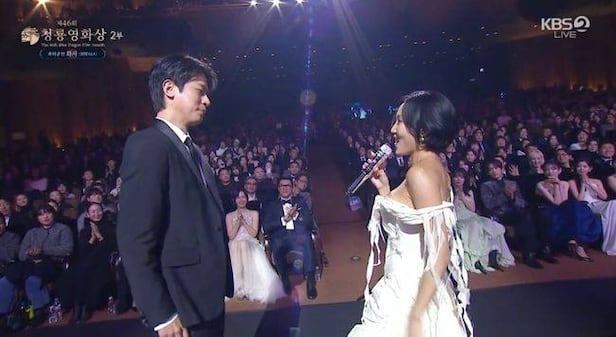

Hwasa’s spontaneous, emotional reaction to actor Park Jung Min’s serenade of her song “Good Goodbye” at the 2024 Blue Dragon Film Awards wasn’t just a viral clip—it was a cultural reset. This analysis delves into how that raw moment triggered a massive streaming resurgence for the 2023 single, proving that in today’s K-Pop landscape, genuine human connection can outperform traditional marketing. It underscores Hwasa’s unique position as a multi-hyphenate artist whose career is increasingly defined by these authentic intersections between music, film, and public persona.
- What Exactly Happened at the Blue Dragon Film Awards?
- Why Did “Good Goodbye” Suddenly Skyrocket on Charts?
- What Does This Moment Reveal About Hwasa’s Artistic Evolution?
- Does This Signal a Power Shift in How K-Pop Music Succeeds?
- How Does This Viral Moment Compare to Other K-Pop Resurgences?
- Frequently Asked Questions (FAQ)
What Exactly Happened at the Blue Dragon Film Awards?
The 45th Blue Dragon Film Awards, a premier event celebrating Korean cinema, took an unexpected turn during the presenter banter segment. Actor Park Jung Min, known for his roles in films like “The Glory,” was co-presenting with Hwasa. In a lighthearted moment, he directly addressed her and began singing a heartfelt, acoustic-style snippet of her 2023 solo track, “Good Goodbye.”
The Unscripted Reaction That Captured the Nation
Cameras immediately cut to Hwasa, whose face cycled through a cascade of genuine emotions: initial surprise, followed by visible fluster, a hand covering her mouth, and finally, a deeply moved, teary-eyed smile. There was no pre-rehearsed aegyo or idol-perfect response. It was a raw, human moment of an artist being truly seen and honored by a peer from a different entertainment sphere.
“I was so embarrassed in the moment, but truly touched. To have an actor I respect sing my song so sincerely in that setting… it felt like the meaning of the song was understood,” Hwasa later shared in informal comments, as reported by industry sources.
Why This Clip Broke Through the Noise
The clip spread across SNS platforms like Twitter, Instagram, and TikTok within minutes. Its power lay in its authenticity contrast. In a highly produced awards show environment, this was an unfiltered crossover moment. It appealed to multiple fandoms—MAMAMOO’s MooMoos, Park Jung Min’s fans, and general film audiences—creating a perfect storm for virality. Viewers weren't just sharing a funny clip; they were sharing a narrative of artistic validation.
Why Did “Good Goodbye” Suddenly Skyrocket on Charts?
Following the broadcast, data analytics revealed a staggering trend. “Good Goodbye,” a song released over a year prior, experienced a meteoric second wind on major Korean streaming platforms like Melon, Genie, and YouTube.
The Data Tells the Story
Chart positions tell a compelling tale. The song, which had exited daily Top 100 charts months earlier, re-entered and surged into the Top 20 on multiple services within 48 hours. YouTube views for the official audio and lyric videos saw a 500% increase in daily traffic. This wasn't a mild bump; it was a full-scale revival, often dubbed a “chart reversal” or “song resurrection” in K-Pop parlance.
The Psychology of the “Rediscovery” Loop
This phenomenon operates on a simple psychological trigger: curiosity-driven consumption. The viral clip acted as a massive, organic advertisement. Millions who saw the clip asked the same questions: “What song is that?” “Why was she so moved?” “What are the lyrics?” This drove immediate search and stream behavior. Furthermore, the context of the awards show lent the song a new layer of emotional depth and prestige, encouraging listeners to reappraise it not just as a pop track, but as a poignant piece of storytelling. For real-time chart movements like this, fans often check our Charts page for updates.
What Does This Moment Reveal About Hwasa’s Artistic Evolution?
This incident is not a random accident but a direct result of Hwasa’s deliberate career trajectory post-MAMAMOO’s group activities. She has meticulously built a profile that transcends the idol label.

From Idol to Cultural Icon & Multi-Hyphenate
Hwasa’s path mirrors a broader trend of idols seeking sustainable, respect-based careers. She is a singer, solo performer, variety star, and fashion icon. Her appearance at a film awards show as a presenter, not just a musical performer, signifies her acceptance into the broader entertainment elite. This positioning made Park Jung Min’s gesture read as peer-to-peer respect, not fan service, amplifying its impact. This multi-hyphenate strategy is becoming essential, as explored in our analysis of The Double Bombshell: How a Top Idol-Actor's Marriage & Exit Redefines K-Pop's Acting Career Playbook.
The Authenticity Capital She’s Banked
Hwasa’s public persona is built on perceived authenticity—from her body-positive messaging to her unapologetic stage presence. The public believes her reactions are real. Therefore, when she was visibly moved on national television, audiences believed the emotion was genuine, making the moment infinitely more shareable and powerful. This “authenticity capital” is a currency she has accrued over years and spent effectively in this single instant.
Does This Signal a Power Shift in How K-Pop Music Succeeds?
Yes, in a significant way. The “Good Goodbye” resurgence highlights a growing alternative to the standard, high-budget, company-driven promotional cycle.
The Rise of the “Organic Moment” Marketing
Traditional promotion relies on music show wins, choreography challenges, and planned variety appearances. This event demonstrates the unparalleled power of an unplanned, organic moment that creates a compelling narrative. It is marketing that cannot be bought. It requires an artist with a strong, genuine persona placed in the right cross-industry context. This demands a shift in agency strategy from pure control to cultivating opportunities for these genuine intersections.
Longevity Over “Comeback” Spike
The focus is shifting from just dominating the chart in the first week of release to building a discography with “evergreen” potential. A song’s ability to be rediscovered and find new relevance months or years later—as seen with “Good Goodbye”—is becoming a key metric of true impact. It speaks to song quality and emotional resonance beyond trendy production.
How Does This Viral Moment Compare to Other K-Pop Resurgences?
While viral moments are common, their nature and outcomes differ. The Hwasa incident sits in a unique niche compared to other famous song resurgences.
Viral Event / Song Catalyst Primary Platform Outcome & Key Difference Hwasa – “Good Goodbye” (2024) Cross-industry peer validation at a formal awards show. Broadcast TV / Integrated SNS Legitimization & emotional narrative; boosted song’s prestige. BTS – “Spring Day” (Annual) Cultural symbolism & fan-led memorial events. Twitter / Fan Communities Seasonal, sentiment-driven resurgence tied to specific meaning. Brave Girls – “Rollin’” (2021) Fan-compiled video of military performances. YouTube Underdog narrative leading to a full career reversal. IVE – “After LIKE” (Sampling) Use of a universally recognized sample (I Will Survive). TIKTok / Short-form Video Challenge-driven and meme-able, leveraging familiar audio.Analysis of the Comparison
As the table shows, Hwasa’s moment is distinct for its source: validation from a respected figure in a parallel industry (film). Unlike challenge-driven virality or fan-led movements, this carried a connotation of artistic merit being recognized beyond the K-Pop bubble. It didn’t just make the song popular again; it retroactively added a layer of critical acclaim to it. For more on how idols leverage different platforms for influence, see our breakdown in April's Variety Star Rankings Decoded.
Frequently Asked Questions (FAQ)
Q: Has Hwasa officially commented on the viral moment?
A: While she hasn’t issued a formal press statement, Hwasa has acknowledged it through casual fan interactions and in behind-the-scenes contexts, expressing her initial embarrassment but profound gratitude. She emphasized how meaningful it was that the song’s emotion was understood.
Q: Did Park Jung Min plan to sing “Good Goodbye”?
A> Based on accounts from staff close to the event, the gesture was largely improvised. While presenters often have loose talking points, the specific serenade was a spontaneous act by Park Jung Min, which is why Hwasa’s reaction was so genuinely unrehearsed.
Q: Will this lead to a musical collaboration between Hwasa and Park Jung Min?
A> There is no official announcement of a collaboration. However, the public’s positive response has certainly created a compelling narrative for one. It would depend on their respective schedules and artistic directions. Such cross-industry collaborations are increasingly common, as seen in V's Acting Comeback: Decoding the Strategic Casting.
Q: Has this affected Hwasa’s brand reputation or commercial value?
A> Analysts note a significant positive impact. The moment reinforced her image as a respected, emotionally intelligent artist with broad appeal, likely enhancing her value for endorsements and future high-profile hosting gigs. It’s a textbook case of positive brand synergy.
Q: Could this happen to any older K-Pop song?
A> Not easily. The song itself needs inherent quality and emotional lyricism to warrant rediscovery. The catalyst also requires a perfect storm: a credible figure, a prestigious setting, and an artist with a public persona authentic enough to make the reaction believable. It’s a rare alchemy.
Conclusion & What This Means for K-Pop’s Future
The resurrection of “Good Goodbye” is a landmark case study. It proves that in an algorithm-driven age, human emotion and cross-cultural respect remain the most potent forces for connecting art with an audience. For artists, the lesson is to build authentic, multi-dimensional careers that create opportunities for these genuine moments. For agencies, it’s a call to look beyond rigid promotional windows and nurture the long-term narrative around an artist’s entire body of work.
The era where a song’s life is limited to its promotion cycle is fading. The future belongs to artists like Hwasa, who create music with depth and live careers with authenticity, allowing their art to find new life in unpredictable, powerful ways. This moment isn’t just a viral blip; it’s a blueprint for sustainable artistry. To follow more evolving artist narratives and industry shifts, stay tuned to our News page for continuous coverage and in-depth analysis.