

A Moment of Surreal Contrast
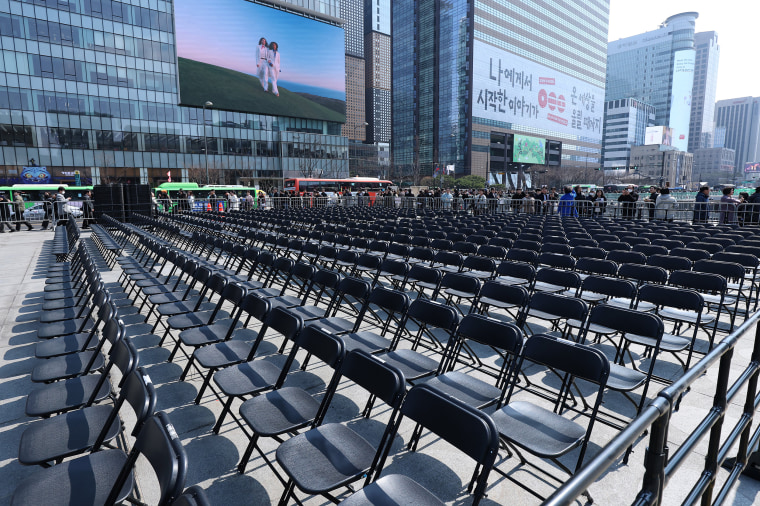
It was meant to be a coronation. A triumphant, symbolic return to one of Seoul’s most historic and politically charged public squares for the world’s biggest pop band. On a balmy evening, the towering statues of Admiral Yi Sun-sin and King Sejong the Great looked on as BTS’s RM, Jin, and Jimin took to a grand stage in Gwanghwamun Square, performing their newly released single “ARIRANG” for a televised national holiday special. The production was majestic, the symbolism potent—a modern cultural powerhouse paying homage to tradition. Yet, for viewers at home and a handful of journalists on the ground, a discordant visual stubbornly pulled focus from the performance itself: vast, unmistakable swaths of empty white seats fanning out from the stage.
The images spread with viral speed. Side-by-side shots comparing the meticulously planned, digitally rendered previews of a packed plaza to the stark reality of a sparsely filled audience section became the weekend’s most contentious K-pop talking point. This was not a case of a few no-shows; this was a foundational gap between expectation and reality. Almost immediately, the discourse crystallized around a single, damning industry term: “over-inflation.” The incident has sparked a firestorm, raising uncomfortable questions not just about BTS’s current drawing power amid military enlistments, but about a systemic K-pop practice of prioritizing spectacle over sustainable crowd management, and the perilous gamble of prestige booking.
“It was a ghost town dressed in glitter,” remarked one long-time industry photographer present at the event, who requested anonymity. “The energy from the artists was incredible, professional as always, but it was bleeding into a void. You couldn’t ignore the empty space. It felt like a metaphor for something bigger.”
Gwanghwamun: From Protest to Performance
To understand the weight of this moment, one must first understand the gravity of the location. Gwanghwamun Square is not a conventional concert venue. It is the ceremonial heart of South Korea, flanked by the Gyeongbokgung Palace and the modern National Museum. It has been the stage for presidential inaugurations, massive political demonstrations, and national celebrations. Its use for a pop concert is inherently a statement, requiring high-level governmental approval and carrying an implicit message of cultural significance endorsed by the state.
For BTS, whose journey is etched into the modern mythology of South Korea, performing there was a logical apex. From their early days at small venues to selling out stadiums worldwide, their narrative is one of monumental ascent. Their last performance as a full group before the enlistment era began was a historic, free concert in Busan to support the World Expo bid, drawing a reported million-strong crowd. Gwanghwamun, for the first major domestic performance by members post-enlistment, was meant to signal a continuation of that unparalleled connection. However, as explored in our previous analysis "Beyond the Stage: HYBE's Calculated Statement on BTS's Gwanghwamun Event", the logistics of such an event are a labyrinth of corporate and governmental coordination, where artistic ambition can clash with operational reality.
The group’s current chapter is uniquely complex. With members in various stages of military service, activities are fragmented. The performance featured only three members, alongside a pre-recorded video segment from the others. While the fanbase, ARMY, remains fiercely loyal—as evidenced by the record-shattering streams for their latest release detailed in our charts coverage—the dynamics of engagement for subunit or solo events are inherently different from those for the full group.
The Precedent of Prestige Bookings
This is not the first time a K-pop act has faced scrutiny over attendance at a high-profile, non-traditional venue. The industry has a noted history of “prestige bookings”—securing iconic locations like Olympic stadiums, grand plazas, or famous international landmarks for concerts or fan meetings. The goal is twofold: generate unparalleled media buzz and cement the artist’s status. However, the financial and logistical risks are immense. Rental fees for such locations are exorbitant, security and infrastructure costs balloon, and the pressure to fill a space not designed for concerts becomes a monumental task. Often, the sheer scale of the venue can dwarf even a sizable audience, creating an optical issue even with a respectable turnout.
Deconstructing the "Empty Seat" Phenomenon
The immediate backlash centered on a simple, visible fact: empty seats. But the reasons behind them are a tangled web of ticketing strategy, event design, and external factors.
Ticketing: A Closed System?
Reports indicate that attendance for the Gwanghwamun performance was not based on public ticket sales in any traditional sense. Instead, it was largely an invite-only affair, with seats allocated to various entities: government officials, corporate partners, media, and a limited number of fans won through lottery-style contests held by broadcasters and the band’s label, HYBE. This system, while common for state-adjacent television events, inherently creates fragmentation. Not all invited guests attend. Corporate seats often go unused. The fan allocation, while fiercely contested, was a tiny fraction of the total seating constructed.

“When you don’t have a direct, paid transaction with the majority of your audience, you lose all predictive power,” explains Park Ji-won, a live event strategist. “You’re hoping the prestige of the invitation is enough. For a Saturday night on national TV, for many invitees, it wasn’t.”
The Scale of the Setup
Early planning renders and media reports suggested a massive audience block capable of holding tens of thousands. The actual installation appeared to be slightly smaller, but still overwhelmingly large for the crowd that materialized. The stage design, with its long catwalk, further spread the audience thin optically. This created a “donut effect”—a dense core close to the stage surrounded by rings of increasing emptiness. In an age of ultra-high-definition broadcast and smartphone zoom lenses, this effect is magnified tenfold.
The Shadow of Controversy
Compounding the issue was the lingering technical controversy from BTS’s own recent comeback. As reported in "Sonic Fracture: Inside the Audio Uproar Surrounding BTS's Historic 'ARIRANG' Release," the album’s mixing and mastering choices had sparked intense debate among fans and audiophiles. While unrelated logistically, this created a minor undercurrent of fan discontent that may have influenced the online narrative’s rapid shift toward criticism rather than celebration of the performance itself.
Fan Fractures and Fierce Defenses
The reaction within the ARMY fandom and the broader K-pop community was immediate and polarized, playing out across Twitter, Instagram, Naver cafes, and viral TikTok edits.
On one side, a defensive and heartbroken majority launched a counter-narrative. Hashtags celebrating the performance’s cultural importance and the members’ professionalism trended globally. Fans pointed out:
- The Invite-Only Nature: “You couldn’t buy a ticket! It wasn’t a concert! Blame the no-show invites, not ARMY.”
- Broadcast Success: “The TV ratings were huge! More people saw it at home than could ever fit there.”
- Malicious Editing: Accusations that critics were circulating photos from rehearsals or before gates fully opened.
- Respect for the Members: “They worked so hard. Focusing on empty seats disrespects their art and the song’s meaning.”
“ARMY fills souls, not just seats,” wrote one fan on X (formerly Twitter). “The world watched. The song trended #1 everywhere. That is our metric. Not some empty chairs given to bureaucrats who couldn’t be bothered to show up.”
On the other side, critics—including some within the fandom—saw a moment of necessary reckoning. Their arguments focused on systemic issues:
- HYBE’s Overreach: That the company, in its quest for a historic moment, over-estimated demand and underestimated the logistical pitfalls, setting the artists up for public scrutiny.
- The "Emperor's New Clothes" Effect: A growing sentiment that parts of the industry, and sometimes fandoms, are afraid to acknowledge logistical missteps for fear of tarnishing a group’s image.
- Comparisons to Older Acts: Some pointed to the recent, heartfelt campaigns by 2nd generation groups, as covered in our feature on fan engagement, as a more honest approach to ensuring crowd turnout.
This schism highlights a modern tension in K-pop: the clash between unshakeable digital support (streams, tweets, votes) and the ancient, undeniable proof of physical presence.
Industry Analysis: A Symptom of a Bigger Sickness
The Gwanghwamun situation is not an isolated BTS problem. It is a stark symptom of an “over-inflation” epidemic in K-pop’s live event sector. This practice involves:
1. Venue Ambition Over Audience Realism: Labels and event organizers frequently book venues a size or two above an artist’s reliable drawing power, banking on the prestige to *create* demand. This works for once-in-a-generation acts at their peak, but becomes a gamble for others. The recent, phenomenal success of groups like IVE in the digital realm—as seen with their latest MV milestone reported on our Charts page—does not always translate linearly to filling the largest physical spaces.
2. The "Optics Over Experience" Model: The primary goal becomes generating shareable, breathtaking visuals of an artist on a massive stage, often for online consumption, rather than ensuring an intimate, packed, and electrifying experience for those physically present. The live audience becomes a backdrop prop, and if that prop is sparse, the entire image fractures.
3. Post-Pandemic Recalibration: The global concert industry is still recalibrating after COVID-19. While top-tier acts are breaking records, there is a middle tier where demand is softer. Aggressive venue booking from the pre-2020 era is now colliding with a changed market and potentially altered fan spending habits.
4. The BTS-Specific Factor: For BTS, this moment intersects with their unique “post-enlistment” transition period. The fandom’s energy is currently channeled into digital support for solo and subunit projects—a phenomenon easily tracked on our News page. Mobilizing for a non-ticketed, logistically complicated, subunit television performance is a different ask than rallying for a full-group, ticketed stadium tour. It represents a new challenge in fan mobilization that even the mighty ARMY machinery is navigating in real-time.
What's Next: Course Correction or Continued Spectacle?
The fallout from Gwanghwamun will likely prompt a period of quiet reassessment behind closed doors at HYBE and other major agencies. The risk of reputational damage to the BTS brand, however minimal in the long run, is a powerful deterrent. We can anticipate several shifts:
More Calculated Venue Choices: For future solo or subunit events, expect a return to large but manageable theatres, arenas, and convention halls—venues where creating a “sold-out,” energetic atmosphere is a guaranteed outcome. The era of the automatic stadium or mega-plaza booking for non-full-group activities may be paused.
Transparency in Ticketing: For hybrid broadcast events, a move toward smaller, guaranteed-audience setups, or a clearer public communication strategy about the invite-only nature, could manage expectations from the start.
A Fandom Re-oriented: ARMY will likely use this as a rallying cry for future physical events, determined to prove the doubters wrong. The next ticketed BTS-related concert, whenever it arrives, will be under immense scrutiny to showcase the fandom’s undiminished power.
Broader Industry Impact: Other agencies will study this incident closely. It serves as a cautionary tale against overplaying one’s hand. The focus may slowly shift back from pure scale to curated experience, a trend already visible in the immersive, concept-heavy shows of some 4th generation groups. For more on the evolving strategies of today’s top artists, explore our Artists page.
Ultimately, the empty seats of Gwanghwamun are a Rorschach test for the state of K-pop. They can be seen as a momentary logistical stumble, a sign of fickle fame, or a powerful indictment of an industry drunk on its own spectacle. For BTS, a group that has spent a decade defying expectations, this is but a strange, quiet interlude in their legend. Their legacy is not built on a single plaza’s occupancy rate, but on the seismic shifts they’ve caused in music, culture, and the hearts of millions. Yet, the image endures—a reminder that even kings, performing in the shadow of palaces, must sometimes face the echo of their own ambition, and that in the high-stakes theater of modern K-pop, every seat tells a story. The industry would be wise to listen.