
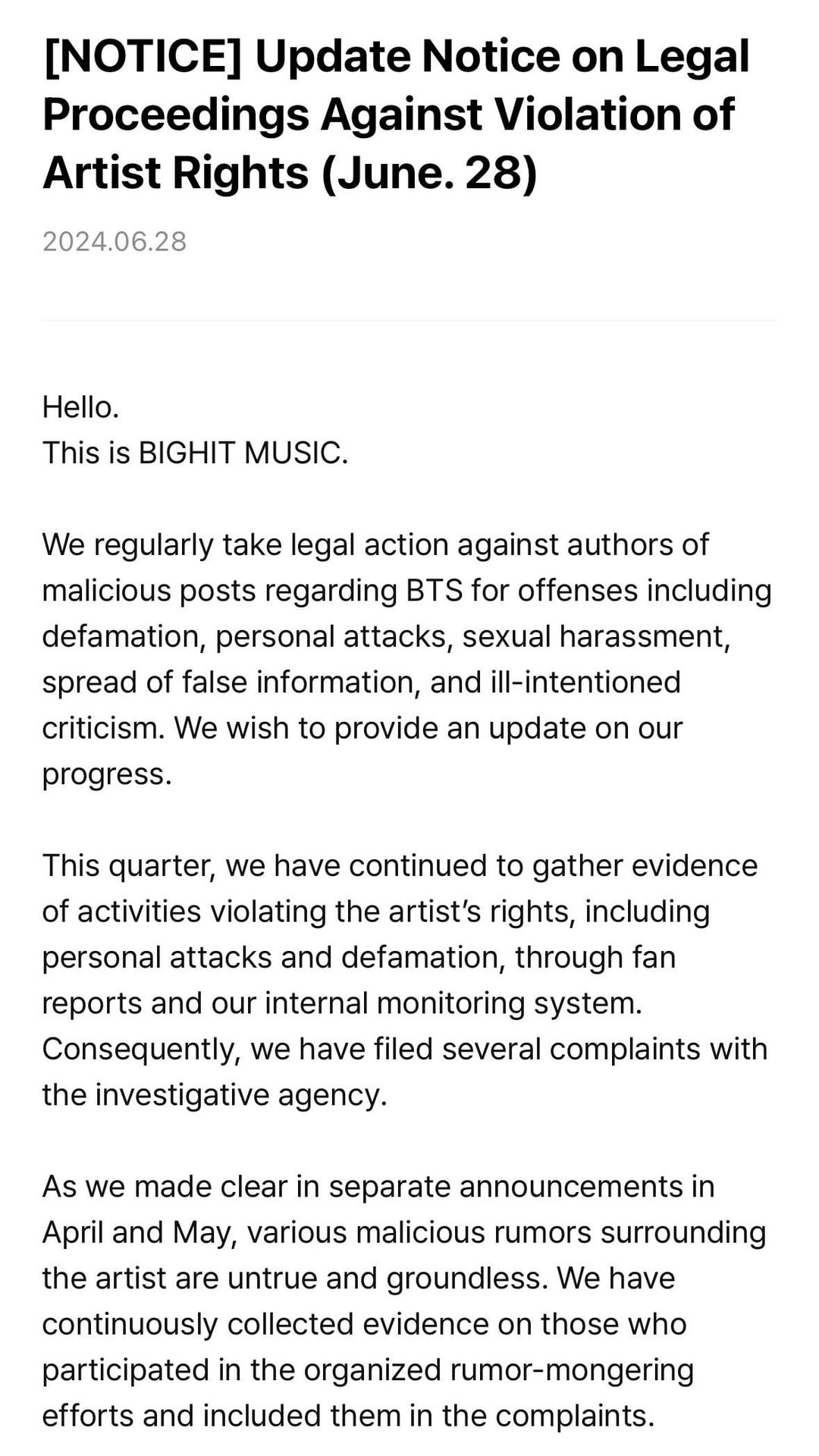

In a move that signals a definitive end to the era of passive warnings, BIGHIT MUSIC has drawn a hard line in the sand. On March 26, the agency, home to global superstars BTS, issued a stark and detailed official statement providing updates on legal proceedings against those who violate the artists' rights. This wasn't merely a routine notice; it was a battlefield dispatch from an escalating legal war, outlining a shift from defensive posturing to aggressive, punitive action. Coming during a period of mandatory military service for the group's older members, the timing is strategic, underscoring the agency's commitment to protecting its artists even when they are at their most vulnerable, and setting a formidable precedent for the entire K-Pop industry.
The statement, cold in its legal precision, revealed the filing of multiple criminal complaints with the Seoul Metropolitan Police Agency, the pursuit of civil damages lawsuits, and the systematic collection of a mountain of evidence against "malicious postings." For the ARMY fandom, it was a long-awaited affirmation of their pleas for justice. For industry observers, it was a clear declaration that HYBE's legal apparatus is now fully mobilized, willing to spend significant resources to not only remove harmful content but to financially and legally cripple its creators. This story is not just about lawsuits; it's about a fundamental recalibration of power between idols, their agencies, and the dark underbelly of online culture.
A History of Hostility: The Long Road to Legal Escalation
The relationship between BTS and malicious online actors is, tragically, as old as their stratospheric fame. From their early days facing industry prejudice to their current status as cultural titans, the group has been a constant target for defamation, invasive privacy violations, and the spread of vicious falsehoods. For years, agencies, including BIGHIT, relied on periodic statements condemning such behavior and promising "strong legal action." These notices, while reassuring to fans, often felt like symbolic gestures, with the specifics of legal outcomes rarely shared publicly, leading to a perception of impunity among offenders.
The Tipping Point: From Warnings to Weapons
The agency's approach began a noticeable hardening in 2021, with a landmark statement that detailed the filing of lawsuits against perpetrators. This was a significant step beyond the standard "we are monitoring" language. The current update, however, represents a quantum leap in strategy and transparency. It suggests that the legal groundwork laid over the past few years has begun yielding tangible results—police referrals, accepted complaints, and active litigation. This shift coincides with a broader, company-wide posture from HYBE regarding artist safety and rights management, as seen in their handling of other serious incidents, such as the alarming reports detailed in our previous coverage "On-Set Inferno".
The context of BTS's current chapter—with members Jin, J-Hope, and Suga discharged, and RM, V, Jimin, and Jungkook actively serving—adds another layer. Historically, enlistment periods have been seen as times of reduced public activity, but not reduced public targeting. The agency’s proactive stance during this phase sends a critical message: the protective shield around the artists remains fully operational, regardless of their civilian or active duty status.
Decoding the Dispatch: A Breakdown of BIGHIT's Legal Offensive
BIGHIT MUSIC's statement is a masterclass in corporate-legal communication, each paragraph serving a specific purpose. It moves systematically from a reaffirmation of principle to the concrete application of legal force.
"Our company regularly initiates legal proceedings against perpetrators of malicious activities related to BTS, including habitually posting malicious content, leaving abusive comments, and spreading groundless information. We would like to provide an update on these ongoing proceedings."
This opening establishes a norm: this is not a one-off reaction, but a continuous, institutionalized process. The use of the word "habitually" is key, indicating they are targeting not just casual trolls, but persistent, coordinated actors.
The Three-Pronged Attack: Criminal, Civil, and Digital
The agency outlined three concurrent legal strategies. First, criminal complaints have been filed against individuals for defamation and insults under the Act on Promotion of Information and Communications Network Utilization and Information Protection. This is crucial—it moves the violation from a purely civil matter to a potential criminal one, with the weight of state prosecution behind it.

Second, and perhaps most financially daunting for perpetrators, is the pursuit of civil damages lawsuits. BIGHIT is not just seeking apologies or content removal; they are seeking monetary compensation for the emotional distress and reputational harm caused to the artists. This creates a direct financial deterrent that mere police reports do not.
Third, the statement emphasizes the relentless collection of evidence, "including new malicious posts," via a dedicated reporting channel. This creates a feedback loop: fan reports fuel the legal machine, which in turn encourages more fan vigilance. It’s a collaborative defense network between the agency and ARMY.
The statement also specifically mentions action against "the spread of false information about the artists' personal lives and the creation and distribution of abusive posts." This is a direct shot at the viral, often tabloid-style rumor mills and the deeply invasive practice of manufacturing and sharing malicious edited content, known as "pann-jjok" in Korean online parlance.
ARMY Rallies: Fandom as a Force for Legal Justice
The reaction from the global ARMY fandom was instantaneous and unified: a wave of resolute support. Social media platforms, often the very arenas where these malicious activities occur, flooded with hashtags like #ProtectBTS and #ThankYouBIGHIT. For a fandom that has long practiced sophisticated digital advocacy—from record-breaking streaming campaigns to trending social justice hashtags—this legal update was another cause to mobilize behind.
From Reporting to Relief: The Emotional Impact
Beyond the public show of support, the deeper sentiment among fans was one of profound, emotional relief. On fan community platforms like Weverse and Twitter, comments reflected years of pent-up frustration. "We've been reporting these accounts for years, it feels like they're finally being heard," one fan wrote. Another stated, "Knowing they are pursuing actual damages is everything. These people need to understand there are real-world consequences."
This legal action validates the fandom's own tireless efforts to police their communities and report abuse. It transforms them from bystanders forced to flag harmful content into active participants in a structured legal defense system. The fandom’s role is increasingly recognized as integral to artist well-being, a theme echoing across the industry, as discussed in our analysis of "Inside Chaeyoung’s Hiatus", which explored the physical and mental toll on idols and the shifting priorities in their management.
Furthermore, the specificity of the statement provided a sense of closure for several high-profile incidents that had plagued the fandom, including the targeted hate campaigns against individual members like Jungkook and V over recent months. It served as a powerful counter-narrative to the sometimes overwhelming tide of negativity, a tangible sign that the artists they dedicate themselves to are being shielded by institutional power.
A Watershed Moment: The Broader Industry Implications
BIGHIT MUSIC's aggressive legal stance is not occurring in a vacuum. It represents the leading edge of a slow but decisive shift in how K-Pop agencies manage artist rights in the digital age. For years, the standard operating procedure involved a degree of tolerance, viewing malicious posts as an unfortunate but inevitable byproduct of fame. Legal action was costly, time-consuming, and often resulted in light penalties for offenders, making it a low priority.
Setting a New Precedent for Protection
This update changes the calculus. By publicly detailing the pursuit of both criminal charges and significant civil damages, BIGHIT and parent company HYBE are setting a new industry standard. They are signaling that the protection of their artists' mental health and reputational integrity is a non-negotiable line item on the budget, regardless of expense. This could pressure other major agencies to bolster their own legal responses or risk appearing negligent in comparison.
The move also interacts with evolving South Korean law and social sentiment. Recent years have seen a growing public discourse about the devastating effects of online bullying and defamation, leading to stricter enforcement and higher penalties. BIGHIT is leveraging this changing legal landscape, positioning itself at the forefront of its application in the entertainment sector. Their action mirrors a societal pushback against the anonymity-fueled cruelty that has defined too much of online interaction.
This proactive legal defense also reshapes the idol-agency relationship narrative. It counters the longstanding criticism of agencies as purely profit-driven entities that exploit artists. Here, the agency is deploying its vast resources explicitly as a shield, acting as a guardian. This strengthens internal trust and presents a powerful PR narrative of corporate responsibility. In an era where chart success and brand value are intrinsically linked to an artist's public image, this kind of protection is also sound business strategy.
The Road Ahead: Lawsuits, Precedents, and an Unwavering Stance
So, what comes next? BIGHIT MUSIC’s statement is not an epilogue, but a progress report from an ongoing campaign. The immediate future will involve navigating the slow wheels of justice: police investigations, prosecutorial reviews, court dates, and settlement discussions. The agency has promised to continue updating fans "without leniency," suggesting we may see more such dispatches, potentially even announcements of verdicts or settlements.
Building a Deterrent Through Consequence
The true success of this strategy will be measured less in individual lawsuit wins and more in the creation of a credible deterrent. If high-profile cases result in substantial financial penalties or even jail time for perpetrators, the risk calculus for malicious posters will fundamentally change. The goal is to make the cost of harassment so prohibitively high that it shrinks the space where such behavior flourishes.
This legal fortress also has implications for BTS's highly anticipated full-group activities in 2025. By aggressively cleansing the field of malicious actors now, the agency is working to ensure a safer, more stable online environment for the group's historic return. It’s a long-game strategy for legacy protection, ensuring that the narrative surrounding their comeback is about the music and their artistry, not mired in manufactured controversies.
Furthermore, this stance empowers the artists themselves. Knowing their agency is engaged in such a forceful, systematic defense allows members to focus on their service, their individual projects, and their eventual reunion with a greater sense of security. It addresses the immense, often silent pressure idols face, a pressure glimpsed in confessions from juniors, as noted in our article "The 'One-Shot' Idol".
In conclusion, BIGHIT MUSIC's legal update is a landmark moment. It transcends the specifics of any single case against a hate commenter. It is the declaration of a new paradigm where an idol's right to safety and dignity is defended not with vague press releases, but with the full force of the law. For BTS, for ARMY, and for the K-Pop industry watching closely, it marks the day the shields were not just raised, but were forged into swords. The battle for the soul of fandom culture has entered a new, more consequential phase, and the precedent being set here will resonate on every K-Pop news desk and in every agency boardroom for years to come.