
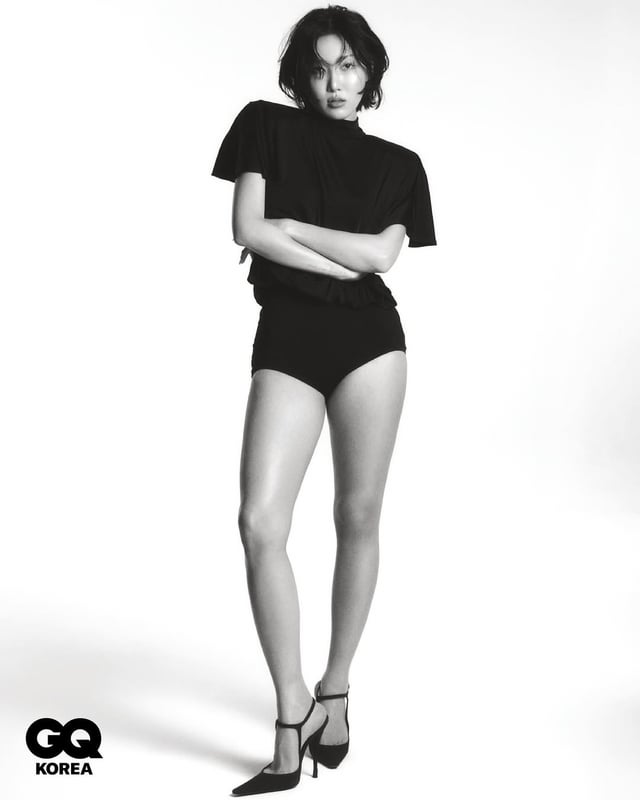
In an industry often criticized for its polished veneer and manufactured personas, few artists possess the sheer gravitational pull and unapologetic authenticity of Hwasa. This week, the MAMAMOO powerhouse and solo sensation has once again seized the cultural conversation, not through a musical comeback, but through a breathtaking visual and narrative exposition in the pages of GQ Korea. The recently released April issue features Hwasa in a series of high-fashion pictorials that are as striking as the candid, deeply personal interview that accompanies them. This isn't merely a photoshoot; it's a manifesto.
The images, splashed across the men's fashion magazine's editorial spread, showcase Hwasa in a range of avant-garde and sleek, powerful looks. From sharp-tailored suits that accentuate her formidable stage presence to more conceptual, intimate shots that capture her raw expressiveness, the pictorial is a masterclass in visual storytelling. However, the true revelation lies in her words. Moving far beyond typical idol promotional chatter, Hwasa delves into her profound relationship with music, her evolving perspective on her career and self-image, and the hard-won confidence that defines her path. For fans and industry watchers, this feature serves as a compelling checkpoint in the journey of one of K-Pop's most fascinating and resilient figures.
The Hwasa Paradox: From MAMAMOO's Fierce Maknae to Korea's "It" Girl
To understand the significance of this GQ Korea feature, one must first appreciate the trajectory of Ahn Hye-jin, known globally as Hwasa. Debuting in 2014 as the youngest member of the vocal powerhouse group MAMAMOO, Hwasa quickly established herself as the group's wildcard. With a uniquely husky and soulful vocal tone, a commanding stage presence that blended fierce charisma with playful sensuality, and a songwriting credit on their debut track, she defied the typical "maknae" (youngest member) archetype from day one. Alongside her members Solar, Moonbyul, and Wheein, she helped build MAMAMOO's reputation for live vocal excellence, humorous authenticity, and a genre-blending sound.
Breaking the Mold, One Controversy at a Time
Hwasa's career, however, has been a continuous narrative of challenging norms. Her solo debut with "Twit" in 2019 was a cultural reset, topping charts and cementing her status as a standalone force. But her path has been punctuated by public scrutiny over her body, her fashion choices, and her unflinching confidence, which some conservative quarters misinterpreted as arrogance. From wearing a "revealing" stage outfit to simply eating a banana on a variety show in a way that sparked a bizarre controversy, Hwasa has often been at the center of heated online debates. Yet, with each incident, she emerged stronger, her fanbase (MooMoos) more fervent, and her public image more solidified as a symbol of self-love and defiance against unrealistic beauty standards. She didn't just weather these storms; she used them as kindling for her artistic fire.
Her influence expanded beyond music. She became a fashion icon, a sought-after brand ambassador, and a regular on variety shows where her blunt, witty personality shone. This multifaceted career makes her feature in a prestigious publication like GQ Korea—a space often reserved for top actors, musicians, and cultural trendsetters—a logical yet powerful milestone. It’s a recognition of her status not just as an idol, but as a defining cultural figure of her generation. For more on artists who redefine their public roles, read our feature on SORA’s Handwritten Touch: Myoui Mina Shares Personal Wedding Invitation with Fans, Promising “A New Duet”.
Deconstructing the GQ Korea Feature: Visuals and Veritas
The GQ Korea spread is a deliberate departure from cute or overtly glamorous idol photoshoots. Styled with a minimalist, high-fashion edge, the photographs frame Hwasa as both a consummate professional and an enigmatic artist. One shot captures her in a stark white tank top and jeans, her gaze direct and challenging, tattoos visible—a statement of personal ownership. Another sees her draped in the luxurious folds of a designer coat, her expression contemplative and severe. The aesthetic is mature, confident, and undeniably cool, aligning perfectly with the magazine's brand and Hwasa's own evolved public persona.
The Heart of the Matter: Hwasa's Candid Interview
While the pictures are captivating, the interview text is where the feature truly resonates. Hwasa speaks with a reflective honesty that is rare for an active idol at her level of fame. She opens up about the core driver of her career: an unabating, deep-seated passion for music itself.
"These days, I think I love music more than ever. It's not just about performing on stage anymore. The process of creation, the emotion in a single note, the way a lyric can capture a feeling I couldn't articulate—that's what consumes me now," Hwasa shared with the magazine.
This shift from performer to creator-artist is a critical evolution. She discusses spending hours in the studio, not out of obligation, but out of a genuine compulsion to create. This narrative reframes her public persona from simply a "successful soloist" to a dedicated musician in the midst of her craft, a theme that resonates with the artistic journeys of groups like BTS, whose recent work also explores deep introspection.

Perhaps most poignant is her discussion on aging and self-acceptance in the K-Pop industry, which often idolizes youth. "I'm in my late twenties now, and I feel more 'me' than I ever did in my early twenties," she stated. "The anxiety about how others see me has faded. Now, my focus is on whether I am satisfied with my own work, with my own life." This mature perspective challenges the industry's often-toxic fixation on novelty and adolescence, positioning Hwasa as a leader for a new era of idols who prioritize longevity and personal fulfillment over fleeting trends. Her journey reflects a broader shift, similar to how other idols are navigating life milestones, as seen in our article Beyond the Spotlight: Tahiti's Jisoo Celebrates a Rainbow Baby.
The Moos Are Loose: Fan and Community Reaction
As expected, the release of the pictorial and interview excerpts sent shockwaves through the fandom and general K-Pop communities online. Social media platforms, particularly Twitter and Instagram, were flooded with the hashtag #Hwasa_x_GQ, trending globally for hours. The reaction was a multifaceted wave of admiration, pride, and deep emotional connection.
On fan forums like Weverse (where Hwasa is active) and international sites like Reddit's r/kpop, the discussion was richly layered:
- Visual Praise: Fans meticulously analyzed each photo, praising the styling for highlighting Hwasa's unique beauty and powerful aura without sexualizing her. Many noted how the "no-makeup" makeup looks and simple styling felt like a celebration of her natural features.
- Interview Resonance: Long-time MooMoos expressed how moving it was to see Hwasa articulate her growth. Comments like, "She's put into words the journey we've watched her on for ten years," and "This is why I stan an artist, not just an idol," were prevalent. Her comments on aging resonated deeply with older fans who have grown alongside the artist.
- Cultural Impact Recognition: Many fans and casual observers highlighted the significance of a female K-Pop idol, known for challenging beauty norms, being featured so prominently in a major men's fashion magazine. They viewed it as a mainstream embrace of her influence beyond the typical idol sphere.
The overwhelming sentiment was one of protective pride. Fans see this feature as validation from a prestigious institution for an artist they have watched fight for her place and her identity in the spotlight. It’s a testament to her connection with her audience, built on a foundation of perceived authenticity. To explore the power of dedicated fanbases, check out our coverage of chart-breaking achievements on our Charts page.
Industry Ripples: What Hwasa's GQ Moment Signifies
Beyond fandom celebration, this GQ Korea feature sends several important signals to the K-Pop industry and adjacent entertainment sectors.
1. The Evolving Idol Media Landscape
Gone are the days when idols were only covered by pure music or fan-centric outlets. Hwasa's feature in GQ Korea is part of a growing trend where top-tier idols are treated as full-spectrum celebrities and style icons by high-fashion and lifestyle magazines. It blurs the line between "idol" and "artist/actor" in media perception, granting idols a different kind of cultural credibility. This parallels how groups like BTS and BLACKPINK have graced international editions of Vogue, Harper's Bazaar, and Rolling Stone.
2. Authenticity as the Ultimate Brand
Hwasa's marketability stems directly from her perceived realness. Brands and magazines are increasingly drawn to personalities who offer more than just a pretty face—they want a story, a point of view. Hwasa's narrative of self-acceptance, resilience, and artistic passion is incredibly potent. It makes her collaborations, like this one with GQ, feel organic and impactful rather than purely transactional. She represents a shift where an idol's "flaws" and struggles, once hidden, can become the core of their strength and appeal.
3. Redefining Longevity for Female Idols
At 28 (Korean age), Hwasa is speaking openly about a phase of life that many female idols have historically been pressured to avoid or quietly transition out of. By openly discussing her late twenties with excitement and confidence, and by securing a major fashion spread during this time, she is actively rewriting the script. She is proving that an idol's relevance and marketability can grow, not diminish, with age and experience, paving the way for the generations behind her. This focus on sustained career evolution is also evident in the strategic planning of newer groups, such as KATSEYE's meticulous rollout for their debut single "PINKY UP".
What's Next for the Singular Star?
So, where does Hwasa go from the peak of a prestigious magazine feature? If her interview is any indication, the focus remains squarely on the music. The passion she describes is not passive; it is the engine for her next move. Industry insiders and fans alike are now on high alert for news of a solo comeback. The introspection and renewed love for creation she detailed suggest that her next musical project could be her most personal and sonically ambitious yet.
Furthermore, her individual activities outside of MAMAMOO—which continues in a non-exclusive group format with all members at different agencies—show no signs of slowing. Expect more high-profile brand endorsements, potential acting offers that leverage her strong screen presence, and continued appearances that showcase her unique personality. She has built an empire as "Hwasa," a brand synonymous with fearless individuality.
Ultimately, this GQ Korea moment is less about a single photoshoot and more about a crystallization. It captures Hwasa at a pivotal point: fully in command of her image, deeply invested in her art, and fearless about her future. She stands as a powerful case study in how to navigate the pressures of K-Pop not by conforming, but by continually, unapologetically redefining oneself. For the industry, she is a challenge and an inspiration. For fans, she is a mirror and a champion. And for herself, as she so eloquently put it, she is finally, satisfyingly, "me." As we watch her next chapter unfold, one thing is certain: the world will be watching, just as it did when other groundbreaking artists redefined what global success looks like. Stay tuned to our News page for all updates on Hwasa's next move and more insights from the heart of the K-Pop industry.